“Yesterday had been a day like all the other days during the last year and a half since the Russians invaded Germany. Everybody working at Junkers Aero Space, a former Nazi company researching and building aero planes in Dessau, was doing their job. It was incredible that the Soviet Government did not stop operations after their occupation but had the plant rebuilt, kept the work force and even expanded it. It was a direct violation of the Yalta agreement stating that Germany was not allowed to produce armaments. “
A reader of my book “We Don’t Talk About That” had sent me an e-mail asking if we might be able to meet. She and her brother lived about 30 km away, so we met halfway in a small café. The story they had to tell was shocking news to my ears. I never had read or heard about it.
At the end of WWII the technological achievements of Germany during the war proved a challenge and an opportunity for the two new world powers, the USA and the Soviet Union. Germany had excelled in futuristic technologies, especially in the area of aerospace. Both powers were quick to gather the top German scientists and engineers and relocate them to their countries. Wernher von Braun was the best known scientist taken to the USA to support their rocket program. The story of Junkers Aerospace was virtually unpublicized, the company being located in the eastern part of Germany. Junkers had been the most advanced aircraft manufacturer worldwide at the end of WWII with such concepts as the “discovery of the area rule, operation of jet engines on its aircraft, cabin pressurisation and designs involving forward swept wings.” With the cold war looming and the arms race both powers tried to outdo the other in the aftermath of WWII.
I could hardly believe it when my guests told me that Junkers had been rebuilt and, at the end of June 1946 employed 3.325 people sworn to strict secrecy, a slip of the tongue punishable by death. Their father was one of those workers. They themselves were small children. The German employees lived in the small city built around the plant tightly controlled by the Soviets. Nobody had ever expected a re-location of this huge company to the Soviet Union. But, all equipment and personnel of Junkers was to be re-located. At its peak 4.000 Soviet secret service and military personnel were involved in the planning and execution of the plan. Re-location plans were talked about when an airplane built there could not be tested because the runway was too short. But it never occurred to the employees and unbeknownst to them the plane was shipped to Russia. It was the start of something traumatic.
With not even a hint on the morning of the 22nd October 1946, more than a year after the invasion, hard knocks on every house door woke the occupants. Military trucks were standing ready to be loaded with whatever every family decided to take with them as they were told of a re-location. Trains were waiting at the station. They did not have much time to plan or pack, – just get ready. They also had no idea where their final destination was. After a very long uncomfortable journey they had arrived at a small village built of simple “Finnish” prefab houses about 100 kilometers from Moscow. The village even had a German church, a German school and some small shops. Their father’s job as an engineer had been an important one in Germany as well as it was now in Russia. Some families had asked to leave their families in Germany but the appeal was ignored and not answered.
These two people, sitting with me at a small table drinking coffee, told me the story of their life in Russia. They were small children, three and five years old, they went to school in Russia, learned what it meant “not to talk about it”, referring to topics talked about at home. Incredible hardships, one of the worst being the Russian winters and living in a very cold and drafty house were part of their daily life. The Germans were teaching Russian employees all they knew and in many cases a certain comradery developed between them.
Seven years later talk about going “home” started to circulate. Little by little certain families were picked up and left town but their turn had not come yet. Another year went by and finally the family could go home but the father still had to stay. They sold almost all of their possessions hoping to start fresh in a new Germany. They knew two Germanys had been established, the German Democratic Republic (DDR) and the BDR, the western part. The family was relocated to East Berlin and the Mother tried to re-establish old connections. She soon realized that she would like to be in West Germany. A job offer for her husband by a Mannheim company would be available once he returned from Russia.
My two guests told me that it wasn’t all “just bad”. The total re-location of people and workplace had created a German island in Russia. Close friendships were established, neighbours helping neighbours, entertainment was ‘home made’ and the shortage of almost everything led to creativity and do it yourself projects. More children were born there and considered this place their home. A number of people had married a Russian and did not want to go back to Germany. However, now, many years after the deportation and living in Russia for eight years, people have gone back to visit remaining friends and see the further development of their little village into a town and come back with stories about the incredible hospitality they have experienced. Many of these former special workers are now living all over the world and the older generation starts to thin out. The connections between these people having lived in Russia against their will is incredibly strong and after fifty years the first and now more regular anniversary reunions have been organized where it all started: In Dessau, Germany.
There still are so many untold stories out there, seventy-five years after the horrible war. It is so hard to believe that soldiers, people, children had no say in what happened to them, they were moved by cruel hands like chess figures. There is so much we still don’t know.
Remember: Lest we forget.

 On December 28th, 2015 I was interviewed once again by Greg Mackling of CJOB Radio, Winnipeg. The topic of our conversation was my latest writing project “Forget Me Not – A Bouquet of Stories, Thoughts and Memories” which was printed on an Espresso Book Machine at the Nanaimo Harbourfront Library in order to give me some “proofing” copies. This video captures that conversation. The book is expected to become available in early 2016.
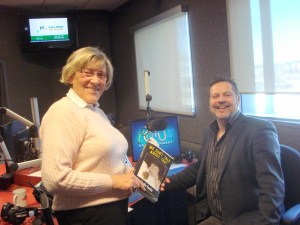 A radio program that will interest everybody: Greg Mackling of CJOB Radio in Winnipeg asked me if I care to talk about the different types of publishing. I had told him about my experience with the “Espresso Book Machine” popping out a book every 15 minutes once it is “uploaded”. My newest book, “Forget Me Not – A Bouquet of Stories, Thoughts and Memories” was printed on the machine, just to get some copies before it is published in January. I wanted copies to use as Christmas gifts! It’s rather expensive for a limited number of copies but a perfect way for people who just write for fun, write their life story for their family and want something of lasting value and “purrrrrfect gifts” for their loved ones. So listen to the program at 10.30 AM Pacific time (12:30 p.m. CT) on Monday, Dec. 28th on CJOB –
 Red Beet salad: Again, one medium sized red beet, a much bigger juicy apple, ¼ cup extra virgin olive oil, ½ lemon freshly pressed, 1 large heaped tablespoon of brown sugar or maple syrup, caraway seed if you like it. Mix oil, lemon and sugar/maple syrup/caraway. Grate the apple, stir into the mixture. Grate the beet and mix everything together. It can be eaten right away but I like to let it soak, stir again and then enjoy it. This beet salad is loaded with fiber as well and therefore also aids digestion.

 And every single one of those stories, thoughts or memories carry some kind of subliminal message; a fact of life, parts of history, thoughts of previous and present political happenings, psychological insights. All those stories, even a few fairy tales, will entice conversations or discussions around the family table or with friends. Yes, go ahead and talk about it. It is not healthy to keep your thoughts or feelings ‘inside’, especially if they trouble you. I find it liberating to ‘talk about it’. It is surprising how often one just needs a sounding board. I am not always expecting my conversation partner to answer me, to give me advice or set me straight or even discuss my problems. When hearing yourself talking you often find or hear the answer.

 They clean their boots and shoes! And polish them until they shine.
 I was interviewed today by Greg Mackling of CJOB 680 in Winnipeg. You can hear the interview on YouTube at
  Don’t think it is easy for me to tell you this story. It should be one of the chapters of the sequel to my book “We Don’t Talk About That”. It is a little love story but it really isn’t a love story. Read it and decide for yourself what you want to call it.
 Giselle Roeder