Unknown's avatar

About gmroeder

Author: - there was so much I never talked about and now, that my memoir "We Don't Talk About That" is written I can't stop talking about it. And the reviews I get are awesome; so I think this book needed to be written. Interesting that I receive many e-mails from people who read the book and now tell me their similar stories... Did I open "a can of worms?" I think there are so many people who carry a heavy memory load and they do need to "unload". But interesting enough, even more people want to know MORE of my life and therefore I am working on a sequel.

Children love cold water

Cold water foot bath

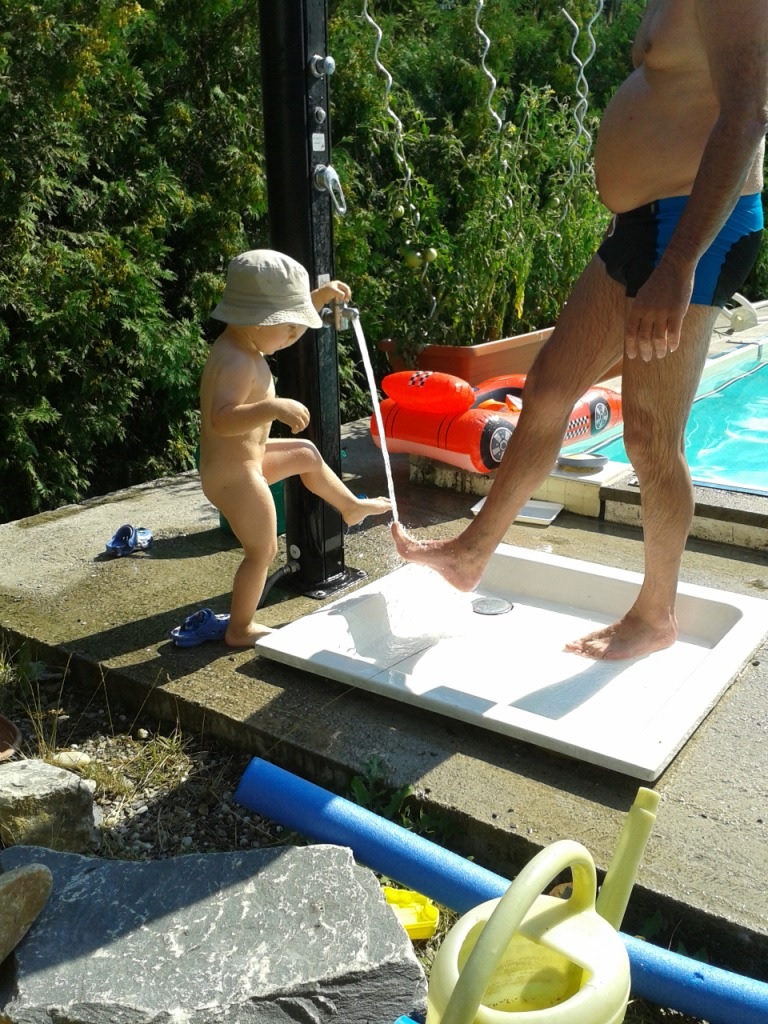
A foot bath with Grandad

Children naturally love water. Playing in the bathtub and not wanting to get out, running around in a summer rain, jumping into puddles and squishing the mud between their toes, wading or sitting in play pools and, best of all, building sand castles running back and forth at the ocean and screaming when mom says “It’s time to get out of the wet bathing suit…” Yes, – mom is right. The nerve endings for detecting the “cold” when it’s too cold have not developed in the skin of children yet. They can take the cold water for a long time, even to the point of turning “blue”. It’s probably nature’s way to protect them but it is also detrimental for their health.
Look at this happy picture of grandfather and child. There is nothing better than cold water to cool down on a hot summer day. Running cold water from your toes up your legs (always start on the right foot, it being the farthest spot from the heart) is wonderfully refreshing. Using a garden hose to do this is even better. What happens in the body?
Warm or hot days make you feel lazy. Why? Because your blood pressure sinks and your energy level declines. The cold water on your legs helps to increase the circulation to the upper body by pushing more blood out of the legs, – to put it simply. It clears your head and you can even see better. Try it!

See – Healing with Water

A Chance Encounter

Image may contain: flower, plant, sky, nature and outdoorIt was a bit cooler today, we had some rain last night. By far not enough here in Bavaria while they had heavy thunderstorms in other parts of Germany. During the morning, after my water treatment and massage, I packed up some clothing I don’t need anymore and went looking for a Salvation Army container to donate it. I saw a Red Cross shop, just looked in for curiosity sakes. I could not believe a) the quality of their donated offers, and b) the prices. 2.00-3.00-5.00 or 7.00€ for really GOOD stuff. If I ever come back, I’ll travel without a suitcase, get what I need, donate it at the end of my trip and be worry free on my way home.

But, now I need to tell you about that afternoon. After a healthy noon meal and a little nap I took my Nordic Poles and wandered off. I got myself a kilometer counter. I seemed the only person walking through still blooming meadows, quiet forest as the birds were resting during the midday heat. Coming by a Hunter’s restaurant I decided not to stop for their fantastic cheese or apple cake. I rested on a bench for a while, feasted my eyes on the beauty surrounding me and checked my km counter. It said 3.7 kilometers.

After another 3 km I arrived at the “Kurpark”. I was drawn to a bench in the sunshine, occupied by a big elderly gentleman with a bright red sweater, his pretty little brown dog next to him. For an unexplainable reason I stopped and commented on the dog. I am a bit of a dog nut, and this was one I could have fallen in love with. I heard a sad story about it, how it was born in Spain in a garbage pile with three others, the mom went out scavenging for food, came to nurse and went off again. The dog babies were very afraid and shy, but this man and his wife decided to rescue one. They picked a little boy and called him Carlos. Carlos liked me, sniffed my hand but did not lick it. We just sat there next to and looked at each other. Then Carlos decided he had enough sun, got down, the man let the leash out and Carlos settled in the shade of a nearby tree.

Now, as you can guess, the man asked me if I lived in this town. When I told him about my home in Canada, he was amazed that I still spoke perfect German without an accent. I mentioned that I have a book reading next week.
“Oh, on Tuesday in the Gugger Hause and you are Mrs. Roeder.”
I exclaimed, “How do you know that?”
“I happened to see a poster yesterday and decided to be there. My name is Roeder as well.”

Can you imagine that the next half hour was taken up with ‘what, where, when etc.’ – and how that little dog had made me stop to experience something so totally out of the ordinary.

I needed to share this with you!

What happened to the Berlin Wall?

Berlin Wall

The hated Wall came into existence on the 13th of August 1959 – a huge surprise in the morning. It was the best kept secret. NOBODY had any  knowledge of the plans for it. It divided the great city of Berlin into East and West, and cutting families from families, in many cases even along the center of a street. The ‘Fall of the Wall’ was a another surprise in 1989 as hundreds of thousands marched and the East German Police put their guns down and watched helplessly as the wall was stormed. I watched the happening on TV and thought it was a trick film as people climbed the wall and started dancing on it. Secure gates were broken down and East and West people hugged, laughed and cried and couldn’t believe that no shots were fired. Finally, in June 1990, every effort was made to remove the hundreds of miles of the hated monster. Lots of souvenirs were sold after the “Fall of the Wall” in 1989; thousands of people hacked and picked and took parts home as a reminder of the terror it has caused. I know two people who showed me their treasure, a little piece of the wall. Thousands of people all over the world have a piece and it is impossible to track them all down.

Berlin did not destroy all of it. An ‘Open Air Gallery’ has attracted artists from all over the world to create their art on long parts of the wall. Many places in Berlin now have memorials, one is called ‘Parliament of Trees against Terror and War’ – an imaginative creation by Ben Wagin, using sixteen trees and fifty-eight original wall parts. Tourists visit those places and take photos. There are more memorials: the ‘Mauer Park’ and the ‘Topography of Terror,’ an original part of the wall with Hinterland and Death zone, another one with the tower used by sharpshooters. The Berliners are maintaining these reminders to show the world what has happened here. It is a warning to be vigilant and not let it happen again.The Berlin Wall was built to keep people “in” since they were escaping by the thousands each day. I was one of them.

But not only the Berliners kept relics and built memorials. A commission from Japan came in 1990 and bought two parts for a Museum Village honoring the saving of German Seamen in 1873.

The most extensive collection of the wall is found in the Newseum in Washington D.C. The CIA in Langley, Virginia also displays three relics, and another three are gracing the Garden of the UN Main Office Building in the USA.

Winston Churchill coined the expression ‘The Iron Curtain’ in 1946. His granddaughter, Edwina Sandys, a wellknown sculptor, incorporated eight wall pieces in her ‘Freedom Memorial.’

South Korea was encouraged by the ‘Fall of the Wall’ that a unification is possible. They have five relics of the Berlin Wall in their Theme Park in Uijeongbu, representing the dream of their own ‘Unification’ with North Korea. Right now it is a very timely dream, and we hope it comes true soon. The leaders of both countries shook hands across the border and had long friendly talks.

Brandenberg Gate

You will find a piece with personal graffito of the Berlin Wall in Kingston, Jamaica, next to the Military Museum. It was a gift from the city of Berlin to the sprinter Usain Bolt after he ran a world record during the Berlin World Championships in 2009. Amazing that  many years after the ‘Fall of the Wall’ a relic of it is still a precious and welcome gift.

It is interesting how a piece of the wall came to be at the Vatican: The Italian businessman Marco Piccinini obtained a segment during an auction in Monaco and gifted it to Pope Johannes Paul II.

Last but not least, the City of Berlin presented a piece of the wall to the Freedom Fighter Nelson Mandela when he was released after twenty-seven years in prison. Due to Nelson Mandela, the Berlin Wall is represented in Kapstadt, South Africa.

My personal experiences happened before the wall was built. I escaped the East in 1955. My parents had a close call the day before the infamous “Wall” was put up overnight and saw the light of day on August 13th 1959. My parents tried to escape on August the 12th but did not make it. (see my book “We Don’t Talk About That“) Our family was divided for fifty years. It was interesting to see the new generations struggle with the new reality. The younger people in East and West had a difficult time understanding each other. During those fifty years of communist indoctrination in the East, a lot of brainwashing had taken hold.

We don’t want more walls! The only one we can accept and appreciate when traveling is the Great Wall of China.


Easter Bunny and Easter Eggs: A bit of History

From Wikipedia

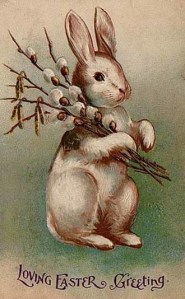
For the last few days, I have been contemplating the fact we have an Easter Bunny and not an Easter Chicken? Doesn’t it make more sense in regards to laying the eggs? But now I know it is not about laying the eggs – it’s about delivering them!

The idea of Easter goes back to the Pagan times. A festival about the Spring Equinox was celebrated, long before Christianity, in the Northern Hemisphere. The Spring Equinox is the day when dark and light are identical, in other words, night and day are of the same hours. The festival was about the renewal of life. The word ‘Easter’ is based on the Goddess Eostre, the “Goddess of Spring and Renewal.” Eggs were the symbol of new life; rabbits are the symbol of fertility. Did you know that a rabbit can get pregnant again before the developing babies are even born? I found another interesting tidbit: For their first-time, a rabbit can get pregnant like the Virgin Mary: It can deliver babies and still be virgin.

Another fact I have often wondered about is the changing date of Easter. This was decided by the Nicae Church Council in 325 AD. They determined that the Easter Festival should always be on the Sunday following the full moon after the Spring Equinox. This is a time between March 25th and April 25th. (Explained by Professor Cusack on Wikipedia)

The name for ‘Easter’ derived from the Jewish Passover in most European countries:

It is Pascha for Greece, Pasque for Italy, Paaske for Denmark, Paques for France.

The Anglo-Saxon English speaking countries retained the name Easter based on the Pagan Goddess Eostre, while Germany calls it Ostern. With the advent of Christianity, the ‘old stories’ about the renewal of life, especially the reclaiming of life by Jesus Christ established Easter as we know it today.

The Easter celebration was brought to America by the German and Dutch immigrants to Pennsylvania during the 17th century. The painting of Easter Eggs started in the Middle Ages in the East European countries. They developed the egg-painting to a fine art. During my childhood, we tinted eggs while boiling them with herbs or flowers, or put our pride in painting blown out eggs with pretty little pictures. These decorated eggshells would be hung on pussy willow or forsythia twigs for a table center.

With the advance of commercialization during the 18th and 19th century, the first sugared eggs were produced in Germany, followed by the English Cadbury company offering chocolate eggs and even chocolate bunnies. Hallmark postcards with Easter Greetings appeared at about the same time.

From Wikipedia

The decoration of the Easter eggs is still practiced in East European countries, especially in Ukraine. The absolute “Top Egg” would be the Fabergè Egg, today worth a mint and mainly kept in Museums and a limited number in private collections. The Royal House of England has three in their possession.  The House of Fabergè, during the years between 1885 and 1916 had produced about fifty very intricate eggs for the Tsar of Russia. Two a year were ordered as Easter gifts for his mother and his wife. Fabergè also filled orders by other wealthy families. Many of these eggs had small gifts inside, portraits or, in a few cases, even animals, decorated with precious stones. The last two eggs the Tsar ordered for Easter 1917 could never be delivered because of WWI. The Russian Revolution put an end to the luxury life of the Romano family. The whole family was executed. The Bolsheviks had no use for these treasures and sold them to whoever gave them money. Of the fifty Faberge ̀ eggs in the Tsars possession, only forty-three of the “Imperial Eggs” have survived. So it was believed. One was bought at a flea market by a scrap dealer in the US Midwest in 2014 and was almost melted down for its intrinsic value of about $500.00. Luckily, the man Googled it, found a news item about it, flew to England to a Fabergè specialist and could never believe his luck: It was the third Imperial Egg ever made in 1887 and was estimated to be worth 33 million dollars.

Talk about laying (finding) a “Golden Egg”!

Happy Easter!


I’m Tickled Pink – I’m Pickled Tink

Wow! This blog post relates to a recent e-mail I received from Bob Pickles, the WW I history writer. But first our history:

On June 21, 2014, Bob Pickles wrote a review of my memoir ‘We Don’t Talk About That.’

“Giselle Roeder’s book is a vital piece of the jigsaw of suffering in World War II (& representative of civilian suffering in all conflicts). It could well have been a story of the tragedy endured by Jews, Gypsies or Polish intelligentsia perpetrated by the Nazis. If it  (the book) were not so harrowing, it should be desired reading in schools & given the same historical, literary importance as “The Diary of Anne Frank.” To be read alone with a strong drink perhaps. – (it is) A fine testament to the unquenchable spirit of survival & hope with the help of a few ‘angels’ along the way.”

This is just an excerpt from his review. Reading it gave me goose bumps. I thanked him with all my heart and this started an occasional e-mail exchange. He was not happy with the ending of my book – so he has been encouraging me to write a sequel. He is not the only one. Many of my readers keep asking.  A now ninety-year-old lady, who bought and gave away fifty-seven copies of my book, begs for the continuation to read before she dies.

A few months ago Bob Pickles asked me for help with translations of German expressions for the newest book in his series of WWI, “The Foster Family in the Great War.” I happily obliged. Since I didn’t know many of the profanities soldiers might have used I had asked several German-speaking writer friends. One was Elisabeth Marion, a WWII history writer.  Her most famous book is “The Night I danced with Rommel.” Bob Pickles was happy with my translations.  I thought nothing of it, I love helping someone. Anyone!

A few days ago I received a surprising e-mail from Bob:

Hi Giselle, just to let you know my latest (8th) WW1 novel is published on Amazon as both a paperback and as a Kindle edition. Entitled “Vimy” – a novel of the Princess Patricia’s Canadian Light Infantry’s attack on Vimy Ridge 1917 – I have dedicated it inside to you.

If you “Look Inside” the book on the sample on Kindle, the parts you kindly translated into colloquial German are found in the first few chapters.

Wow! A book by Robert S. Pickles, a serious UK history writer, dedicated to meee? Never, ever did I think any book would ever be dedicated to me.

I’m tickled pink – I tink I’m pickled. Thank you, Bob Pickles. I will recommend your book to the Canadian Legion; I would think a number of the Canadian veterans will also be tickled pink to read about the Princess Pat’s Light Infantry role at Vimy Ridge.


Revelation of a Time Capsule and More

Stresow Church

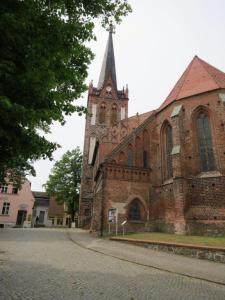
Once upon a time, there was a small village in the eastern part of Germany called “Stresow.” A church with a cemetery surrounding it and a pub was built in the center. Those two places were also the centre of any social life of the hard-working farmers. Since women were not allowed in the pub, they would meet after church in the cemetery during their task of taking care of the graves to visit with each other and chat. To this day, the graves are planted with flowers in German cemeteries and each family tries to have the best-looking one.

Many years went by. After WWII in 1945, the states of East Prussia, Silesia, and Pomerania, about one-third of Germany were ceded to Poland. The German inhabitants had ten minutes to get out of their homes where they had lived for generations. My own family was amongst the millions evicted, and so was the family of my cousin Joachim. With only the clothing on our back and with what we could carry, we were three weeks on the road to nowhere, slept in barns when lucky or under the stars. (the full story in my memoir “We Don’t Talk About That”)

I have never been back to my birthplace but my cousin Joachim has. Poland belongs to the EU, and visits are possible. Joachim has been back several times. He only lives about seventy kilometers away while I live on another continent. Joachim made friends with the Polish family who now lives in his father’s house. He had the most incredible experience in 2006. A friend of his Polish friend is a teacher in the neighboring town of Bad Schoenfliess. He is in charge of a museum and was happy to show Joachim two rooms dedicated to the “German Time.” There are photographs of Joachim’s family and his ancestors as well as of my parents and other families we know. Joachim was amazed.

The most significant surprise was a folder he was given with old handwritten documents, letters, and newspapers of the years from 1871 to 1896. They had been contained in a ‘Time Capsule” buried when a new church tower was built in 1896 after the old church tower had collapsed. Nobody could read any of these documents since they were written using the German Süterlin letters.  Joachim was able to read them. There was a list of twenty-four farmers living in Stresow in 1871, including Joachim’s great-grandparents. Two pastors serving the small community between 1871 and 1896 had written an account of life during those years. Joachim was able to re-write the most critical documents. Photographs of the old and the new church tower were included in the time capsule.

What an exciting experience for my cousin Joachim!

The same year he had another surprise coming. In 1945, when the family was evicted and had to leave within ten minutes, his grandmother had stuffed one hundred-forty-five photos into his school satchel with a change of underwear. These photos had been picked up out of the mud after the Russian invasion. I had picked ours up from the pile of manure in the middle of our yeard. They represent the only memorabilia of our life from before 1945. During the long walk, Joachim, his grandparents, and his mother had a chance to stay in a house for two nights. Joachim and his two small sisters played with the six-year-old son Robert living there. They looked at the pictures. Joachim’s satchel was forgotten when they left, and his grandma always lamented as long as she lived about the loss of those treasured photos from home. She died and never got over the loss.

Almost sixty-one years later, the ITS, a search service connected to the Red Cross as well as churches,  found Joachim’s sister Marianne. She had looked for and listed their dad’s name many years ago. Now, with the Internet, it had been possible for the previous six-year-old Robert, at sixty-seven years old, to find the family who had stayed with them in 1945. Robert had kept the photos in a box in his attic all those years. During a project to add on to his house, he came across it and started searching for the kids he had played with in 1945.

Joachim phoned Robert and made a reservation to visit the next day. The newspaper in Joachim’s hometown got hold of the story, and I have in my hands a copy of the one-third page with a photo of my cousin holding a photograph of himself and his two sisters. A large one at the bottom is of ten men, the artistic biking club with Joachim’s father and uncle in their sports uniform. Needless to say, Joachim in his eighties and the former little Robert in his late sixties, are now close friends.

Former WWI Memorial

Joachim exclaimed when he first related this story to me:

“You cannot pay for something like this. To get your lost treasure back after sixty years is absolutely miraculous.”

Free e-book Promotion Results:

It is interesting for me, the writer, to see the results of the e-book promotion from March 4th to March 10th, offered by Smashwords:

FREE ‘sales’ of my book “We Don’t Talk About That” = 15

FREE ‘sales’ of my book “Forget Me Not”                      =   4

FREE ‘sales’ of my book “Ein Mensch von Gestern”     =   3

It will be even more interesting to see if the giveaway FREE is creating real sales. I like to thank all my faithful Facebook and other social media friends for sharing my promo-blog and saying a few words about my books they have read.

For all who have received my FREE e-books, happy reading. Please place “Reviews” on my website www.giselleroeder.com or Smashwords https://www.smashwords.com/books/view/734091.

Thank you!

Promo: Read an e-Book Week March 4-10

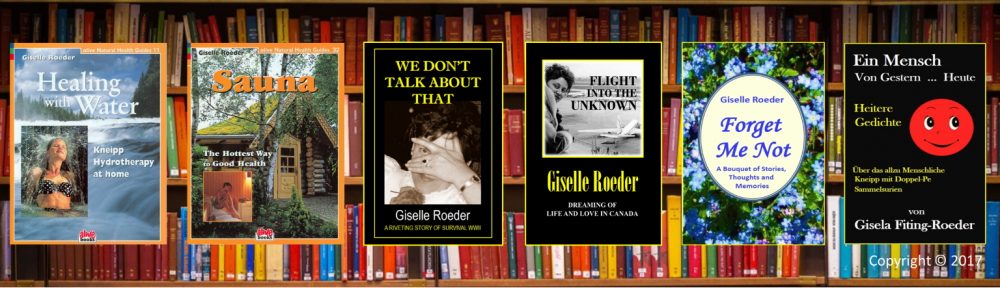
Three of my books in e-book format are FREE only at Smashwords from March 4th – 10th.

To access the sale follow these links:

We Don’t Talk About That:
https://www.smashwords.com/books/view/734091

Forget Me Not:
https://www.smashwords.com/books/view/608409

Ein Mensch von Gestern:
https://www.smashwords.com/books/view/732607

Books I published or read throughout 2017

At the beginning of 2017, I still had several books to finish reading. It was an uphill struggle since I had picked books for learning more about history and not for entertainment. Some were really hard to stick with since the authors were not always writing in an easy style.

However, as every year, I will let you know which books filled more cavities in my brain:

  1. I had to finish “The Kaiser, The Warlord of the Second Reich” by Allan Palmer. A tough read, especially since I had hardly learned anything about German history, growing up in the Eastern part of Germany, where Russian history post 1917 was all that was taught.
  2. “Peter The Great” by Ian Grey was quite a lengthy book based on incredible research. I often had to go back to previous pages to ‘connect the dots.’ I admit that I got intrigued by the Russian history before the Revolution putting an end to the rule of the Tzars.
  3. “The Girl with No Name” by Diney Costelloe. A story about the Kindertransports during WWII and how they fared in London during the bombings.
  4. “On The Street Where You Live” by Mary Higgins Clark. This one not related to history. A mystery novel. Murders were repeated after 100 years.
  5. “Prague Winter” by Nikolaus Martin. This one was very interesting because I had met the niece of the writer in an airplane. It is a heartwrenching story of the Nazi Invasion of Prague and how people coped with it.
  6. “Love, Lies and High Heels” by Debby Conrad. It is a light, fluffy love story. It felt as if written by a teenager. Maybe I will read another book by Debby one day to see if she has ‘matured.’
  7. “The Refugee” by Anna Bruic. The title speaks for itself. No, it does not have anything to do with the present day refugees.
  8. “The Munich Girl” by Phyllis Edgerly-Ring. A love story of Adolf Hitler and a girl in Munich, their secret life and clandestine meetings and an unexpected end to it all.
  9. “Lebensborn” by Roberta Kagan. I wanted to know more of the infamous ‘stud farms’ to breed Aryan babies. It wasn’t quite what I had expected.
  10. “Refugee Road” by Nikki Landers, herself a prolific reader and writer. Part of a series of books.
  11. “You Are My Sunshine” by Roberta Kagan. After reading “Lebensborn” by her, I wanted to know more. The story she weaves in this one feels not quite real. Unmarried girls, pregnant and with no home to go back to, find a place in one of the Nazi’s clinics, they have to sign a contract to give up their baby.
  12. “Lucy’s Christmas Miracle” – One of many Frank Rozzany Detective short stories by Alex Mandossian. I have read more of this series and sometimes have held my breath.
  13. “Threaten to Undo Us” by Rose Seiler-Scott is a well-researched account of families torn apart by the Nazi invasion of Poland and the tragic fare of German people living there.
  14. “Personal Paparazzi” by Alina Vincent & Christine Whitmarsh. A book about writing, marketing and more. The two writers are very active on social media teaching courses.
  15. “Never a Mistress, No Longer a Maid” by Maureen Discroll. After a lot of heavy reading, a person needs a break. I enjoyed this book.
  16. “The Fall of The Dynasties: The collapse of the old order 1905 -1922” by Edmund Taylor. It was not new to me how the leading dynasties in the European part of the world were all related, and one could hardly understand how they could make war against each other. History, meticulously researched and well written.

Those are the books I read, most on my Kindle and Kobo. I also checked a lot of books on Amazon where you can click on “Look Inside” and get an idea what they are about. There was quite a number I would have loved to get and read, but as a writer, I only have so much time.  I had started to read two books over Christmas but did not finish either yet. Therefore I like to leave them to my report at the end of 2018. God willing I will still live at that time, and no new war has blown our planet to bits!

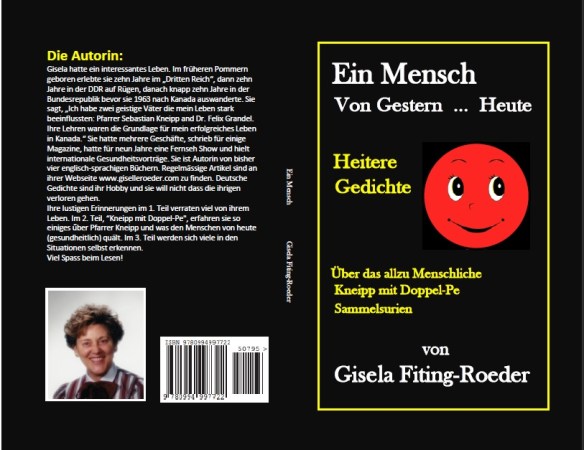
Now about the book, I published in 2017: A collection of my German language poems; poems I had written over a period of about thirty years. Happy poems! I had a lot of fun putting the book together while I took a ‘sabbatical’ from writing my sequel to “We Don’t Talk About That.” Written in the style of Eugen Roth’s poems, they inevitably bring a smile to the readers face. A terrific gift for all German-speaking friends.

“Ein Mensch von Gestern – Heute” is available on all the known Amazon sites, Kindle, Kobo, Smashwords. Wonderful as a paperback but also available as an ebook.

Goodbye 2017

It is the last day of the year 2017. I am thinking of the 365 days past. I am contemplating what the New Year may bring. I have no crystal ball. Nobody has an answer. If we are a few billion people with a brain on this planet, every single one has different hopes, wishes, and beliefs. I am trying to write a blog that means something, possibly something that touches a nerve in everyone. Everyone? Who am I kidding! I can but try. And try I will.

New Year’s Eve: We celebrate and make a lot of noise. We make New Year’s Resolutions, resolutions that will be broken within the next few weeks or even days because ‘life happens.’ Something always gets into our way to do what we set out to do, want to do or planned to do. We woke up with a thought to write a fantastic blog – someone asked to do something else, and everything changes. The mood, sometimes even the energy is gone. What we really wanted to say changed. The moment, that magic moment, when you felt just right to do this one thing, is gone.

Looking back on 2017, it was a troubled year. Worldwide, politically and for me, even personally. But what is my personal pain compared to the pain of thousands of people fleeing their homes with just the cloth on their back, children starving, soldiers raping helpless women, beheading or killing well-meaning men? The worst is that all of this is done in the name of religion. Did anybody choose to born a Muslim, a Christian or a Jew? Or belonging to any of the many other denominations? How many Gods are there? I always thought there was but ONE, and he is a loving God, not one who spews hate and fire at one particular group that tries to kill another group. Who’s side is HE one when soldiers in war pray for victory? I’m reminded of a little story:

A zebra goes to see God. He asks ‘Lord, am I white with black stripes or am I black with white stripes?’

God looks at the zebra and says: ‘That depends entirely on how you see yourself.’

I like to see it not just depending on color but ‘how we see ourselves.’ Has HE given humanity ‘free choice’? A choice to do what is right? HE doesn’t get involved in humanity’s foolishness. Someone on Facebook asked ‘How can God let this happen?’ and another answered that HE may have turned his back on us because we don’t allow HIS name in schools, and we try to banish him from our lives. It’s troublesome to think about all this. And, maybe it is better not even to write about it. I stepped into a wasp’s nest once when I wrote an article for a newspaper questioning different parts of the bible and mentioned Emmanuel Kant’s Philosophy. It was also a New Year’s write-up, and boy, did I touch many nerves! The Newspaper had a hay-day with all the pro- and contra letters for weeks!

What do I look back to, personally? Problems with my health, physical problems that affected me mentally. I got depressed but tried hard to pretend all was alright. I had a terrible time getting to work on my sequel to my memoir “We Don’t Talk About That.” In that book, I was honest and told how it was, and I couldn’t find a way to tell what happened to me and my life after those first thirty years. I thought of all the things I still had to do, wanted to do and never got around to do. I went through all my files, sorted, destroyed and found papers I didn’t want to go into the wastebasket after I’m gone. I found poems I had written over many years, mostly funny ones, many with double meanings, my goodness, actually a history of human life during the years starting around 1960! Reading these gave me hope and smiles back, and a will to do something with them. My little book “Ein Mensch von Gestern – Heute” was born. It’s in my first language, German, but there are still a lot of people who do speak it. The title means “A Human from Yesterday – Today.” The story of how we people from yesterday cope with life as it has changed since yesteryear. Hahaha, and now we are back to today, the last day of 2017.
Did I have moments when I thought of stopping the time from flying? Yes, there were some. But how do you stop time? With a stopwatch? Heh, buddy, it doesn’t work that way.  Every breath you take is part of a second that moves time forward. Did you ever read Goethe’s ‘Faust’? The first two lines inspired me this morning to write about it. Here is part of Dr. Faustus’ conversation with Mephisto about time:
“If to the moment, I shall ever say
‘Oh, linger on, thou art so fair!’
Then may you fetters on me lay.
Then I will perish, then and there!
Then may the death-bell toll recalling,
Then from your service you are free;
The clock may stop, the pointer falling,
And time itself be past for me!”

The answer of the devil, Mephisto, was a warning. Faustus should not be hasty with his wish, but if so, he wanted it in writing, signed with blood. Maybe here we find a base for what we often say nowadays: ‘Be careful what you wish for, you may get it!’

       Happy New Year to all of you! I love you, my readers! I love people!
A big hug for all!