E – Day?

No idea what “E – Day” is? For me it is a very special day in my life: Emigration Day.

I stepped into an airplane at the Frankfurt Airport. The plane lifted off and I saw the fields of Germany, seemingly laid out with a giant ruler getting smaller and smaller, the many little villages with the steepled church towers always right in the middle of the surrounding houses placed like toys out of building box. I saw the endless grey line of the autobahn reaching out through endless forests finally giving way to floating clouds and then there was nothing. We were “above it all”. Above the Earth! I had left the land of my ancestors. I was on the way to a new life on a different continent. I had escaped all my troubles I thought… it is hard if not impossible to explain my feelings: Weightless? Floating like a feather in the wind? It had nothing to do with FLYING; – no, I am talking about myself: my emotions, my feelings, even my physical body. When I drifted off into semi-consciousness I had an out-of-body experience: I had no emotions, I had no feelings and I had no physical body. I looked down on myself sitting in the airplane, eyes closed with a crease between the eyebrows, hands folded in the lap. And all of a sudden a desperate small voice woke me up and brought me back to reality:

“Lady, can I have a drink?” My new daughter. The four year old girl cuddled next to me knew I did not speak much English. She did not want to wake up her “new mommy”. She was calling the stewardess. She couldn’t sleep. Her dad was waiting in Vancouver. She was like a pebble on the beach, rolled around by wind and waves. Her mother had left her. For several years she had lived with her dad in room and board, for the last nearly three months with her paternal grandparents in Germany. When I came “home” on weekends she wouldn’t let go of my hand. She was desperate for motherly love and would proudly introduce me to anybody who would stop by: “My new mommy!”

It was December 13th 1963. We had a refueling stop at the International Airport Keflavik in Reykjavik, Iceland. Holding her little hand tightly in mine we seemed the only people on the planet. We walked the frozen grassy airfield for almost an hour before they let us board again and start the long flight over the green fields and mountains of Iceland and the white icy peaks of Greenland occasionally visible through the clouds towards North America.

That’s when I learned that Iceland is green and Greenland is white! I have looked down on Greenland many times thereafter and it always irked me that I did not see any green…but incredibly beautiful white peaks and valleys. It’s hard to believe that there are places for people to live and to make a living.

Lions Gate cropped

Heading towards Lions Gate Bridge

December 14th: One of the most special days of my life: Arrival in Canada. The Vancouver International Airport was a shadow of what it is today. The Vancouver Hotel was the highest building in the city. Halfway across the Lions Gate Bridge my Canadian Husband asked me: “Well? What do you think?”

“This place is too beautiful to live here. It is more like a holiday destination…”

He laughed: “You better get used to it. This is where you will live.” Five months later we moved to Winnipeg and while driving through the Rockies my little girl asked her dad: “Why is mom crying so much?”

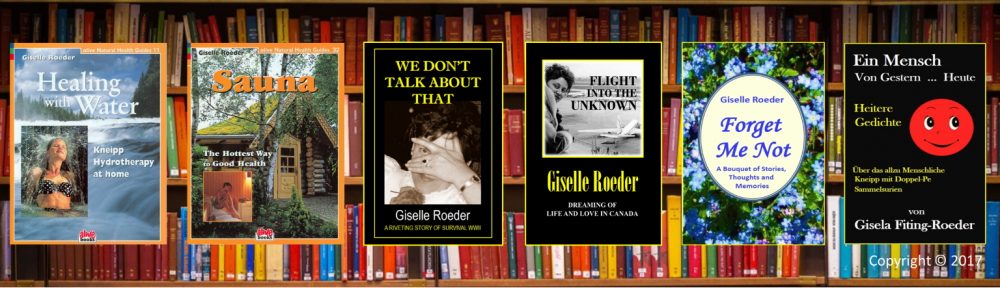
And now my friends, I have given away part of the sequel to “We Don’t Talk About That”!

It would make sense for you to read that book to understand WHAT it was that drove me to leave the land of my ancestors, marry a pen friend and have an ‘instant family’. At one point in “We Don’t Talk About That” I had told my parents: “That’s what I want, I want ‘later children’because neighbours had mentioned that ‘later children’ are easier when my third sister was born. She had been such a quiet, easy going kid.

E – Day. 14th of December is my E-Day. It’s also my second sister’s birthday and the birthday of her first daughter, – but for me, the 14th of December is and always will be like

“MY NEW BIRTHDAY”.

The Fall of the Berlin Wall #BerlinWall

Berlin WallIt was in 1968 that my father and I had a chance to talk about his last will and testament. He lived in East Germany, I lived in Canada. East Germany was a communist country with strongly fortified borders, rows of barbed wire fences, mine fields in front of those and guard towers with sharp shooters present around the clock. Within the country you could move freely as long as you always registered with the police after arrival when visiting relatives in a different city for more than a few days. You also had to de-register when you left and register again when you came back to your permanent home. It was practically impossible to get a visa to visit relatives in West Germany – unless you were a 65 year old male, or 60 if you were female. Younger people were kept “in” since too many had escaped before the Berlin Wall had been built. Now, at the end of the sixties older people had a chance; – if they didn’t come back, no loss and one person less to pay a pension to.

Father would never get a visa for Canada but he got one to visit his second daughter, my sister in Hamburg, West Germany. I sent a flight ticket to her, she got him a West German passport in exchange for his East German one and he came to Winnipeg for three glorious weeks. He asked “Wouldn’t it be better to take the train from Hamburg to Frankfurt instead of flying? I am afraid I’ll be late and then I’ll have to hang on to the straps and stand all the way to Canada.”

We talked about a will. He did not have one since he did not know how to do it. His youngest daughter stull lived in East Germany close to them, one daughter lived in Hamburg and I, his oldest, lived in Canada. I tried to convince him to leave everything to the youngest since she would be the one to look after my parents when they were getting on and needed help. He thought it not fair and thought we, the two in the “West”, should have something as well.

“Dad, we don’t need it. We are both established and we couldn’t spend it anyway.”

Eastern money had to stay in East Germany. Even if we came to visit we had to exchange West money one to one for each day we stayed there, so any inheritance would be useless.

With a guileful expression he looked at me and whispered ironically: “My girl, you will see, it will change one day. The way things are going at home can’t go on. Sooner or later the wall will come down.”

“Dream on, Dad that will never happen.” I did not believe him. But I did convince him to make a will leaving me out and my sister in Hamburg agreed to it as well. He never felt comfortable about it but eventually he did leave us out of his will.

On the evening of November 9th I was resting on my couch in my cozy home in Vancouver reading and listening to a Mozart concert when my phone rang. It was my son:

“Mom, do you have the TV on? They are dancing on the Berlin Wall! Mom, hurry – switch your TV on, this is history in the making. You ought to see this! The East German Police have put their guns down, hundreds of thousands are streaming through Check Point Charley into West Berlin, people are hugging and kissing, dancing and singing and drinking champagne, they are hacking away at the wall, Mom, you ought to see this!”

My son in Winnipeg and I in Vancouver, connected by the telephone, sat up long into the night, ran up a huge phone bill, but it did not matter. The wall was coming down! The wall that had divided thousands of families for nearly thirty years, ours included. We shared these first hours and laughed and cried. I had taken him to Berlin when he was about twelve years old and we had looked over the wall from a platform built on the west side, almost twenty years hence.

My father had been right. Oh, how I wish he could have lived to see the day, I know that his tears would not have stopped running down his beloved face. He died in 1983, six years too soon.

Now we are close to November 9th, 2014 celebrating:

“Twenty-five year anniversary of the fall of the Berlin Wall.”


Book Reading Today #WeDontTalkAboutThat

Another pleasant evening with 23 people this time at the Nanaimo North Library for a book reading with some interesting questions and discussion. One lady bought a copy yesterday and read the whole book overnight in order to be informed when she came to the book reading today – another case of “could not put it down”! So many people wondering when the next part of my life will be revealed. Many thanks to Stephen Warren and Darby Love from VIRL who helped to make this event possible.

Granny’s Hands #WeDon’tTalkAboutThat

Durer handsMy treat for you today is reading a chapter from my memoir. It’s one of the many memories of my childhood.

Granny went to church every Sunday and her praying hands left an indelible imprint in my soul. She had grown up speaking mainly Low German and often had trouble pronouncing some words in High German. My parents wanted us to grow up with High German, preparing us for a better education. Granny tried hard to please her son, my father. I once listened to one exchange between her and Dad:

“Mother, – it is not ‘Gesus’, – it is ‘Jesus’.”

“Erich, you told me to speak High German to the children, and then the ‘j’ is pronounced ‘g’ like in ‘go’ and not as it would be in Low German ‘jo’.”

“In that case you are right, Mother. But ‘Jesus” is a name and it needs to be pronounced ‘Jesus’ and not ‘Gesus’. Would you say ‘Gohanna’ to Johanna, would you?”

“Oh, now I understand. I’ll remember not to speak to the children of ‘Gesus’ anymore.”


Many children had the measles and I got them too. My eyes hurt and I was very sick. I felt lousy, alone and sad, forgotten by everyone. The room was dark with the shutters closed. As the sunlight came through the slanted openings, I imagined it as long, silent fingers playing with the bits of silver and specks of brown in the dark blue wallpaper. I could even imagine faces in the shadows caused by the lilac trees outside – here and there a ship, and there was the good Lord himself on a cloud with some angels around Him. He had friendly, old eyes but He wiggled a finger at me attached to a long, sinewy hand. I was not afraid but just kept on looking at the imagery. The hand was white with a touch of pink and I could almost see through it. It was a beautiful hand.

The hand was cool and soft. I felt it on my forehead. It helped my eyes not to hurt so much but I did not want to open them, I wanted to feel those cool fingers. Was I an angel now, like those behind Him? It did not matter. I felt suspended between being and not being, I was floating. Please God, just a little longer….

Was it this plea or was it the voice coming from a distance, “She has quite a high temperature and she is delirious….”

All of a sudden, I was back in my bed, the perspiration trickling into my ears, which hurt, too. The long fingers and the streaks of sunlight were gone. There were no faces, no ships, no God, no angels on the wall, just that dark blue wallpaper with bits of silver and specks of brown. This used to be my father’s room. My bed was a black ebony sleigh bed. My father had told me proudly that it was his before he got married.

I opened my eyes just a bit and looked right into Granny’s wrinkled face. Her one hand was on my forehead and she took my hand in her other one.

“Did you have a nice dream, my girl? You smiled and you looked so happy.”

I just nodded – thinking she would laugh at me if I told her of the things I had seen. I felt that she belonged to Christel. She always hugged her, cuddled her, held her on her lap, stroked her wavy hair, and comforted her when she was crying. I was only allowed to just sit beside her, close enough, but never on her lap. She never stroked my hair.

Tears were stinging my eyes. I closed them again. Granny’s hand felt so good on my forehead and I wished she would not take it away. I thought of how beautiful her hands were, even though they were wrinkly or maybe because they were wrinkly. Her face was beautiful and wrinkly too. Often I had looked at her, wanting her to hug me so badly that it hurt. My mother did not hug me either, nor did my father. There was just a handshake and a light formal, “Good Night” kiss – nothing else. But I could not let anybody know or show how much I wanted to hug or be hugged – only babies did that. I was a big kid now, a kid ready to go to school. Maybe it was good to be sick. I could feel the hand on my head and it felt so good. I did not want it to stop.

“I want to look like Granny when I am a grandmother,” I decided.

My ears got worse and Dad had to go to pick up the doctor from the city. It was a good thing that he still had the motorbike. Granny had to put special drops into my ears at frequent intervals. The drops felt cool and tickled as they ran down into my ear canals. I asked where Mom was. Granny explained that she was not allowed to come close to me because I was contagious. Mom had never had the measles and when grownups get them, they could die. She also explained that the measles were dangerous for a new baby. Which new baby I thought but was too tired to ask.

“Don’t worry,” she said, “your mother often stands at the door and looks at you. She hopes you will get well soon.”

During my whole childhood, I had recurring ear infections and my ears are still very sensitive. Noise hurts, even drives me to tears, and I cannot stand windy days without a cover.

Time for me to take a look at this world

Big expectation for my entrance: The heir has to be a boy. The first born is expected to be a boy. The names of my Great Grandfather and my Grandfather, “Friedrich Wilhelm” frightened me and I decided instead to be a girl. At least they picked a name I liked and there was no other girl called “Gisela” in my village. I liked the shortened version even better and listened when someone called “Gila” or “Gillala”.

Gisela summer 1935

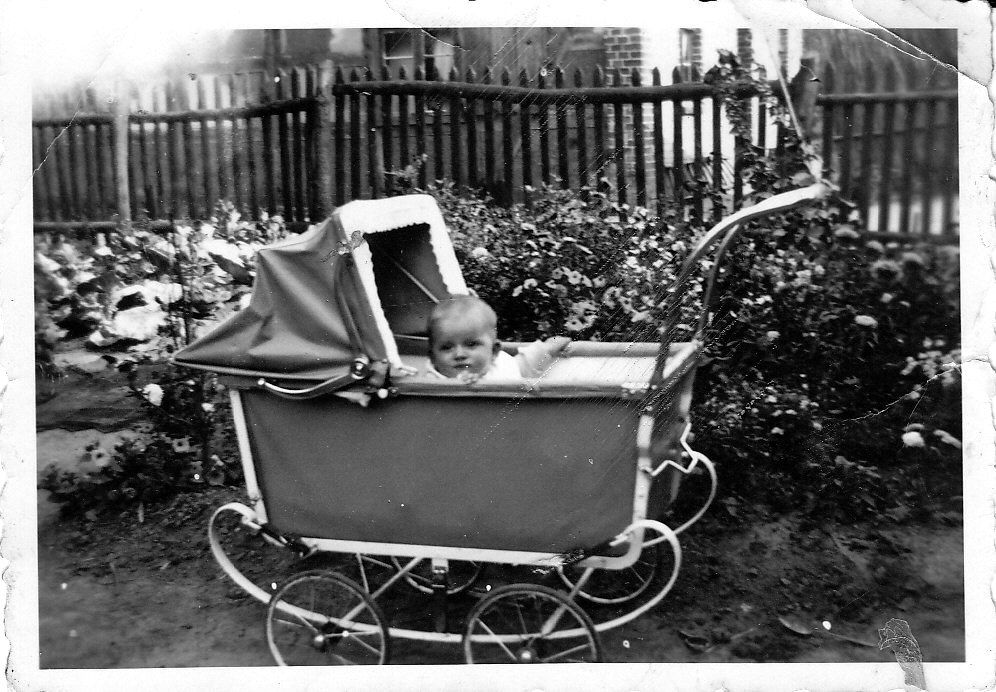
A new pram just for me

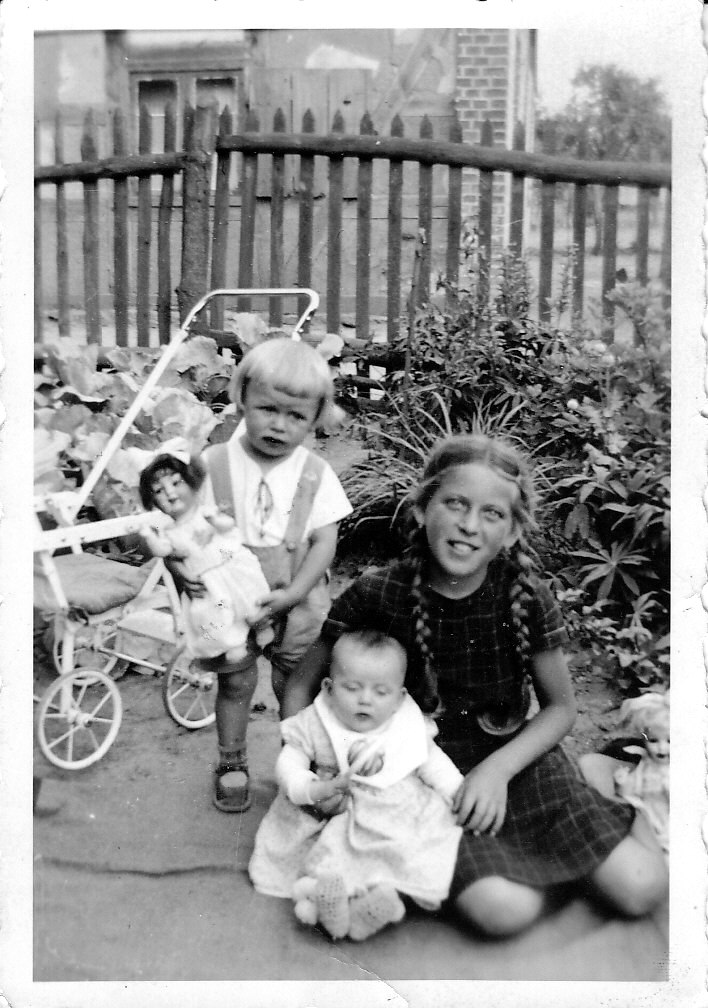
Siegfried, Lisa and baby Gila

My father’s youngest sister Lisa, who became my “big sis” and baby sitter and one year older cousin Siegfried, my second love, after Dad.

Lisa & Gisela

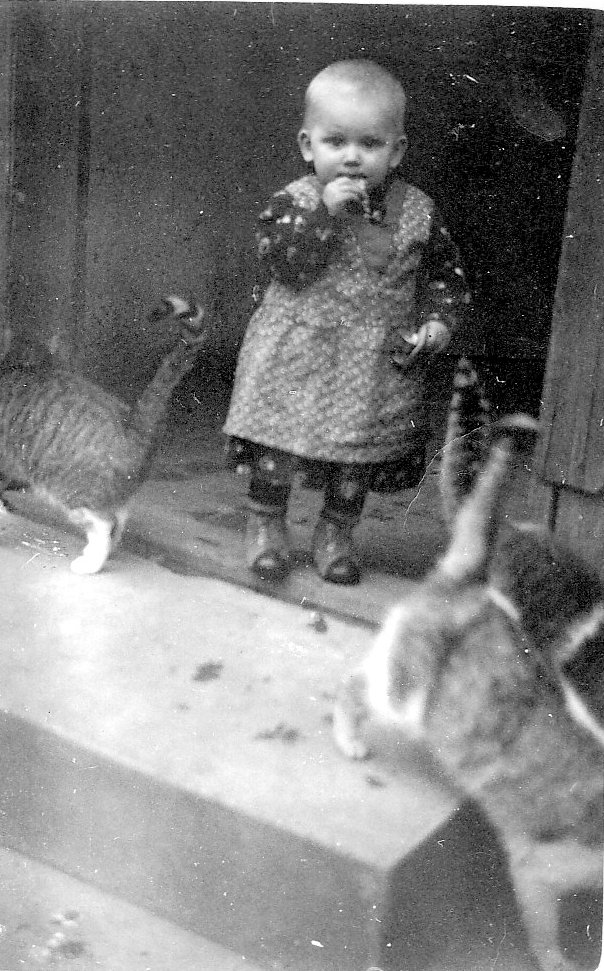
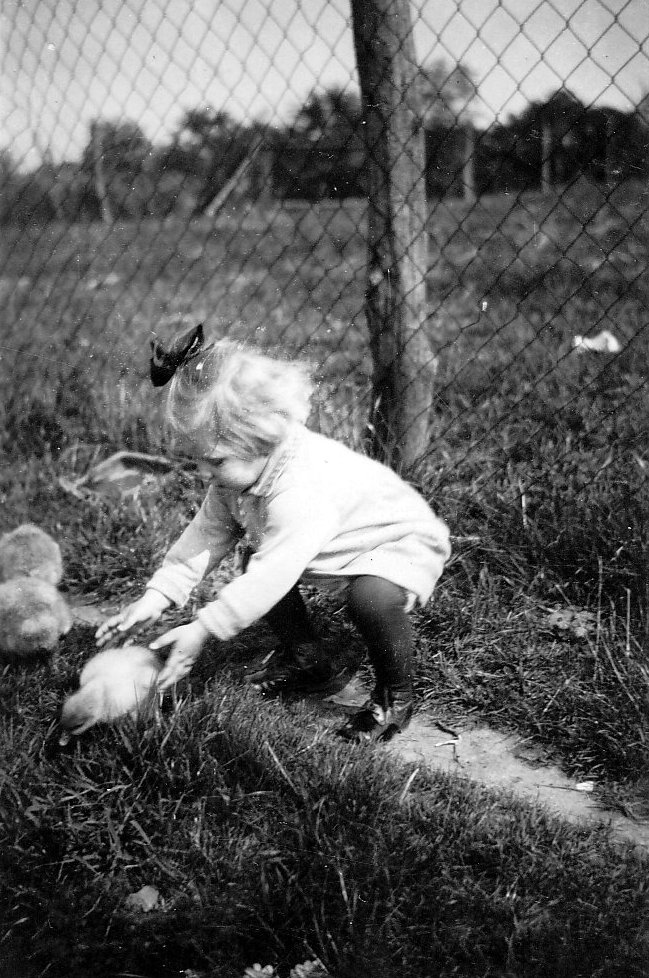
Maybe this was the reason I always liked geese, alive or crisp out of the oven (we never had turkey!)

image0-001

When I was one year old they shaved all my nearly black hair off. Superstition was that I would get really beautiful new hair

image3-001 (2)

Surprise! I became a blond girl. Do blonds really have more fun?

Charming village life

WWI Memorial and behind it was the pub.

WWI Memorial and behind it was the pub.

During my early life I thought we were quite well off or even rich. After all, there was that box with billions of Marks in a corner of our attic.

We lived like peasants in medieval times, compared to village life today. My feelings must have been triggered by the love and protection our parents gave us, – we never wanted for anything, except perhaps candies, cake or cookies every day, these were just for Sundays. But, we did not know better. We accepted life the way it was. We did not know that water could come out of a faucet on the wall instead of going to the pump outside. We did not know what it would be like to have constant warm water without starting a fire and heating a kettle.

A view over the Stresow Lake where I almost drowned

A view over the Stresow Lake where I almost drowned

We did not know what a toilet within the house would be like because our outhouse had a box under the seat that “things” just fell into. We played tag, we played hide and seek, we skipped rope, we played hopscotch, we played ball against the house wall in a certain sequence with different movements, we played with marbles (the glass ones were very special and were traded carefully), we played with a spinning top and we rolled and ran behind a hoop with a stick. We were kids, in the truest sense of the word. No radio, TV, no texting, no electronics. During winter evenings our parents had more time; it was a time of storytelling, sing-alongs, and board games.

The approximately one-thousand people in our village all lived a similar life. Sunday Church was a time for meeting and talking to the others; the male folks would go to the pub; the women would go and water the flowers on the graves of the dearly departed. There they would chat, and exchange the latest gossip. The big time politics in the cities would not affect this laid-back life. Nobody was divorced and nobody lived “in sin” or had affairs. We also had our “village idiot”. That is a term not acceptable today either, – just as all those other activities have no place in our society anymore. I dare to say all the Stresow families were happy, just like we were.

Breaking News

A lucky escape

Our sister Edith sometime after he supposed drowning

Our sister Edith sometime after her supposed drowning

Here is a piece of my family history of which I was totally unaware until after I had written “We Don’t Talk About That”.

Edith is my youngest sister and was the baby that barely survived our trek on the road to nowhere. She recently celebrated her 70th birthday and when I spoke to her on that occasion I mentioned the fact that my book had just been published. In that conversation she asked if I had included the story of her drowning. This was the first I had ever heard of this tragedy.

My sister Christel escaped from East Germany after me in 1956. As was required by the authorities she surrendered her East German passport pending issuance of a West German one. During this interval she received first a telegram, then a letter, stating that “Edith has drowned, come home immediately”. Without travel documents she was in no position to “go home” but was, quite naturally, most upset to learn of our youngest sister’s demise.

Shortly thereafter my father who was, by now, allowed to leave East Germany because if he failed to return it would be one less pension to be paid went to visit Christel in Hamburg. Christel met him at the train station dressed in black as she was in mourning for Edith. Father asked why on earth she was dressed all in black whereupon she burst into tears and said it was because of Edith’s death. Father was astounded to learn of his youngest daughter’s drowning since he had, only that morning, left her at home. Christel explained about the telegram and showed him the letter. He was able to recognize the writing as that of a neighbour living in the attic suite above my parents’ home and it became evident that this neighbour was a Stasi agent.

The telegram and letter had been a ruse to try to get Christel to return home where she would have faced 30 years imprisonment for having defected to the west. What a lucky escape she had. Why have I never heard about this before? Is this another instance of “We Don’t Talk About That”?

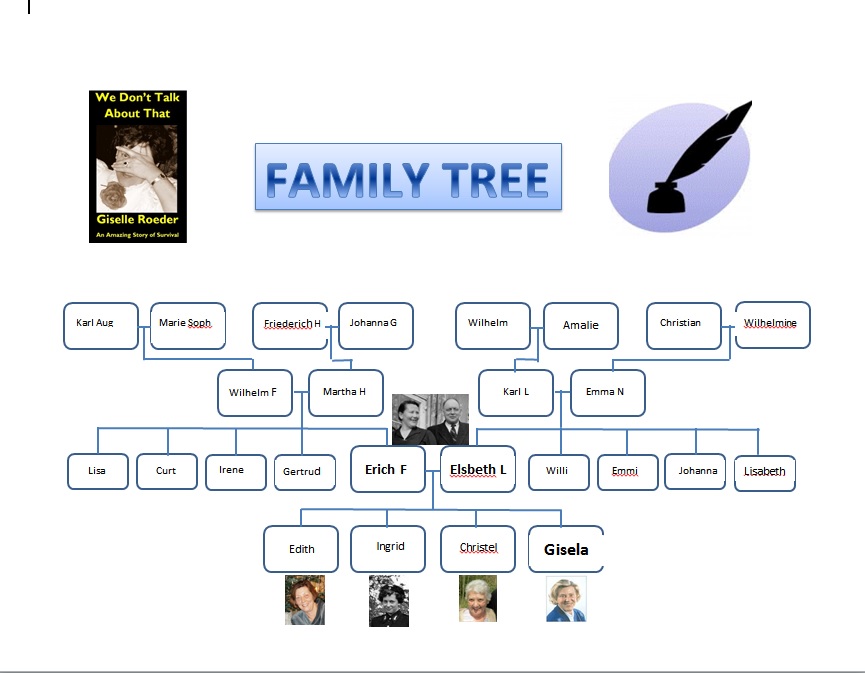
My Family Tree

Family Tree - Mother, Father and four daughters

Family Tree – Mother, Father and four daughters

On purpose I just put the last four generations in this “tree” in order to avoid difficulties in looking at it when reading my book “We Don’t Talk About That”. I hope it will help you to place a particular person within the story. I could have gone further back – or forward for that matter. Going “back” does not add anything of interest now and going forward comes in the sequel of which you can read an excerpt at the end of my present book.

Weddings of Three Sisters

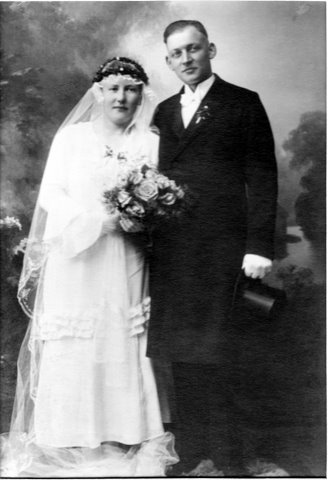
Erich and Elsbeth married in April 1932

My parents - Elsbeth and Erich

My parents – Elsbeth and Erich

It was a difficult courtship because Elsbeth was promised to another man by her father and Erich was simply not good enough. She did not give in to her parents and finally their wedding day came. Erich was teased about his inability to give his wife expensive gifts… and it came to the point when they got up and left the wedding party.

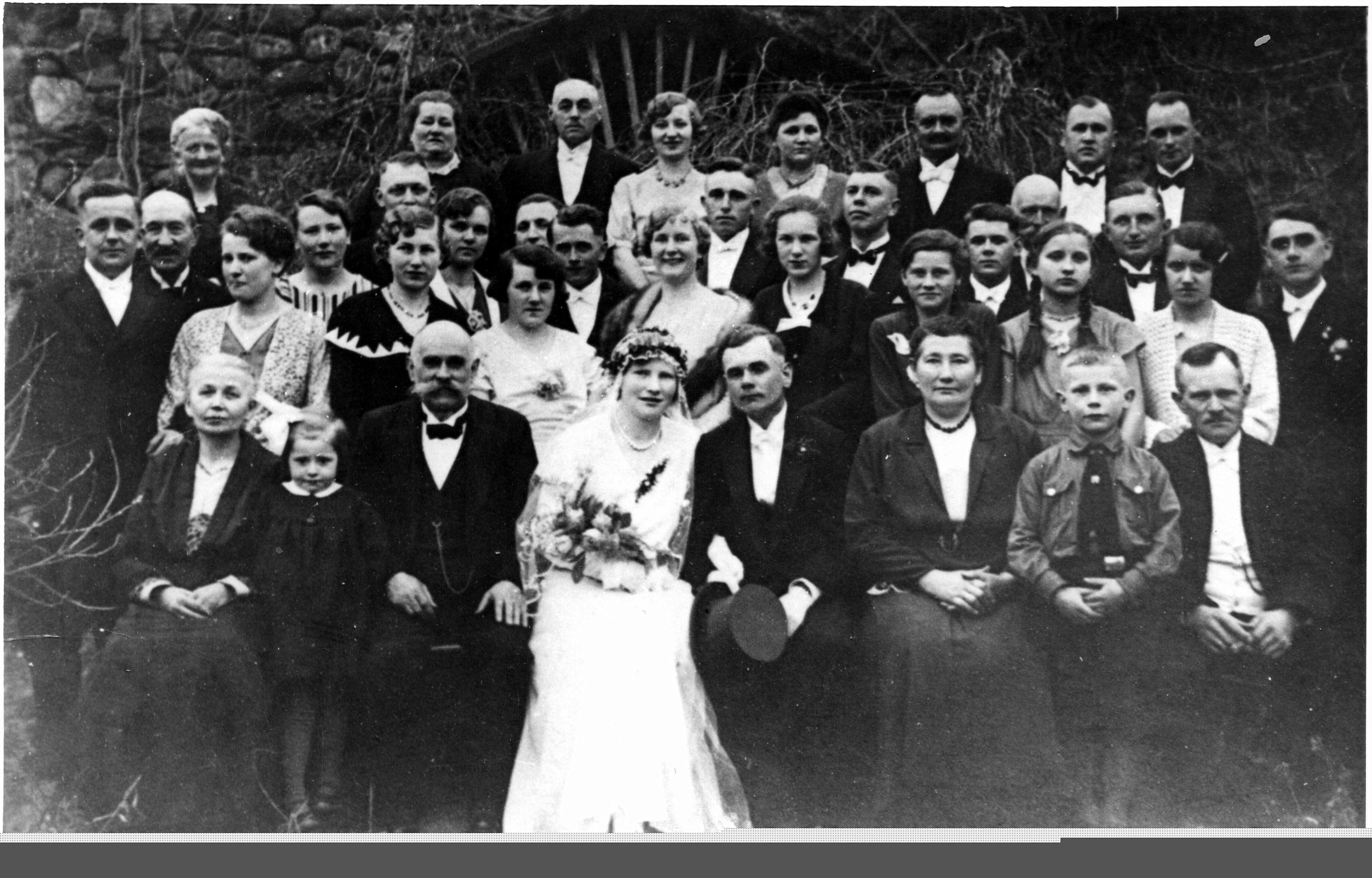
Johanna and Robert married in March 1933

Aunt Johanna and Robert S wedding

Aunt Johanna and Robert S wedding

Robert was welcomed into the family with open arms because, unlike Erich, he came from a wealthy family. He could give his wife a horse if he wanted too while Erich could only afford a whip.

Emmi and Erich L. married in 1929 (?)

Aunt Emmi and Erich L wedding

Aunt Emmi and Erich L wedding

Looking at this wedding photo one would think of rather a different party – certainly not a wedding. Notice the black dress of the bride? She was not allowed to wear “white” because she was pregnant. Her Erich was also “just a tradesman”, maybe pregnancy was her way of getting her own way.

Meet the Players

My Mother’s Family

Grandma and Grandpa

Grandma and Grandpa

Grandmother and Grandfather – my mother’s parents were a very unlikely couple. He was stern, introverted, always sat thinking in his beloved pergola, his chin on the cane he held in his hands. The pergola was attached to the very old city wall that ran through his gardens. Whenever we visited, always on Sundays, that’s where he could be found. Grandma would send us to say “hi” to him, but he never smiled, just looked at us. The pergola was totally covered with green climbers. I remember the sun shining through the leaves and as a child with an active imagination I often thought he was some kind of a saint because of the sun giving him a halo.

Grandmother on the other hand was outgoing. She cooked the best jam I ever tasted. I loved it with a passion. Black currants and plums cooked for a long time. She knew that it was the only thing I wanted when visiting. When the rest of the guests had coffee and cake I would get her home baked bread with this jam! My mouth would start to water before we even left home. She always served it with a big smile to me and stroked my hair. That was as far as expressions or gestures of love ever went.

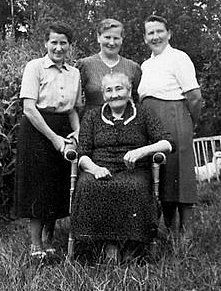
Grandma with 3 of her daughters, Emmi, Johanna and Elsbeth

Grandma with 3 of her daughters, Emmi, Johanna and Elsbeth

I do not have a photo of all Grandma’s children, my aunts and the only uncle. In this photo taken sometime in the early 1940’s we have my mother Elsbeth (right) with her sisters Johanna (centre) and Emmi (left). The youngest sister Elisabeth (the princess) was always off somewhere and Carl made himself scarce by finding work in the barns.