Is there just too much information fed to us by the media? I think they have a dilemma too: Too much and too many serious things are going on in the world. Syria, Iran, North Korea, England, Russia and last but not least the USA keeps us breathless and, in many cases even frightened. Hardly a day goes by when we do not get upset over a new announcement, and it hardly ever is about something we would emotionally get involved in: some good happenings in our own backyard.
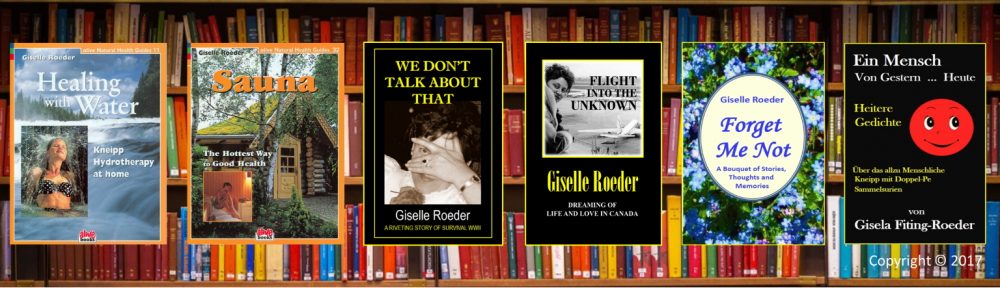
 I don’t want to add to it. I am just a person who, after writing the memoir “We Don’t Talk About That” – the years growing up under the Nazis, and then later under the Communist Regime in East Germany – who really is OVEFED but UNDERNOURISHED by the present political situation. I would like to stick my head in the sand and write another book, a happy one! But that is dangerous and surely not advisable.
Talk about a happy book! It was on a flight from Hawaii to Canada when I got chatting with the stewardesses in their Business Class galley kitchen. Naturally the talk included the question “what do you do…” and my writing career came up. There was a time when “I did not talk about that” – but now, finding a willing ear to listen, I can’t shut up. One of the ladies was very keen on my title “We Don’t Talk About That”. She had serious questions. Later, she went on to tell me about her aunt who had written a similar book, “Prague Winter” – and highly recommended I read it. I Googled it, found it, read it, and was amazed when I found out a lot of information about the writer: Madeleine Albright. I was not familiar with her name.
 Madeleine Albright was the first woman ever nominated and accepted to become the Secretary of State in 1993. Wow! What a story! From the little Czech girl in “Prague Winter” to making history for women. What an intelligent person! She has written a number of books. One paragraph in the book I read resonated with me so strongly that I absolutely must share it with you:
“In the end, no one who lived through the years of 1937 to 1948 was a stranger to profound sadness. Millions of innocents did not survive, and their deaths must never be forgotten. Today, we lack the power to reclaim lives, but we have a duty to learn all that we can about what happened and why – not to judge with the benefit of hindsight but to prevent the worst of that history from playing out again.”
 True words! So, my dear readers and followers, we are NOT TO STICK OUR HEADS INTO THE SAND. Let’s open our eyes; a lot of what has happened back then, what I have written about in “We Don’t Talk About That” and Madeleine Albright in “Prague Winter”, is happening again and there are a lot of signs that worse may be to come. Madeleine Albright is working on a new book “Fascism” to be published in April 2018. “The author examines the economic, religious, racial, and cultural factors that are today dividing populations and fostering bigotry across the globe, while also looking at how demagogues from Mussolini to Duterte have attracted followers by exploiting fear, nurturing anger, and promising easy answers to complex problems,” according to HarperCollins, her publisher.
Do the people in power ever learn from history? Do they even KNOW the history or are vaguely interested in it? Do the people who elect them, have any clues? Maybe every generation has to make their own mistakes, have their own experiences, make their own history and create their own past. Will the next generation after them learn from it? Most likely, not. Maybe we resent or do not want to learn from or ‘copy’ our predecessors.
Somewhere I saw a quote, something like this: “When a boy is old enough to believe or even follow his father’s advice, he usually has kids who don’t believe him.”
 This one, book I, “We Don’t Talk About That” covers my first thirty years in Germany; the second book will deal with the next thirty years in Canada, and then we’ll have to take a good look at my incredibly active ‘retirement years’ – I am not sure yet if I quite make it another thirty years! Close though…
 translate my books. That will not happen – friends, it is not a matter of translation, it will be a total re-writing. I don’t have enough years left in my life to tackle it. Therefore, this little book may be a “candy” – and I promise that many of the poems deal and tell a lot of my life! For those of you who have German friends or relatives, you couldn’t send them a better gift! However, I find a poetry book is something you have to hold in your hand, it does not read the same when it’s an e-book, so – I have another surprise: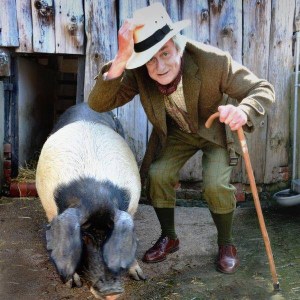
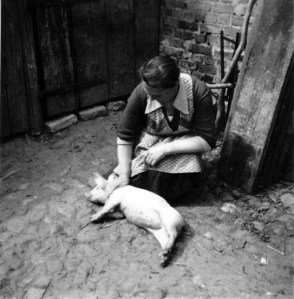 Aah! Yes, pigs are very intelligent. I bet they can read your mind. I grew up with pigs – no, not in their sty! We raised and slaughtered two each fall. We made sausages, smoked ham and bacon, canned a lot of meat and lived on it for a whole year. We were never hungry during the war years. The piglets loved and enjoyed my mother’s tenderness – just look at the picture! When they grew up to about 250 pounds and were let out of their sty with a rope around a leg, they KNEW they were going to be killed and screamed blue murder. I also learned that their meat is not as good when they are not killed ‘humanely.’ Actually, that goes for every animal. Tension and stress leave their mark in the harvested meat. Pigs are, from their DNA makeup, the closest relatives of humans and are used for medical research and even transplants. I met a former cannibal on Fiji, donkey-years ago. He told me human flesh tastes similar to pork. Sometimes, when I pound cutlets into schnitzels, I think of it and don’t really want to eat it. The part of a pig that became pork I like best is the smoked ham, especially the Italian kind, the ‘Prosciutto.’
 Last week you read about the beginning of our Morocco tour! The food was good, plentiful and tasty. Next morning, we toured the city of Marrakesh, an oasis and royal city founded by Berbers over a thousand years ago. Blue blooming trees lined the street into the city. I loved it! I was surprised by an old Jewish quarter. It was very clean in comparison and their flag with the ‘Star of David’ was almost the same as the flag of the country since it also had the same star. I did not know that. The visit of a Berber Market was frightening. Hundreds of entertainers, magicians, snake charmers, monkeys, begging children and thieves tried to get the purses. They would take your camera if you tried to shoot a photo since they believed you would steal their soul. If you paid – the soul was saved! We quickly retreated, found a terrace café on a roof, had a cola and shot pictures long distance. We encountered a woman nursing her child when walking along a small path back to the bus. The baby was approximately eight months old and kept suckling but looked at me when I stopped. It stretched the little hand out to beg. They learn early. A boy, ten years old, told us he makes more money on a day than his working dad does in a month. Asked to leave us, he said, “no, don’t pay, talk, I to learn English”.
 Next was Casablanca, a very modern city with wide streets and a large, beautiful Mosque. We were allowed to see part of it and our tour guide pointed out the incredible tile work. We drove by the bar where “Sam” had played the piano… Casablanca is the largest and an important harbour city on the Atlantic. We visited one of the souks in the old part and were warned again to hold on to our purses. Imagine narrow dirty pathways, loaded donkeys and their owners yelling “Baluk – attention”, begging women, pickpocketing kids, “shlepper” offering to save you from getting lost; people pulling at you from all sides, hundreds of small stalls but overflowing with wares. With help of the tour guide I bought a silver necklace with the “Hand of Fatima” for good luck. To gain respect you have to bargain, it is part of their custom. I enjoyed the smells of spices, was intrigued by the colorful silks, and couldn’t resist buying a few meters for a dress. To get it made at home cost more than the material. The seamstress told me it was ‘fake silk’- but at least it was washable. Famous brands, from t-shirts to purses were cheap, everything was fake!
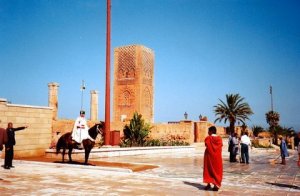 The longest day trip with 380 kilometers was along the coast to the capital city of Rabat. The brief city tour next day was almost overwhelming. We saw the Royal palace, the Hassan Tower built during the twelfth century with an incredible view of the big wall around the Medina (city center) with the narrow lanes and typical Moroccan shops. We had no time to linger and after the next two hundred kilometers we were in Fes, one of the four Royal Cities. I liked Fes best. Three parts of the city were built
  during different epochs. The famous ‘Blue Gate’, the great walls and many Mosques in and around the old parts were fascinating. Of special interest were the paint pots in one particular area. Workers were busy to tint all kinds of products. I later fell for the beauty of a heavy brass platter with inlaid little flowers on enamel and the star of the Moroccan flag in the center. I didn’t even realize it was the Star of David until Margo pointed it out. It was done by the famous artist who had fashioned the wonderful golden gate for the king’s summer palace.
 Our last stop was in Meknes, a city of two parts: the old and the new city. Meknes was the former residence of the kings. Thick high walls surround the old town with the ‘Great Mosque’, the narrow bazaar alleys, and the wonderful ‘Bab Mansour’ leading into the Kasbah and the Imperial city of Sultan Moulay Ismail. It is a monumental gate, completely tiled in green and gold. It was finished by the Sultan’s son Moulay Abdallah in 1732. An inscription (translated) on top reads:
 Ever since I saw the movie “Casablanca” I wanted to go to Morocco. A few years before I realized that dream, I had been in Tunisia. The main memory of it now is a visit to a “Camel Market”. People would buy and sell live chickens, goats, dogs, cats, and wonderful hand knitted rugs plus unbelievable junk. When I asked why the chickens were “live” they said because they don’t have fridges. They keep them until they want to eat them. I was surprised by a huge mountain of buttons. Yes, buttons of all kinds, small ones, big ones, colourful and plain ones. The seller said, “I found them all…”
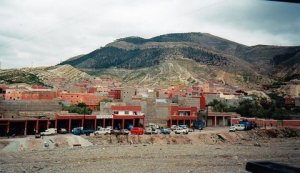 I shared a room with Margo. We found it on the second floor. It was furnished with two beds, crisp white bedding, a telephone on a night table, a chest of drawers, and a TV in a corner. The view was directly into the garbage collection area. The glass-less window was open but had wooden shutters set to let the light, the flies, and at night the mosquitos come in. While my companion used the bathroom, I checked out the telephone. No dial tone? I pulled on the cord to find the plug. There was no plug at the end. O.k., I thought, we don’t really need a phone. Next, I tried to switch the television on. Dead? Again, I checked the cord and found the same result. No plug. That moment, Margo called “Giselle, I can’t flush the toilet. There is no water…” I rushed in; she was embarrassed because she had a smelly job to flush away. I figured the water was switched off – turned the screw under the tank and, viola, there was water! We closed the lid and let it run. She had undressed for a shower. I gave her privacy. Then, another scream:
 The people were very friendly and now not busy. I asked them,
 Two hearts were breaking as the young couple was released to go. They promised undying love to each other and forever display it in their flowers. The ocean girl’s flower shows only the lower half of the petals while the mountain boy’s flower only grows the upper petals. Both halves will make a perfect flower with petals all around as it was meant to be.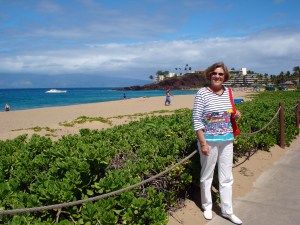
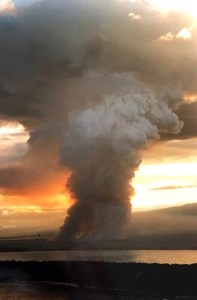 The
The  Pele recovered. She went on to Oahu. Here she dug several fire pits. The ocean goddess, her sister Namakaokahai, flooded them to drive Pele away. One of Peles Oahu craters is the well known “Diamond Head” in Honolulu. After a brief sojourn on Molokai, she fled to Maui. We are still in awe of the huge Haleakala crater she built on this island, extinct now for many years but famous for tourists who drive up in the middle of the night to experience an unforgettable sunrise. Tip: Dress warmly! Baby, it’s cold up there…
 on the Kilauea summit. People have built a small community on this mountain: you can stay in an hotel, spend hours in a museum, buy and write postcards and post them right there in a small post office to get the special stamp. Living in harmony with Madame Pele? Hmm, I don’t know.The Hawaiians warn you about ill health or other serious problems if you take any pieces of lava or even black sand from some beaches on the island. I talked to the lady in the post office about it. She got quite passionate and, to convince me, she opened a door to a room full of unopened parcels, shelves full of letters from all over the world. Tourists, who didn’t heed the warnings, had sent back what they took away. I was able to read some of the letters, letters from people who regained their health after having sent Pele’s goods back. A huge pile of lava pieces next to the post office was lava sent back in already unpacked parcels.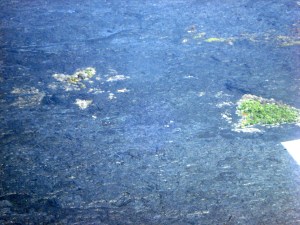
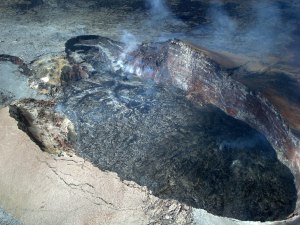 cities on this volatile ground, created many farms, beautiful gardens, airports and many new roads. The lava provides a fertile ground once men with their big machines have a go at it. The birds do their thing with droppings containing seeds and one can only wonder about the power of nature: create, destroy, then recreate. But the might of the volcano can not be harnessed. Looking into the crater from above, it’s a boiling gray soup. And, when Pele gets mad, beware!
 The three weeks at our ‘home away from home’, the Ka’anapali Beach Hotel, were sunny and, like always, wonderful. I learned more of the Hawaiian mysterious stories of sudden winds lasting only seconds and wrote about it on my Author Facebook ‘We Don’t Talk About That’. The beach was very wide, and by the time we had to depart, only one-third of it was left. The ocean gives, the ocean takes… During our time there, three weddings were celebrated on our grounds. All were glamorous. The couple in one was absolutely beautiful with the Hawaiian flower leis and their gorgeous outfits. He in a white suit, she in a gown that would take half of my closet to store. I couldn’t understand that at neither one the “Hawaiian Wedding Song” was played. To me, that song touches not only the heart but reaches the soul.
 Giselle Roeder