Successful Book Signing Today #WeDontTalkAboutThat

Book signing

Book signing at Chapters

I had a successful book signing at the Woodgrove Centre branch of Chapters today. Many thanks to Manager Tim and the rest of the helpful staff at Chapters.

Tomorrow I look foward to a book reading at the North Nanaimo branch of the Vancouver Island Regional Library on Hammond Bay Rd at 6:30 p.m.

Refresh – Four Minutes of Fame #WeDontTalkAboutThat

The YouTube link originally posted for this blog post was changed. The link below is now the correct path to the video.

Red light, interview in progress.

Red light, interview in progress.

We all have our moment in the sun. I had all of 4 minutes under the bright lights and in front of the TV cameras last week. Check out The Show on YouTube and scroll forward to 29:15 for my interview about upcoming book signings and book readings.

https://www.youtube.com/watch?v=onwpKtKENSM&feature=youtu.be

Answer to a question: #WeDon’tTalkAboutThat

Question markOne writer on a sub-group on LinkedIn posed this question:

“Who is the most memorable character in your book?

I did just that, the name I gave was “Gila” who was the heroine of “We Don’t Talk About That” whose story is an amazing story of survival. After several days had passed I went on to post the following on LinkedIn:

I am surprised how much text many of you wrote. For my part I tried to keep my posting very short. Now I may add a bit more of Gila’s story titled “We Don’t Talk About That“:
Christmas 1944 – it was the last year of my childhood but I did not know it then.
During the month of January 1945 the Russians made rapid advances into Germany. For my eleventh birthday nobody came to visit because people had been robbed or even killed by German deserters for clothing or money, everyone stayed safely at home. A few days later our teacher announced that the school would be closed, permanently. The Red Cross would turn it into a field hospital since the front was very close. We had heard the noise of the fighting for days now. Mr. Koenig had tears in his eyes when he, with a breaking voice, said “Good Bye children, may God be with you. We may never see each other again.” As we left he shook our hand instead of looking at the usual ‘Heil Hitler’.
That afternoon the church doors were wide open despite the cold. The organ was played ‘with all the stops pulled’ as the village folks said. And that was where the Russians found him, his wife sitting by his side. ……
It was very dark when some horrible screams woke me up. I thought it was a bad dream, but my dad whispered: “Please, be quiet, be very quiet.” We heard some loud cursing and the house door was opened and closed with a bang. The screams came from Helen and Betty. Several Russians had raped them. Their grandfather had tried to protect them and was brutally beaten. When he was unconscious they just threw him out the door and went on with their business. To our horror we found him dead and frozen in the morning. …..
A couple of days later all men and women between sixteen and sixty years of age were horded together, the unfit and nursing mothers were pushed aside, the rest were taken to Siberia. …..
The first Russians moved on and the next ones evicted everyone. We just followed all the other villagers with no idea where to go. We walked across a field where the mighty Russians had killed the last of the fighting German army. Body parts lay scattered. I pushed the pram with my baby sister. My mother called out “Gila, don’t look to your right.” Tell a kid not to do that! A soldier with his head beside him leaned against a fence. His legs were not attached but on the other side of the pram. This sight became a nightmare for me for many years.
Arriving at a house where about 40 women and children were standing around we asked if we could join them. One woman said “The more the merrier, that way we might get away with just one soldier raping each of us instead of a whole army.” The Russians locked us all into one small living room. One spoke a little German. Asked why the Russians raped young girls as well as old grandmothers he shrugged his shoulders, and said “Woman is woman. Has hole.” …..

The above is just a short part of the book. Gila, her mother and sisters walked on with hundreds of thousands of others alongside the Russian war machinery on their victorious march towards Berlin for three weeks, no food, no water, disease, lice; the dead and dying were just left in the ditch. …..

Starting towards the end of 1945 the rebuilding of some kind of order, school, farm work, the establishment of East and West German States, followed by Gila’s haphazard education to become a PhysEd teacher, kayak sport, escape to West Berlin, an unwanted affair, a confrontation with a convicted rapist on parole became all too much. Gila had just one wish: To get out of Germany, to get away, to emigrate, to be free, to start a new life.

See BOOKSTORE to purchase book. To FOLLOW my blog go to top of right hand column and click on FOLLOW button.


What happened to them? #camping #BalticSea #escape #kayaking

They were sleeping in four tents next to us. We were camping on the beautiful Isle of Hiddensee. Located between the mainland and the larger Isle of Rügen it was one of our favourite weekend and even holiday spots. Hiddensee was a narrow long island and you could walk from the high cliffs with the lighthouse at the Rügen side all the way down to the other end where it tapered out into sand banks. Starting to paddle or with a good breeze and able to hoist our five square meter sails it would only take us between three and four hours from Stralsund to Hiddensee. We would aim for about the middle of the island, a place called Neuendorf with the fishing harbour, surrounded by typical bright white romantic thatched island homes. These low houses with small windows were hunched down low to let the constant wind blow over them. We had to start walking on a sand bank for the last one or two kilometers and pull our boats until we hit deeper areas again. The island was quite narrow here and had dunes and a nice beach facing the open Baltic Sea.

May I see your ID

Show your ID

We were four girls in two boats and had two tents. We found a nice camping place adjacent to the nude beach. We were surprised to see fully uniformed policemen checking the passports of the nude people. Where do you carry a passport if you have no clothing on? While we were spending the rest of the day sun-tanning and swimming several other tents had gone up in a row next to us with five single kayaks placed upside down between them. Five very fit looking men in their twenties were organising their blankets and cook ware. When they noticed us next to them they called “Want to have dinner with us? Just soup, – but good company as a side dish and music for dessert. You’ll have to have your own bowls and spoons though.”

For several days they were busy exploring the island and the very few shops in Neuendorf and Kloster, the village closer to the high part of Hiddensee. They would sit on the dunes every night for hours and watch the military search light reaching out with bright long arms over the Baltic, starting at the lighthouse and coming back from the sandbanks.

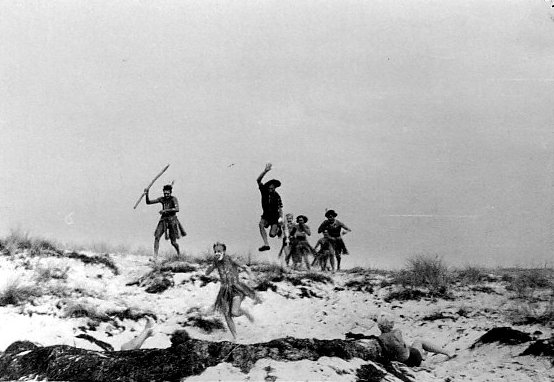
Indians - 1

Tribal attack

Indians - 2

Dress rehearsal

We planned to attend a costume dance and were busy picking beach grass and making grass skirts. Intrigued they inquired what we were up to. “Can we join you?” We were delighted. Now we did not have to walk home in the dark on our own after the dance. We made more grass skirts and with lipstick painted Indian designs on our faces and bodies. The men had found some feathers to complete our costumes. We celebrated with a kind of dress rehearsal on the beach and a few drinks loosened our inhibitions. With lots of noise we entered the dance hall and celebrated with our own tribal dance. We scalped a few people, and at the end won first price for which we received a bottle of rum. The boys disappointed us by saying ‘good night’ when we suggested sitting on the dunes with them and let the bottle go around. “Tomorrow is another day” were their parting words.

We won first prize

We won first prize

When tomorrow came their camping places were empty. Tents gone, boats gone, not even a garbage bag left. It was as if they had never been there. Inquiring of other campers nobody had seen or heard anything.

What happened to them?

To find out order your copy of “We Don’t Talk About That” right now! Reading this book will make your head spin.


Granny’s Hands #WeDon’tTalkAboutThat

Durer handsMy treat for you today is reading a chapter from my memoir. It’s one of the many memories of my childhood.

Granny went to church every Sunday and her praying hands left an indelible imprint in my soul. She had grown up speaking mainly Low German and often had trouble pronouncing some words in High German. My parents wanted us to grow up with High German, preparing us for a better education. Granny tried hard to please her son, my father. I once listened to one exchange between her and Dad:

“Mother, – it is not ‘Gesus’, – it is ‘Jesus’.”

“Erich, you told me to speak High German to the children, and then the ‘j’ is pronounced ‘g’ like in ‘go’ and not as it would be in Low German ‘jo’.”

“In that case you are right, Mother. But ‘Jesus” is a name and it needs to be pronounced ‘Jesus’ and not ‘Gesus’. Would you say ‘Gohanna’ to Johanna, would you?”

“Oh, now I understand. I’ll remember not to speak to the children of ‘Gesus’ anymore.”


Many children had the measles and I got them too. My eyes hurt and I was very sick. I felt lousy, alone and sad, forgotten by everyone. The room was dark with the shutters closed. As the sunlight came through the slanted openings, I imagined it as long, silent fingers playing with the bits of silver and specks of brown in the dark blue wallpaper. I could even imagine faces in the shadows caused by the lilac trees outside – here and there a ship, and there was the good Lord himself on a cloud with some angels around Him. He had friendly, old eyes but He wiggled a finger at me attached to a long, sinewy hand. I was not afraid but just kept on looking at the imagery. The hand was white with a touch of pink and I could almost see through it. It was a beautiful hand.

The hand was cool and soft. I felt it on my forehead. It helped my eyes not to hurt so much but I did not want to open them, I wanted to feel those cool fingers. Was I an angel now, like those behind Him? It did not matter. I felt suspended between being and not being, I was floating. Please God, just a little longer….

Was it this plea or was it the voice coming from a distance, “She has quite a high temperature and she is delirious….”

All of a sudden, I was back in my bed, the perspiration trickling into my ears, which hurt, too. The long fingers and the streaks of sunlight were gone. There were no faces, no ships, no God, no angels on the wall, just that dark blue wallpaper with bits of silver and specks of brown. This used to be my father’s room. My bed was a black ebony sleigh bed. My father had told me proudly that it was his before he got married.

I opened my eyes just a bit and looked right into Granny’s wrinkled face. Her one hand was on my forehead and she took my hand in her other one.

“Did you have a nice dream, my girl? You smiled and you looked so happy.”

I just nodded – thinking she would laugh at me if I told her of the things I had seen. I felt that she belonged to Christel. She always hugged her, cuddled her, held her on her lap, stroked her wavy hair, and comforted her when she was crying. I was only allowed to just sit beside her, close enough, but never on her lap. She never stroked my hair.

Tears were stinging my eyes. I closed them again. Granny’s hand felt so good on my forehead and I wished she would not take it away. I thought of how beautiful her hands were, even though they were wrinkly or maybe because they were wrinkly. Her face was beautiful and wrinkly too. Often I had looked at her, wanting her to hug me so badly that it hurt. My mother did not hug me either, nor did my father. There was just a handshake and a light formal, “Good Night” kiss – nothing else. But I could not let anybody know or show how much I wanted to hug or be hugged – only babies did that. I was a big kid now, a kid ready to go to school. Maybe it was good to be sick. I could feel the hand on my head and it felt so good. I did not want it to stop.

“I want to look like Granny when I am a grandmother,” I decided.

My ears got worse and Dad had to go to pick up the doctor from the city. It was a good thing that he still had the motorbike. Granny had to put special drops into my ears at frequent intervals. The drops felt cool and tickled as they ran down into my ear canals. I asked where Mom was. Granny explained that she was not allowed to come close to me because I was contagious. Mom had never had the measles and when grownups get them, they could die. She also explained that the measles were dangerous for a new baby. Which new baby I thought but was too tired to ask.

“Don’t worry,” she said, “your mother often stands at the door and looks at you. She hopes you will get well soon.”

During my whole childhood, I had recurring ear infections and my ears are still very sensitive. Noise hurts, even drives me to tears, and I cannot stand windy days without a cover.
Book getting rave reviews #WeDontTalkAboutThat

I am pleased when I see flattering reviews from readers of We Don’t Talk About That but it is both humbling and heart warming to receive rave reviews from established UK historical authors such as Bob Pickles and Ann Victoria Roberts. Check the REVIEWS tab above to see what they have said.

#Horses – and their shoes

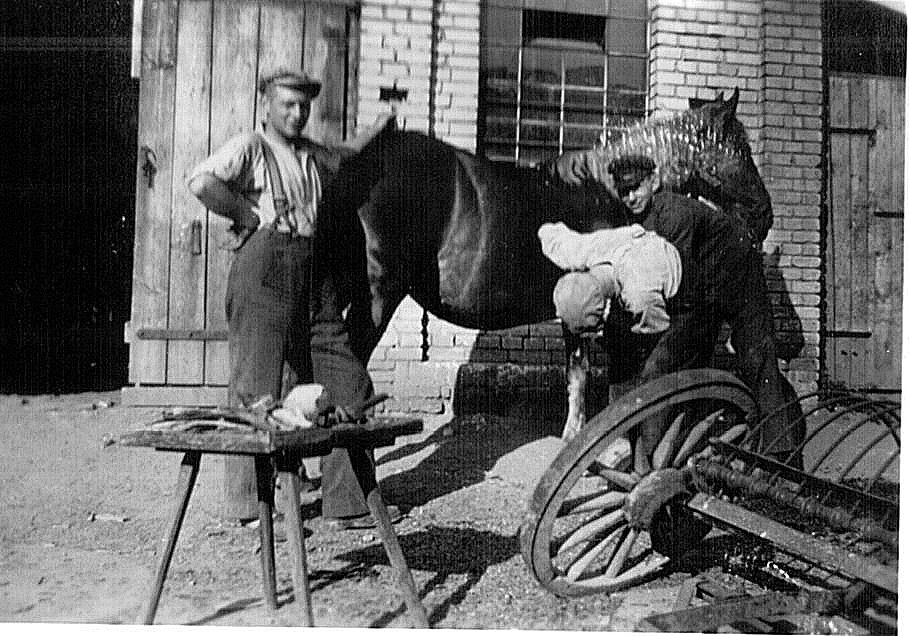
Erich Fiting-Helmut & ?

Shoeing a horse at Father’s smithy.

Do kids nowadays have a chance to see how a horse gets new shoes? Or do they experience the special “smell” when the red-hot iron horseshoe is fitted onto the horse’s hooves? Or do they hear the “swish” when the blacksmith places the iron in cold water for a second or two before he places and fits it on onto the horse’s hoves, one at a time, lifted up sometimes by another man, usually an apprentice? Would they even know what a farrier is? Hardly. I remember it well. I know about the ‘swish’. I remember what it smelled like. I remember being afraid the horse would be hurt. How can the glowing iron not hurt? And the long nails with the almost square head that go into the horseshoe to hold it in place? How can the horse stand it? I didn’t realize then that the bottom of the horse’s hooves are something like a very thick callous, or a very thick toe or finger nail of ours, no nerve endings in it. Only once have I seen a horse bucking and I was afraid my dad would get hurt.

Our own horse Lotte was conscripted in 1939. My dad explained ‘the Führer needs her for the war.” I asked, “Can’t he use another horse? Why our Lotte?” Yes, why our Lotte. It wasn’t just our Lotte. There is a short chapter about it in my book “We Don’t Talk About That”.

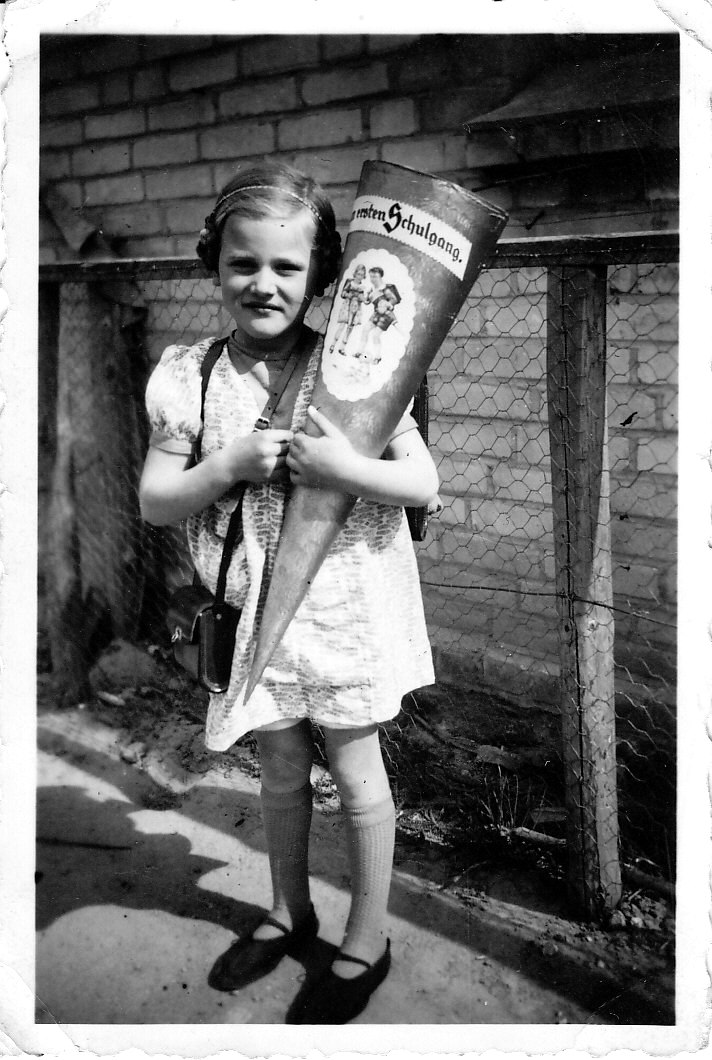
Gila-First Scool Day

First day at school with a horn of plenty (not!).

Omi-Mutti m. Ingrid - Tuti-Manfred-Christel-Dieter-Gisela - Siegfried

A family outing to the lake. Omi-Mutti m. Ingrid – Tutti-Manfred-Christel-Dieter-Gisela – Siegfried

I could hardly wait to go to school to learn to read, to be independent from Granny reading to me. It was in spring 1940. It was exciting to look forward to the big “School cone” and all the goodies in it. How disappointing to find very little – but then, – even a six year old knew there was a war going on. Pretending to be happy I was fighting tears, – just look at the photo. But soon the summer holidays stretched out for two long months and our cousins from the Island of Rügen came. We played our usual games and were happy to go to the lake with Mom, Granny and Aunt Tutti. She plays a very important role in the book. You’ll meet her again…

Of #Books and #Parrots

A moment between signings

A moment between signings

A BIG thank you to Nanoose Medicine Centre and to Perks Coffee Bar located in Red Gap Centre, Nanoose Bay for stocking all my books and for allowing me to conduct a book signing session there yesterday for copies of  “We Don’t Talk About That”.

Nelson, the blue tailed Australian macaw drops by for a chat

Nelson, the blue tailed Australian macaw drops by for a chat

Thank you too to Nelson, the blue tailed Australian macaw, for coming along to liven up the proceedings.

Book Reading and Signing

On Home Turf

Eyeglasses on Open BookI will be reading selected passages from my book “We Don’t Talk About That” and answering your questions at a Book Reading and Signing event in the Clubhouse at 6738 Dickinson Road, Nanaimo on Wednesday July 16th commencing at 8:00 p.m. We need to know numbers in advance so if you plan to join us please RSVP by leaving a comment in the “comment bubble” above – top right.

A Five Star Review #bookreview

A British author of WW I books has written the following glowing review of “We Don’t Talk About That” after reading the book in 3 days and giving it a 5 star rating on Amazon in the UK.

Bob Pickles (from Amazon.co.uk):

Giselle Roeder’s book is a vital piece of the jigsaw of suffering in World War II (& representative of civilian suffering in all conflicts). It could well have been a story of the tragedy endured by Jews, Gypsies or Polish intelligentsia perpetrated by the Nazis. It is not : it is from the other viewpoint – that of a German family (Pomeranian) caught up in a relentless & ruthless revenge policy endorsed by Stalin himself by rampaging & victorious Russian troops determined to wreak havoc on a nation who so equally ravished their own country & population. Revenge is indeed violently exacted upon the females of all ages by the terrifying & simple phrase “Frau, Komm” . Anyone who knows their history will understand the terror behind these powerful two short words. Not since the Japanese visited their venom on the innocents of Nanking or Manilla has rapine acts of such propensity been perpetrated in so condensed a period or area.
Nonetheless, ‘Gila’ & her family endure, comfort & protect each other through all adversities of starvation & illness, separation & violence in its many forms to seek salvation & safety of a kind in the West Germany of post-war Europe. Gila’s subsequent determination to educate herself & find a satisfying & humanly rewarding career is inspirational to today’s doubting youngsters. If it were not so harrowing, it should be desired reading in schools & given the same historical literary importance as “The Diary of Anne Frank”. To be read alone with a strong drink perhaps – a fine testament to the unquenchable spirit of survival & hope with the help of a few ‘angels’ along the way. My only criticism is the abrupt ending which cries out for the developing story of Gila’s emigration to Canada & adventures & subsequent career & personal life there – we all like a happy ending!
Buy, read and learn the balance of history & why the current campaign supported by Angelina Jolie & others against rape in conflict is such an important but seemingly futile message of hope. “Without hope, we are but grains of sand washed into an ocean of despair”.