Unknown's avatar

About gmroeder

Author: - there was so much I never talked about and now, that my memoir "We Don't Talk About That" is written I can't stop talking about it. And the reviews I get are awesome; so I think this book needed to be written. Interesting that I receive many e-mails from people who read the book and now tell me their similar stories... Did I open "a can of worms?" I think there are so many people who carry a heavy memory load and they do need to "unload". But interesting enough, even more people want to know MORE of my life and therefore I am working on a sequel.

Flu Time: Fighting nasty bugs…

Some nasty flu bug might catch you unawares. Have you thought about building up your immune system by increasing your vitamin intake? The summer with the wonderful berries, the fall with all the fresh and ripe fruit, both are gone, at least in our part of the world. Imported fruit and veggies do not contain enough natural vitamins and minerals to protect your health since they have to be picked when not ripe or ready. They are ‘gassed’ or prepared with chemicals to last and not go ‘bad’ during shipping until on the shopping counters for you to buy.

I would like to introduce you to a not so well liked vegetable, especially not in its raw form. I am talking about red beets. Most people say ‘oh, they have this earthy smell, I don’t like it and I can’t even imagine eating them raw.” On the other hand they are one of the healthiest things you could eat. They are loaded with enzymes, vitamins and minerals. The high iron content would not be advisable unless one is iron deficient. Let’s get practical and talk about the way you can ingest and enjoy red beets:

  1. One medium sized red beet, a bigger juicy apple, lemon to taste and a table spoon of extra virgin olive oil. Juice the beet and the apple. Add the lemon and the oil, stir and drink, swallowing sip by sip. The oil is important to convert the forerunners of the fat-soluble vitamins and make them available for your body. If, for instance, you juice carrots (add apple for taste and enzymes!) you need to add oil as well. You should never have more than one eight ounce glass of beet juice each day. It is especially helpful when fighting the flu. If you drink more than a glass of carrot juice daily you will start turning orange. These drinks are also very good for your eyes.
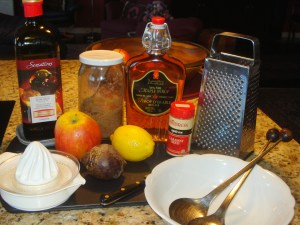
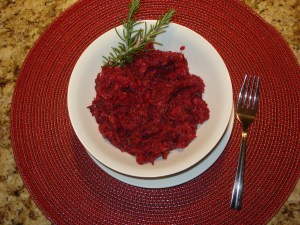
  2. DSC07608Red Beet salad: Again, one medium sized red beet, a much bigger juicy apple, ¼ cup extra virgin olive oil, ½ lemon freshly pressed, 1 large heaped tablespoon of brown sugar or maple syrup, caraway seed if you like it. Mix oil, lemon and sugar/maple syrup/caraway. Grate the apple, stir into the mixture. Grate the beet and mix everything together. It can be eaten right away but I like to let it soak, stir again and then enjoy it. This beet salad is loaded with fiber as well and therefore also aids digestion.
    Enjoy! Red Beet Salad

    Enjoy! Red Beet Salad

    It is considered a “beauty salad” since it has a lot of vitamins good for the skin and sparkling healthy eyes.

  3. Naturally you know how to prepare cooked beets. These are good for you as well but don’t have quite the “health boosting power” of the raw beet salad. When store- bought they usually contain way too much vinegar. When I do them myself I avoid vinegar and use lemon.
  4. The recipe I listed for beet salad can also be used with carrots.

Try the beet recipes, you may be surprised how good and refreshing they taste when prepared the way as above. The work with the preparation is worth the benefits. No side effects!

Remember: “He who has no time to care for his health daily will have to have time to be sick for weeks, months or years.”

“Forget Me Not” – A New Book is Born

Stories – Thoughts and Memories

3-D book coverAnd every single one of those stories, thoughts or memories carry some kind of subliminal message; a fact of life, parts of history, thoughts of previous and present political happenings, psychological insights. All those stories, even a few fairy tales, will entice conversations or discussions around the family table or with friends. Yes, go ahead and talk about it. It is not healthy to keep your thoughts or feelings ‘inside’, especially if they trouble you. I find it liberating to ‘talk about it’. It is surprising how often one just needs a sounding board. I am not always expecting my conversation partner to answer me, to give me advice or set me straight or even discuss my problems. When hearing yourself talking you often find or hear the answer.

Every story is standing on its own and is independent of the others. Some are short, some are longer. Quite a number are stories of unforgettable people, men or women I met along the journey of my life. Could it be that you find yourself in one of those stories? Where it was suitable I added a photograph as well. Many names have been changed to protect the privacy of the characters in the stories.

Somehow this book is a “bridge” between my memoir “We Don’t Talk About That” and the sequel to it, planned to be published in fall 2016. Since the sequel will be dealing with the rollercoaster ride through five decades after my emigration to Canada I decided to tell some of the stories ahead of time. An author is usually restricted to a certain word count to keep a book “manageable”.

“Forget Me Not” comes at the right time of year – Christmas time. It makes a fantastic stocking stuffer. It will make YOU unforgettable to the happy recipient.

PRE-PUBLICATION AVAILABILITY

The book is not yet available to the wider public. To receive a pre-publication copy, a collector’s dream, waiting for the final edit and maybe with the odd extra or missing comma, you may contact me using the form below giving me your name and email address. The cost for the pre-publication copy is $ 20.00CAD plus $4.10 CAD in Canada and $7.00 CAD  postage to the USA..

← Back

Thank you for your response. ✨

Saint Nicholas Day

Children in Europe get very excited on the evening of December 5th. They do something their parents for once don’t have to remind them of:

Shoe shineThey clean their boots and shoes! And polish them until they shine.

Why would they do that? Only on this particular day, December the 5th? It is a tradition. Once upon a time, way back in the fourth century, there was a kind Bishop with the name Nicholas. He was the Bishop of Myra, now called Anatolia in Turkey. He had the gift of bringing children back to life or cure terrible ailments. He loved children. He gave them little gifts or secretly dropped coins into their shoes. After he died on December 6th 346 he was canonized and became a Saint, a Saint to protect the children. The people had revered Bishop Nicholas because he was so kind to their children. They celebrated his life on that day. To keep Bishop Nicholas, who was now Saint Nicholas, ‘alive’ in the minds of their children they would put little gifts or sweets into their cleaned shoes. If the children were unruly or had not been good they would put some dry branches or a stick into their shoe to remind them of a forthcoming punishment from Saint Nicholas. But Bishop Nicholas had never punished the children. The dry branches or the stick were the invention of the parents.

The tradition for children cleaning and polishing their shoes on the evening of December 5th has lived on, especially in Germany, Austria and Poland. Saint Nicholas is known by other names, – in German speaking countries it is Sankt Nikolaus; in Switzerland it is Samichlaus; in the Netherlands it is Sinterklaas and there are many more. The American Santa Claus or the Father Christmas in the UK is derived from the good old Saint Nicholas. For commercial reasons they now turn up at Christmas, Christ’s birthday. He is depicted a little differently in each country where the morning of December 6th is anticipated by the children and they look forward to find something in their shoes. They do what children have done for hundreds of years:

They clean their boots and shoes and put them outside their door. Some children are told to just put one shoe out in order not to look greedy. I can tell you from my own experience that we always put both shoes out to show Saint Nicholas how well we have cleaned them. But it is true there was only something in one of them. I remember, later in life, when I had no small children around and I would slip into my shoes or sometimes even my slippers in front of my bed my toes would touch something unusual: A wrapped delicious piece of chocolate or nougat and the warm rush of surprise would be flooding my body.

Did I believe it was Saint Nicholas who brought it? Yes, naturally. Sometimes I had taken over Saint Nicholas’ deeds and sometimes I think my teenagers had also been hired as helpers. Saint Nicholas’ Day is not replacing Santa Claus at Christmas at all. Not in most countries.

Give it a try. Tell your small children about Saint Nicholas and have them put their cleaned and shined shoes out on the evening of December 5th and enjoy their excitement on the morning of the 6th! It is magic to find something in one of your shoes…especially when you are not anticipating it.

Have Fun!

Interview on CJOB, Winnipeg

Title slide - CJOBI was interviewed today by Greg Mackling of CJOB 680 in Winnipeg. You can hear the interview on YouTube at https://youtu.be/a0gjX3cIAoU

Many thanks to Greg and the staff at CJOB for allowing me this opportunity to talk about “We Don’t Talk About That”

The ‘Beheaded’ Rose

DSC02601Don’t think it is easy for me to tell you this story. It should be one of the chapters of the sequel to my book “We Don’t Talk About That”. It is a little love story but it really isn’t a love story. Read it and decide for yourself what you want to call it.

I met Hannes two months too late. Had we met two months earlier something might have become of it. Maybe. Maybe not. He had such an infectious laugh, such as I had never heard from a man and never did again. I knew he would never do or try something I would not want. He was ‘comfortable’ like an old pair of shoes, more like a brother and I felt at ease when I was with him. I still kept him at arm’s length. Why? There were several reasons. One, I was afraid I could fall in love with him. Two, he was in the middle of a divorce even it was a friendly one. Three, he was from the Rhineland and the Rhinelanders had a reputation for being ‘light weights’, people who didn’t take life too seriously. Fourth, he was Catholic and I was Lutheran, a match my parents would not approve of, even if neither of us were religious church goers. Fifth, I was in love with a little girl in Canada who needed a new mommy. Her father and I had been pen friends for two months and he wanted to marry me. But the main reason was I was afraid, simply afraid that a man who was obsessed with me, who had stalked me for years would be true to his promise to ruin any relationship I would ever have with another man. “If I can’t have you, nobody else will.” I had told Hannes all about it. Hannes listened, talked to me and made me see all sides, he pointed out the pros but mainly the cons about going to Canada. He sounded exactly like my father who thought I had gone totally bananas. “Canada! Marry a man you didn’t know, divorced and with a daughter? Nuts!” The problem was my compassion for that little girl, after seeing the photos with the sad eyes. I just couldn’t get her out of my mind. After I had met the grandparents in Wiesbaden I was lost. They didn’t even give me a chance to back out. I wasn’t strong enough. And I didn’t know I was being manipulated. The word did not exist in my vocabulary or my thinking.

Hannes became my best friend. He helped me plan my emigration. We went to the zoo in Hamburg, to a fabulous Indian Restaurant and sampled the “Indian Rice Table” with 23 little bowls containing different delectable types of food. We visited the “Pferdestall” a famous kind of pub/bar in an original horse barn. We attended “A Midsummer Night’s Dream” on the stage under the stars in the Herrenhäuser Gardens in Hanover.  Until I started to get very involved with my Canadian penfriend and his parents and sadly, my friendship with Hannes somehow tapered out. It was the end of a time with lots of laughter for me but I didn’t realize it until much, much later. When I was living in Winnipeg in Canada I got terribly homesick. I wrote to Hannes telling him about my life. He was married to a lady he had seen in the theater. He wrote “I had noticed her legs and they reminded me of you.” He had approached her during intermission, they had a glass of champagne and the rest is history. Hannes and I remained in contact.

It was a few years later when I visited Germany again. I had arranged a meeting with the last company I worked for since I wanted to import their skin care line to Canada. I had been instrumental in developing a number of the creams. Before flying home I planned to visit my sister in Hamburg and since Hannes lived there he picked me up at the train station. He handed me a beautiful long stemmed dark red ‘Baccara Rose’. We walked across the busy plaza in front of the station to his parked car. After he put my suitcase in the trunk he opened the door for me. We both were a bit shy, not yet at ease as we had been during the two months in the past when we had laughed a lot. I held the rose and my purse with one hand, trying to arrange my fancy coat which had a split in the back so the two sides could be lifted and you would not sit on it. I changed the flower from my left to me right hand and arranged the coat around me with the other. Finally I was seated with both coat tails on my lap. Hannes asked “is everything in now?” We looked at each other when I replied, “yes everything is in”. He closed the door and walked around the car to his side. As he was inserting the car key I noticed I had only the stem of the rose in my hand. I felt the shock right down into my tummy:

“Hannes, look” I whispered with a tiny voice. Hannes grabbed his steering wheel, put his head on his arms and slowly, quietly said “Just like us. It’s our story. A beheaded love story, a beheaded rose. I should have seen the rose wasn’t in when I closed the door. Should we stop by a flower shop and I buy you a new one?”

We decided against it. After a while driving along Hannes started to laugh. His Rhineland humour had taken over and he thought the whole episode was really very funny. I was sorry to have lost the beautiful flower head but I saw the weird humour in it as well. Actually, because of the accident, – I never forgot the rose.


Nobody ever expected this

“Yesterday had been a day like all the other days during the last year and a half since the Russians invaded Germany. Everybody working at Junkers Aero Space, a former Nazi company researching and building aero planes in Dessau, was doing their job. It was incredible that the Soviet Government did not stop operations after their occupation but had the plant rebuilt, kept the work force and even expanded it. It was a direct violation of the Yalta agreement stating that Germany was not allowed to produce armaments. “

A reader of my book “We Don’t Talk About That” had sent me an e-mail asking if we might be able to meet. She and her brother lived about 30 km away, so we met halfway in a small café. The story they had to tell was shocking news to my ears. I never had read or heard about it.

At the end of WWII the technological achievements of Germany during the war proved a challenge and an opportunity for the two new world powers, the USA and the Soviet Union. Germany had excelled in futuristic technologies, especially in the area of aerospace. Both powers were quick to gather the top German scientists and engineers and relocate them to their countries. Wernher von Braun was the best known scientist taken to the USA to support their rocket program. The story of Junkers Aerospace was virtually unpublicized, the company being located in the eastern part of Germany. Junkers had been the most advanced aircraft manufacturer worldwide at the end of WWII with such concepts as the “discovery of the area rule, operation of jet engines on its aircraft, cabin pressurisation and designs involving forward swept wings.” With the cold war looming and the arms race both powers tried to outdo the other in the aftermath of WWII.

I could hardly believe it when my guests told me that Junkers had been rebuilt and, at the end of June 1946 employed 3.325 people sworn to strict secrecy, a slip of the tongue punishable by death. Their father was one of those workers. They themselves were small children. The German employees lived in the small city built around the plant tightly controlled by the Soviets. Nobody had ever expected a re-location of this huge company to the Soviet Union. But, all equipment and personnel of Junkers was to be re-located. At its peak 4.000 Soviet secret service and military personnel were involved in the planning and execution of the plan. Re-location plans were talked about when an airplane built there could not be tested because the runway was too short. But it never occurred to the employees and unbeknownst to them the plane was shipped to Russia. It was the start of something traumatic.

With not even a hint on the morning of the 22nd October 1946, more than a year after the invasion, hard knocks on every house door woke the occupants. Military trucks were standing ready to be loaded with whatever every family decided to take with them as they were told of a re-location. Trains were waiting at the station. They did not have much time to plan or pack, – just get ready. They also had no idea where their final destination was. After a very long uncomfortable journey they had arrived at a small village built of simple “Finnish” prefab houses about 100 kilometers from Moscow. The village even had a German church, a German school and some small shops. Their father’s job as an engineer had been an important one in Germany as well as it was now in Russia. Some families had asked to leave their families in Germany but the appeal was ignored and not answered.

These two people, sitting with me at a small table drinking coffee, told me the story of their life in Russia. They were small children, three and five years old, they went to school in Russia, learned what it meant “not to talk about it”, referring to topics talked about at home. Incredible hardships, one of the worst being the Russian winters and living in a very cold and drafty house were part of their daily life. The Germans were teaching Russian employees all they knew and in many cases a certain comradery developed between them.

Seven years later talk about going “home” started to circulate. Little by little certain families were picked up and left town but their turn had not come yet. Another year went by and finally the family could go home but the father still had to stay. They sold almost all of their possessions hoping to start fresh in a new Germany. They knew two Germanys had been established, the German Democratic Republic (DDR) and the BDR, the western part. The family was relocated to East Berlin and the Mother tried to re-establish old connections. She soon realized that she would like to be in West Germany. A job offer for her husband by a Mannheim company would be available once he returned from Russia.

My two guests told me that it wasn’t all “just bad”. The total re-location of people and workplace had created a German island in Russia. Close friendships were established, neighbours helping neighbours, entertainment was ‘home made’ and the shortage of almost everything led to creativity and do it yourself projects. More children were born there and considered this place their home. A number of people had married a Russian and did not want to go back to Germany. However, now, many years after the deportation and living in Russia for eight years, people have gone back to visit remaining friends and see the further development of their little village into a town and come back with stories about the incredible hospitality they have experienced. Many of these former special workers are now living all over the world and the older generation starts to thin out. The connections between these people having lived in Russia against their will is incredibly strong and after fifty years the first and now more regular anniversary reunions have been organized where it all started: In Dessau, Germany.

There still are so many untold stories out there, seventy-five years after the horrible war. It is so hard to believe that soldiers, people, children had no say in what happened to them, they were moved by cruel hands like chess figures. There is so much we still don’t know.

Remember: Lest we forget.

Interview for VIU Elder College Lecture

EscapeI was interviewed by Gregor Craigie from the On The Island program on CBC Radio One this morning. The interview is reproduced in this YouTube video: https://youtu.be/ax9-0rcdSbk

The lecture takes place at 10:00 a.m. on Nov 7th at the Nanaimo campus of VIU.and is entitled “My Escape from Germany after WWII”.For details see: https://www2.viu.ca/eldercollege/courses.asp#sss

Part 3 – “The Water Doctor”

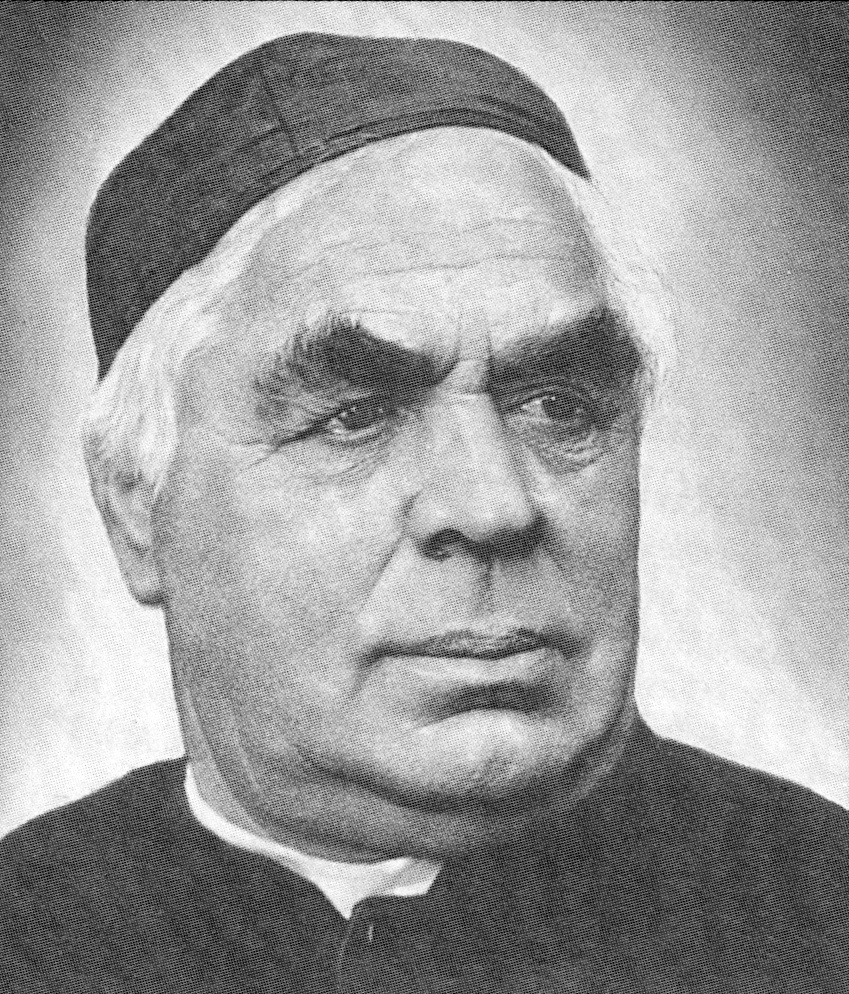
Father Kneipp

The water doctor

Sebastian Kneipp was by no means the inventor or the first one to use ‘water’ for healing. The Persians used water therapy 5000 years ago, the Romans did several hundred years ago followed by a decline caused by an outbreak of venereal diseases. (Too many unwashed bodies sitting in the same pool) Two medical doctors, Father Siegmund and son Johann Siegmund Hahn are credited with bringing the idea of using water to improve health back to life in the very early 18th century. The little book “The Effect of Water unto and into the Human Body” (loosely translated) was the next BIG step in the developing water therapy. Before S. Kneipp discovered this book and used its recommendations, got well and is now known as “The Water Doctor” several other personalities using their own form of water therapy need to be mentioned.

A farmer’s son, Vincent Priessnitz in Austria with similar experiences as the later living Kneipp. Johann Schroth, who developed the “Schroth Kur” involving some water therapy, extreme fasting with very light vegetarian food, walking and interesting ‘dry’ and ‘wet’ drinking days. The ‘wet’ days starting with a glass of light wine. This “Kur” is still offered in Oberstaufen, Bavaria and people from far and wide attend. Another, a very sick man coming from USA was Benedict Lust who spent time with Father Kneipp as well as attending the Oberstaufen Kur, got well and started the “natural healing movement” in America. He studied medicine and became one of the founders of modern Naturopathy on his continent. There were a number of others, especially in the UK, who contributed to the development.

Father Kneipp started out with just cold water. He insisted to get warmed up before any treatment through wood splitting or fast walking and having a bed rest covered in blankets after the treatment to induce the body to heat up and sweat out the disease causing impurities. The rule is “no cold treatment on a cold body.” To go back to bed for up to an hour after any prescribed water treatment is still followed to this day. The reason is to get the body to respond, create warmth and thereby also affect the immune system. During the last twenty years of his life (he died 1897) Father Kneipp gradually changed his approach. As he saw not just tough hard working men but more and more aristocrats, weaklings in his estimation who had to be ‘built up’ he came from cold water to alternate and from full body immersion or ablutions to partial body treatments and warned ‘no two treatments on different body parts one after the other.’ So if the legs were treated in the morning you did not get a treatment for the arms or the upper body until the afternoon. There should be at least three hours between applications. For physiologic reasons the medical profession confirmed the wisdom of it, once they got involved.

“I bequest my system to the medical profession with the challenge to keep it, improve it but mostly, make it accessible to all.” That was written in his testament. Over the years following his death there were disagreements between the Brotherhoods who had received his sanatoria and different doctors. After WWI wounded and recovering soldiers were sent to Wörishofen for rehabilitation. During the time of the Great Depression until after WWII there was a decline but the flood of wounded soldiers during and after WWII caused a resurgence of the “Water Cure”. A few years after the West German Republic was founded and life had stabilized, the German Insurance companies paid for a “Kneipp-Kur” for their members when prescribed by a medical doctor. It proved less expensive than other methods of rehabilitation. In the nineteen-eighties the Insurance companies even started to build their own sanatoria. The Austrian Government approved a study with 15.000 people led by trained Kneipp-Doctors which proved without a doubt that the group treated with conventional PLUS Kneipp treatments recovered much faster than the group treated the old way and reduced the health care cost by three times.

An International Kneipp Organisation and a Kneipp Doctors Association were founded before Kneipp died and they encompass now thousands of people worldwide. You’ll find Kneipp groups in almost every German town and in most of Austria, Switzerland and other European countries as well as Africa. More than anywhere else Kneipp Spa sanatoria are all over Germany, often the treatments combined with climatic or terrain cures. The full “Kur” consisting of three or four weeks, requires one to be under medical supervision, and now rests on five pillars:

  1. Water: Treatments consisting of all forms of water: Cold, warm, alternate, steam; full body treatments or partial treatments with water from washings, immersions, ablutions, packs, body wraps partial or full treatments according to the health issues diagnosed and prescribed by a certified Kneipp doctor. They are administered by a certified Kneipp Therapist.
  2. Herbs: The use of the healing power of herbs inside and out. Herbal infusions or extractions in all bath treatments.
  3. Food: Simple, healthy, wholesome nutritional food, diet if doctor recommended. Herbal teas although Kneipp also allows a wheat beer on occasion. At this point I would like to mention that Kneipp was the first to collect and catalogue herbs and healing plants which became the base for what we now know as “Naturopathy” and “Homeopathy.” Another man very much involved in this development was Kneipp’s former patient, Benedict Lust from America who is the “Father of Naturopathy” in USA.
  4. Exercise: Active and passive exercise. All forms of exercise from yoga to walking, biking and everything in between. Passive exercise consists of all forms of massage used to increase circulation.
  5. Emotional and spiritual balance: Kneipp said: “In all my years of treating people I have never found any healing taking place until emotional and spiritual balance was restored.”

                 “DO NOT FORGET YOUR SOUL”

Very refreshing water stepping

Very refreshing water stepping

The easiest water treatments are the ‘water stepping’ and the cold ‘arm bath’. All Kneipp Spa cities and most Kneipp Groups in villages and towns have established water stepping sites along their hiking and walking trails in forests, meadows, and many resting places in parks. After a good hike the water stepping is very refreshing and surely will avoid swollen and tired legs. The water usually comes from a stream and is quite cold. You walk through the basin two or three times like a stork, lifting the leg out of the water for an exchange of air-water, air-water until the cold “bites”. Now it’s time to get out and walk on the adjacent lawn until your feet are dry and starting to get warm; sit down on a bench and put socks and shoes back on. Just use your fingers to rub the place between the toes dry to avoid the moist warm spots that fungus likes.
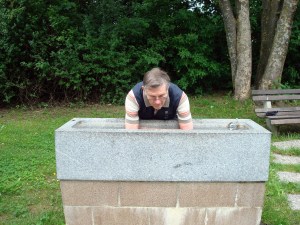
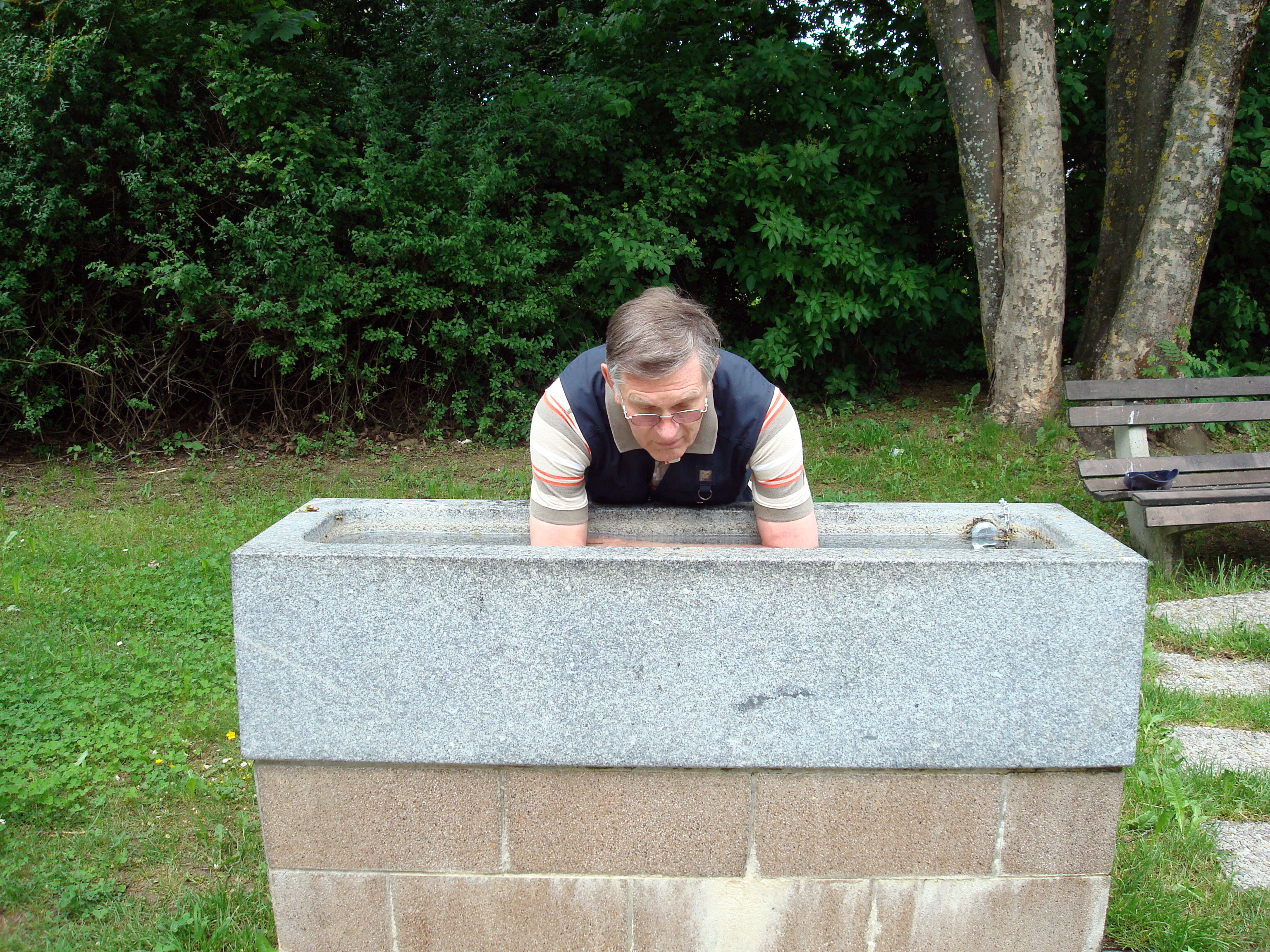
Arm bath after a long bike ride

Arm bath after a long bike ride

Usually next to the stepping basin is also an arm bath trough. A sign tells you NEVER do both, the stepping and the arm bath. Many people prefer the stepping for the incredible feeling of wellbeing. The arm bath feels refreshing as well, it especially clears your head, lifts your mood, and in general is good for your heart, lungs, brain. Take a deep breath before you dip your right arm in first, followed by the left and   e-x-h-a-l-e   deeply. Now breathe normally. Count to about twenty or thirty or wait until the cold ‘bites’. Lift the arms out, stroke the water off with your hands and swing the arms until dry while walking around on the nice lawn next to the stepping basin. Make sure the hands and arms get warm again. It feels good to wear a long sleeved shirt or something of that nature after the bath.

In both cases, water stepping or arm bath, – do not use a towel to dry the skin! Stroking the water drops off and letting the air dry you, is the water doctor’s prescription! By the way, you can do water stepping in your bath tub and a cold arm bath in your sink at home.

my first bookFor detailed advice on how to use water for healing at home, order my inexpensive booklet with photos from: https://giselleroeder.com/bookstore/ or send me a message on my FB page https://www.facebook.com/WeDontTalkAboutThat since I still have a few copies for the special price of $7.00 plus (approximately) $4.00 postage.
Part 2 – “The Water Doctor”

1-image0

Early Sanitoria in Woerishofen

Can you imagine the triumphant reception when Father Kneipp returned from Rome to his small little village? Not excommunicated, but praised by the Pope? The simple folks at home had trouble pronouncing and calling him ‘Monsignor’ – but he just laughed and said ‘don’t even try, I am what I always was, your ‘Father Kneipp’. He had been sent to Wörishofen by the Archbishop to hide him away, to get him away from the ‘water splashing’ and just be the Father Confessor to the nuns of the existing convent in a small village in the middle of nowhere. These nuns were mainly second and third daughters of rich aristocrats who couldn’t be “married off “, a privilege reserved just for first born babies, sons to inherit and daughters to marry other heirs. The nuns had spent their days singing and praying and were shocked when Father Kneipp told them “Ora et Labora” – pray and work, because work is a form of praying. He ordered them to tend the overgrown gardens, plant and harvest vegetables for the convent’s dinner table and establish an herb garden. They had to perform kitchen duties and clean their own quarters. Tears and complaints about ruining their soft white hands in dirt and sun did not result in suspension from work; pretending to be sick or having a sore back resulted in being treated with water.

The convent was close to bankruptcy despite owning fast stretches of land, meadows and acreages, forests and streams. Father Kneipp found the acreages and meadows were “sour” but knew the farmers would not accept his advice, the advice of a priest, who knew how to change it. Therefore he invented “Fritz” and wrote booklets about “Fritz, the successful Farmer”, “Fritz the Bee Keeper” and several others. The advice was followed and the land became rich and fruitful, the farmers were happy and the convent thrived with “Fritz’s” help.

Despite his book “My Water Cure” to keep them away, health seekers and especially poor people kept coming. The laundry room of the convent became the first treatment center. The odd items used in this “Wash House” are displayed in a specially built hut at the ‘Promenade” in what is now ‘Bad Wörishofen’. Several nuns and handpicked men became helpers and the first therapists. A few curious doctors asked permission to attend Father Kneipp’s hour of seeing people and hoped ‘to trip’ him. The deep knowledge of the human condition and his uncanny right diagnosis, but especially his healing success puzzled them. Some stayed on to learn, others went home all over Europe to start their own ‘Kneipp Spa’. An ever increasing stream of visitors with no accommodations aside from hay barns enticed entrepreneurs to start building hotels, guest houses and restaurants. Kneipp had written more books. He used the royalties and the donations freely given by the wealthy to build two sanatoria, the “Sebastianeum” and the “Kneippianum” and a wonderful “Children’s Hospital” where a mother or father could stay with their sick child until ‘cured’. Kneipp, once upon a time a very poor boy, was now considered “rich” but in truth he did not own anything. He donated those buildings to different catholic brotherhoods (i.e. the Benedictines) to run and take care of other health seeking brothers. There is a rumor the “Sebastianeum” was empty on many nights – and since one entrepreneur had built a hotel for nuns close by that’s where the brothers could be found… Don’t take my word for it! The Children’s Hospital was given to a convent and run by nuns.

Presnt Promenade Bad Woerishofen

Promenade Bad Woerishofen

I have stayed in the now, available for both sexes, “Sebastianeum” (168 beds) several times. I always felt close to Father Kneipp as all his advice and his teachings are followed there. I consider him to be one of my spiritual fathers. The “Kneippianum”, still run by nuns today, was developed into a highly specialized clinic for heart disease, employs the best doctors; it owns all the diagnostic machines and tools to diagnose and treat patients scientifically, always complemented by Kneipp therapy.

Let’s go back to Kneipp’s history. He saw up to 200 patients a day. He treated everybody the same, calling them by their first name, rich and poor. He ordered everybody to go barefoot and split wood for exercise, including the Archduke of Austria as well as the Maharadsha with forty attendants from India. Kneipp invented the sandal to give the feet the much needed ‘air’. He visited the Children’s Hospital daily. He fulfilled his duties in the convent as Father Confessor for the nuns as well as his duties when he was voted in as the village priest. He was always available for the farmers who now trusted his wisdom about agriculture. He was called to many surrounding villages to treat or spiritually help the ones who could not come to him. He held daily lectures in an open area about the different aspects of health, often attended by up to 5.000 people. Pearls of wisdom about each aspect he was ranting and raving about made it into our day:

“Fresse and saufe wollet se all” = you all want to eat and drink like pigs but nobody wants to die. When you feel you have eaten you have already eaten too much.”

2-image0-001

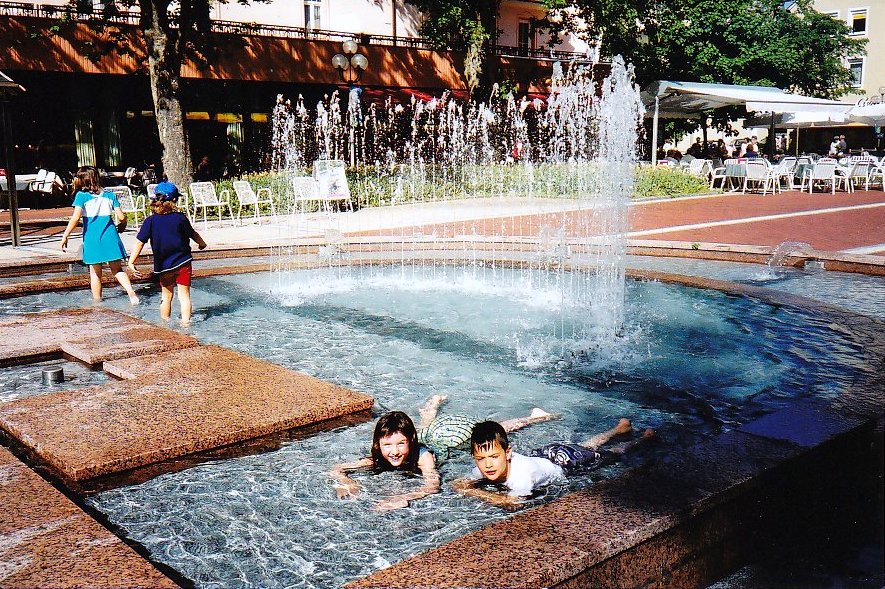
Bad Woerishofen has many fountains – kids love them!

Part 3 will deal with his treatment system as it was developed and used to this day.

German Unification Day

Tree re-unitedThe People of Germany have a special cause for celebration today! It’s their “Unification Day”. East and West Germany were two countries since the close of WWII. They were united in 1989 and are happy to be “ONE COUNTRY” again. For me, having lived through WWII and seen the total devastation but emigrated to Canada in 1963, it is absolutely amazing what and how much the people of Germany have achieved. From saving and cleaning each brick from the rubble their cities were, rebuilding totally destroyed ones and now enjoying one of the highest living standards in the world. My sister tells me not to be blinded by the luxuries visible because despite all, there are many pensioners and  unemployed who have trouble making ends meet with the high cost of living and expensive rents. And still, the country is a strong pillar in the European Union, maybe even the strongest.

When I saw the photo of this tree this morning, placed by someone on Facebook, I couldn’t help but think of the divided Germany and the long years it took to grow together again. Just as the tree shows the healthy growth on top of the united two halves, so does Germany. Let’s hope the roots are strong enough to hold up the ever growing ‘crown’.  For me, – the 5th of October is also worthy of memory. It was the day I escaped East Germany. To this day my heart beats faster just thinking about it. Hundreds of thousands escaped to the ‘Golden West’ risking life and limb. Finally, they built “the wall” to keep their people ‘in’, not to keep unwanted people ‘out’.

For you, who want to know more about the history and rebuilding of Germany since WWI, through WWII and the after effects without reading large history books pick up my compelling book “We Don’t Talk About That” with the compressed political background easy to understand and, as some readers say “understand for the first time” why and how it all happened. The story you’ll read is one of an ordinary German family which stands for thousands of others who lived through the same trials and tribulations but to this day ‘don’t want to talk about that’.

German flagThe Germans have a very good reason to celebrate their special day. Nobody, absolutely nobody, ever expected it to happen; to be able to climb, dance on or hack at, scrape and tear down the Berlin Wall, without any shots fired, without another war happening.

TO BE UNITED AND BE ONE WONDERFUL COUNTRY AGAIN…