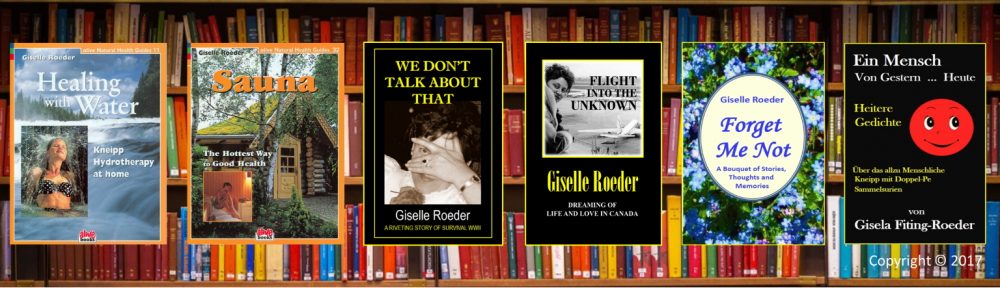
I’ve read the book and I would say that it’s so hard to put down once you start reading it, you seem to be able to see and hear and get to know all the people (not characters as they are real people) you laugh with them and cry with them, you can imagine the pain the heartache, I could go on but when you read the book you will understand what I personally experienced while reading “WE DON’T TALK ABOUT THAT,” I’ve read a lot of books but have never felt so many emotions as I did while reading this book
Tag Archives: World War II
Memories of little Gila, a brief history lesson:
The first of the “Nine Lives of Gila” – see “We Don’t Talk About That”:
 Gila lived her first 30 years in three Germanys. She can’t remember her first 3 or 4 years, but she knows what happened. Hitler took over in 1933 because he promised work and bread for the starving population. Criminals caused brawls and a lot of unrest in the big cities. Hitler told his friend Roehm to establish a new kind of army; therefore, in 1934, he created the SA, also known as the Brownshirts or Stormtroopers, to get the ‘Riff-Ruff’ off the streets. The SA developed into a new army over time. Hitler had his friend Roehm killed because he became too strong. An old general, who fought in WWI explained: “Peace? Peace is just an interlude between wars.” Hitler applied to have the Olympics in 1936 in Germany and, in his usual style, screamed: “We will show the world a recovered Germany!”
To instill pride in their history and their country again, the ‘Hitler Youth’ came into being. Hitler commanded: “I want our young people as swift as Greyhounds, tough as leather, and hard as Krupp steel.”
To entice the Germans to have more children, a “Mother’s Cross” was awarded for mothers of many children. After the fifth child, Adolf Hitler was their Godfather.
Little Gila learnt early on in her life, “not to talk about anything said at home.” Her father allowed her to listen with him to Churchill’s speeches every night on the UK radio.
 The ‘Brownshirts’ had been mostly bad boys, and they had no problem killing people. Everybody was scared of them. Rowdy groups in big cities started defacing and smashing shop windows of Jewish owners. Jews disappeared; they were either captured or took a chance to flee. The infamous ‘Crystal Night’ in Berlin was the height of the criminal acts, and the police lost power. Anybody speaking out against it, hiding or helping Jewish friends or had communistic ideas went to the new ‘Concentration Camps.’ These were not only populated by Jews, as is a common belief.
Mentally or physically disabled people were picked up and brought to special sanatoria. Relatives were told they would be looked after – but they were put to sleep.
A hardly known fact: Unwed pregnant girls, shunned by their families, could apply to be taken into ‘special’ homes. Their babies were placed with Nazi couples right after birth. The mothers had no say in it, even if they expressed their desire to keep their child. Or they would be told the baby died during birth.
Hitler wanted to breed an “Aryan race” – tall, blond-blue-eyed people. Goodlooking blond and blue-eyed girls were enticed or ordered to go to exclusive homes, and tall, blond and blue-eyed Nazi officers would ‘father’ their babies.
Such was the background created by the Fuehrer to ‘clean up’ devastated Germany and build a 1000-year Reich.
Then there were whispers of war. The invasion of Poland in September 1939 was the beginning of a horrible war. The Brownshirts came and confiscated Gila’s horse, Lotti. When she was told ‘the Fuehrer needs it,’ she asked the officer: “Can’t he take another horse?”
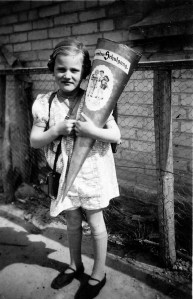
My first day at school
Gila started school right after Easter 1940. As was a German tradition, she looked forward to receiving the “Schultuete”, – the ‘Horn of Plenty.’ Sadly, there wasn’t much in it. No chocolate, just some apples from last fall and a package of candies.
Gila’s first train ride was a trip to Stettin in 1941 to visit her Grandmother’s brother and his wife. They visited the harbour, and many ships were waiting to leave. Gila’s uncle had Jewish friends, and they were able to get on the last ship sailing to America, but no children were allowed. Their son Gerhard stayed with Gila’s aunt and uncle. Sadly, that ship was torpedoed and sank. Gerhard grew up with them and was later declared their son after the war. No problem, all papers were lost due to the eviction in 1945 by the Polish army.
From her home, Gila could always hear the bombers flying to Berlin. She and her family would hide in the ditch of a field and watch the fire in the sky after dropping their deadly cargo over Berlin. Black-out curtains had to be in place. Older men unfit for war became the “Homefront” to keep an eye on everybody. The Hitler Youth kept an eye on the old guys. Nobody knew who an informer was.
1943 – Gila’s father was conscripted into the army. Ration cards limited food supplies, causing a black market. Aunt Anna came from Berlin asking for ‘cow shit” to grow tomatoes on her balcony.
July 20, 1944 – there was another attack on Hitler. Again, like many times before, he was not killed. Seven thousand people, Hitler called them conspirators, were shot; women, children, relatives, whole families were wiped out.
At the end of January 1945, Gila’s teacher told the children the school was to be closed to become a field hospital as many wounded expected. Only 5 kilometres away, the mighty Russians were fighting the last of the German army. When the Russians invaded Gila’s village on February 4th, 1945, she watched but lived through their atrocities, rape and murder. Gila’s childhood was over when she was only eleven years old.
It was the end of Adolf Hitler’s 1000 year Reich.
Conundrum: COVID19 and Books
I’m telling you nothing new regarding the rules about ‘Stay home. Wash your hands.’ These are the two that have been in my thoughts every single hour of every single day for the last two months. I even dream about it. Staying home has never been a problem for me. I have been so busy writing the long-awaited sequel to my book “We Don’t Talk About That.” When this ‘house arrest’ order came, I thought, “Now is the time to finish “Flight Into The Unknown.” Now I have the time! Well, my friends, I always had the time, but I was procrastinating. Now I had no reason to wait.
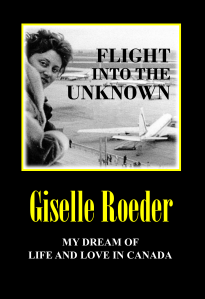 My problem was I had too much material. The “Flight Into The Unknown” would have been overbooked, overloaded with too many stories, too much baggage. What to leave out? Many months ago, Lyn Alexander, my editor, had suggested making my memoir into a series. “Series are in,” she had told me. “Divide what you have in this ‘Flight’ manuscript and write a third book.” I was fighting it.
“I don’t want to write a third book!”
During COVID lockdown, I finished book # 2 at a perfect place. There was no way I could avoid writing a third book. My final thought was, “it’s time to set sail for life after 50.” And it became the title for book # 3, the last book in my memoir series “The Nine Lives of Gila.” Did I have nine lives? Probably more, but cats were on my mind. Cats are supposed to have nine lives. And I had lived through and survived frightening  experiences just like a cat.
COVID influenced me to create the following series, “The Nine Lives of Gila.”
Book 1: “We Don’t Talk About That,” the amazing story of survival WWII and its aftermath.
Book 2: “Flight Into The Unknown,” smartly manipulated into marrying an unknown penfriend and emigrate to Canada.
Book 3: “Set Sail for Life After 50.” Realizing that age is just a number, I saw the world as my oyster.
The first two books are available as e-books and printed books on all well-known internet outlets. Expect book #3 to make an appearance in September 2020. E-books are no problem, but COVID is at fault that Canadians only have limited access to get the printed versions from Amazon.ca – I haven’t even seen my own “Flight” in print. The ‘powers that be’ have closed the borders for large shipments of books printed in the USA. Book shops & libraries are closed. When is the restriction lifted? No idea. It depends on how COVID develops. Books are not essential!
What? Not essential? Books are very essential for locked-down people. It’s helpful to read, to avoid going crazy, to immerse ourselves in reading stories of another life.
Book Review – Cyanide In My Shoe
Scary, eh?
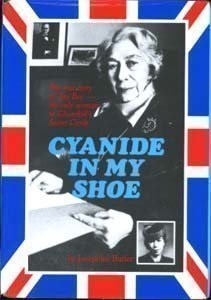 I just finished reading the book with this title by Josephine Butler. She was one of the ‘chosen’ people for a ‘Secret Circle’ of Winston Churchill, her being the only woman. She never met or knew the other members, but had many meetings with the Prime Minister himself, always in secret. She had no idea why what and how dangerous the work was going to be that she was asked to do. Since she grew up, went to school, and even studied in France, she spoke the language like a native. Therefore, she was frequently sent to France after it had capitulated to the Nazis. She was dropped off or had to jump out of a Lysander two-seater plane in remote areas. She still had friends in Paris and other cities of the country, and these helped her to build up resistance cells under life-threatening circumstances.
Occasionally, while reading of her ‘adventures,’ my hair stood on edge, other times, I realized I had stopped breathing. What this woman’s life during the years between 1938 and 1945 was like, deprives every description. Furthermore, what the French people had to endure under the Nazi occupation makes you realize the danger of a repeat if you follow present-day politics. Winston Churchill referred to her as ‘Jay Bee’ during those years, and once commented to someone who had asked why a woman: “95% brain, 5% sex.” When she learnt of it and had a chance, she told the Prime Minister: “I have just as much sex as any woman, given the right place and time.” To which he replied with a twinkle in his eyes, “Let me know about it” – or something to that extent.
When WW II was over, Churchill asked her to take an assignment in Germany, but she declined. She wanted to stay in the country and see things grow. She asked him to allow her to write a book about her experiences someday. “Wait at least twenty years,” he told her. “Do not write fiction, or nonfiction or near fiction, write only the truth. Be careful not to mention names of buildings, or people, unless it is to their benefit.” She waited even longer. She had written a manuscript “Churchill’s Secret Agent” in 1983, on which she based her book “Cyanide In My Shoe.” It was first published in 1991.
I had written the book “We Don’t Talk About That” about my family’s experiences during WW II, how ordinary German people reacted to the Nazis, and then, finally going through the ordeal with the Russian invasion. Probably very similar to the atrocities committed by the Nazis in France or later, in Poland and Russia. I knew a lot of the history surrounding the Allied powers, eventually joining the war to defeat Germany. Winston Churchill had a hard time to hold them back until they could be sure to end the war with victory. He did not want to grant Germany a “conditional surrender” but was only satisfied with an “unconditional surrender.” I must admit, I learnt more from reading Josephine Butler’s book.
I like to say ‘thank you’ to the friend, who loaned it to me. A real treasure. Yes, the book – and the friend.
Two Sides of WW II
This is a letter I like to share with you written by a Russian writer, a lady who writes books from “the other side” – telling stories of what ‘her people’ endured with the Nazis. She read my memoir, and this is what she had to say:
 Dear Giselle, I read your book, “We Don’t Talk About That.” Was there anything I didn’t know before? Factually, nothing (I touch this subject in my books as well). Emotionally, a lot, overwhelming, goosebumps all over the body most of the time: at some points from horror, at others – from joy there were lovely, loving, and supporting moments with the people you met, with the members of your family, and even some enemies (the kind doctor). It took me some time to gather the courage to write to you because there was an overwhelming feeling – shame and guilt for what my people – Soviets, Russians – made to your people, especially to the women, children, the civil population at large. Reading all these details was devastating to me. Some stories shattered my heart. Many brought me to tears, one of them when your parents reunite after your father returned from Siberia. I’m so glad he had. I’m thankful for your understanding (as I feel it) that the Soviets mirrored what Wehrmacht and SS troops committed in the Soviet Union. Most likely, there were no mass rapes, not with such brutal outbursts at least, but rapes they were. The lives of ordinary people – on all sides – were trampled and destroyed. I’m proud of you, Giselle. Of your battle to survive, of remaining human, supporting, and kind at the time when many broke, of the achievements of your life. I expressed my impression in my review on Amazon. Thank you for your book, which is a rare glimpse at the subject that was taboo for so long.
I checked her name, Marina Osipova, on Amazon.com and found a listing for her book. I read as much as was possible by using the ‘Look Inside’ feature. It is a book I will read.
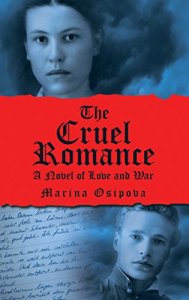 The Cruel Romance tells the story of four young people on their different paths through WWII. The fates of a Russian country girl, a Soviet intelligence officer, a German violinist, and a Russian intellectual are irrevocably intertwined in the war not of their choice, forcing them to navigate the unconscionable moral compromises of life. Who will survive? And, at what price? The story’s conclusion is set in our time.
Revelation of a Time Capsule and More

Stresow Church
Once upon a time, there was a small village in the eastern part of Germany called “Stresow.” A church with a cemetery surrounding it and a pub was built in the center. Those two places were also the centre of any social life of the hard-working farmers. Since women were not allowed in the pub, they would meet after church in the cemetery during their task of taking care of the graves to visit with each other and chat. To this day, the graves are planted with flowers in German cemeteries and each family tries to have the best-looking one.
Many years went by. After WWII in 1945, the states of East Prussia, Silesia, and Pomerania, about one-third of Germany were ceded to Poland. The German inhabitants had ten minutes to get out of their homes where they had lived for generations. My own family was amongst the millions evicted, and so was the family of my cousin Joachim. With only the clothing on our back and with what we could carry, we were three weeks on the road to nowhere, slept in barns when lucky or under the stars. (the full story in my memoir “We Don’t Talk About That”)

I have never been back to my birthplace but my cousin Joachim has. Poland belongs to the EU, and visits are possible. Joachim has been back several times. He only lives about seventy kilometers away while I live on another continent. Joachim made friends with the Polish family who now lives in his father’s house. He had the most incredible experience in 2006. A friend of his Polish friend is a teacher in the neighboring town of Bad Schoenfliess. He is in charge of a museum and was happy to show Joachim two rooms dedicated to the “German Time.” There are photographs of Joachim’s family and his ancestors as well as of my parents and other families we know. Joachim was amazed.
The most significant surprise was a folder he was given with old handwritten documents, letters, and newspapers of the years from 1871 to 1896. They had been contained in a ‘Time Capsule” buried when a new church tower was built in 1896 after the old church tower had collapsed. Nobody could read any of these documents since they were written using the German Süterlin letters. Joachim was able to read them. There was a list of twenty-four farmers living in Stresow in 1871, including Joachim’s great-grandparents. Two pastors serving the small community between 1871 and 1896 had written an account of life during those years. Joachim was able to re-write the most critical documents. Photographs of the old and the new church tower were included in the time capsule.
What an exciting experience for my cousin Joachim!
The same year he had another surprise coming. In 1945, when the family was evicted and had to leave within ten minutes, his grandmother had stuffed one hundred-forty-five photos into his school satchel with a change of underwear. These photos had been picked up out of the mud after the Russian invasion. I had picked ours up from the pile of manure in the middle of our yeard. They represent the only memorabilia of our life from before 1945. During the long walk, Joachim, his grandparents, and his mother had a chance to stay in a house for two nights. Joachim and his two small sisters played with the six-year-old son Robert living there. They looked at the pictures. Joachim’s satchel was forgotten when they left, and his grandma always lamented as long as she lived about the loss of those treasured photos from home. She died and never got over the loss.
Almost sixty-one years later, the ITS, a search service connected to the Red Cross as well as churches, found Joachim’s sister Marianne. She had looked for and listed their dad’s name many years ago. Now, with the Internet, it had been possible for the previous six-year-old Robert, at sixty-seven years old, to find the family who had stayed with them in 1945. Robert had kept the photos in a box in his attic all those years. During a project to add on to his house, he came across it and started searching for the kids he had played with in 1945.
Joachim phoned Robert and made a reservation to visit the next day. The newspaper in Joachim’s hometown got hold of the story, and I have in my hands a copy of the one-third page with a photo of my cousin holding a photograph of himself and his two sisters. A large one at the bottom is of ten men, the artistic biking club with Joachim’s father and uncle in their sports uniform. Needless to say, Joachim in his eighties and the former little Robert in his late sixties, are now close friends.

Former WWI Memorial
Joachim exclaimed when he first related this story to me:
“You cannot pay for something like this. To get your lost treasure back after sixty years is absolutely miraculous.”
Promo: Read an e-Book Week March 4-10
 Three of my books in e-book format are FREE only at Smashwords from March 4th – 10th.
To access the sale follow these links:
We Don’t Talk About That:
https://www.smashwords.com/books/view/734091
Forget Me Not:
https://www.smashwords.com/books/view/608409
Ein Mensch von Gestern:
https://www.smashwords.com/books/view/732607
Review of my Memoir brings Tears to my Eyes
Nikki Landis, a Goodreads author, reviewed my memoir “We Don’t Talk About That: An Amazing Story of Survival”
Her rating: 5 Stars.
Nikki Landis is an award winning author of about a dozen books. She is well known for her “Fight for Light Novels”, “The NightWatchers Saga” and the “Freedom Fighters Series”. In 2017 she was the proud recipient of the IPPY Gold Star for her latest book “Refugee Road”. I have just started to read it and am fascinated.
Nikki is not only a prolific writer, she also reads more than anyone I know, and reviews all the books on Goodreads. Plus, she is a wife and the mother of five boys (7 years to 18!) and works full time. How does she do it? Do her days have more than 24 hours? Oh, I forgot – the night also has 12! Funny! Thank you, Nikki, from all my heart.
Read Nikki Landis’s review:
Read in Aug 2017
Some stories must be told, no matter how disturbing, horrible, or unbelievable they may seem. Some truths devastate because you can’t imagine how they are possibly true. You DON’T WANT them to be true. How can such brutality exist? How can one individual possibly survive after so much horror? How much can the human spirit endure and bounce back from the brink of destruction and continue on?
This book, I think, is probably one of the most emotional and life changing stories I have ever read. It truly touched my soul. I have the utmost respect for the author and her courage, bravery, and willingness to step forward and tell the truth about the shocking and brutal events of her life. She is, WAS, a victim. Her family were victims. Her friends and neighbors. In fact, many German women were and yet they survived. They pushed forward. They endured the despicable and impossible, and they persevered.
This book is not an easy read. I had to stop often, take a breath or break, and come back to the story. Over several days I read and witnessed the horrific events that changed a nation and destroyed a country. As an American woman in 2017, what do I truly know of suffering? What do I know of survival, fighting with everything I have in order to make it through each day? What do I know of living in fear for my life or waiting for the next man to knock on my door, ordering me to disrobe? What do I know of losing all that I own, of being displaced without a home or country, and losing everything, including the people I love? What do I know of starvation?
The answer is simple. I do not. But by reading this story, I have an idea. My heart just aches. I’m devastated. I cannot imagine enduring for even one day what the author and these other women endured for months, years of their lives. How did they go on? How did they later marry and have families? How did not lose their very soul to such inhumane acts?
The story does not end there. The author takes us on a journey of self-discovery and the search for freedom. I found myself cheering her on throughout the book, hoping that she would finally find peace, love, and happiness. I don’t think you can give away spoilers in a novel like this. It’s a true account of suffering and perseverance, of losing everything and finding what truly matters, and because of that, I am happy to say I think the author found what she was looking for in the end.
Chronicling the first thirty or so years of her life, the author lays out life in the 1940’s and 50’s and her youth, her family, and life before the war. Once the war starts, it’s a shocking read. Be warned, this novel tells the brutal truth and is in parts almost too much, but only because of content. The way in which the books is written, in a narrative that feels like you are listening to a close friend, is the only way to get through the stories.
There is a lot of wonderful historical detail from life back in that era, landmarks, cities, geography, and much information about the war and its effects on the German people. For me this is one of the most interesting parts of the book. You hear much growing up about World War II and its effects on the world, the atrocity of so many lives lost, the hatred of the Jewish people, but I don’t think I can recollect much learning in school about the German people and their struggles. It’s wrong. We can’t forget as a society what happened. We can’t condone what happened. We can’t let it happen again.
WE CAN’T FORGET.
Stories like this must be told and published. They must be shared. They need to be read. What hope do we have for humanity if we forget, if the dust covers the words of these atrocities and God forbid, history tries to repeat itself? No, we can’t let that happen. And the author is right to share this story, to talk about what happened, and to ensure her words are written down for all eternity. In her own words, no embellishment, she describes the gritty and grueling aspects of her life from start to finish. There’s no other way the story could be written.
I have a much better understanding of history now. Such experiences must mark a person for life. This is a memoir I would recommend to everyone, but especially I will recommend to the women I know. It’s an emotional, courageous, and extraordinary story that MUST BE READ. I highly recommend purchasing this book and owning a copy for yourself. “We Don’t Talk About That” is truly an amazing story of survival.
Mentally overfed but feeling undernourished
Is there just too much information fed to us by the media? I think they have a dilemma too: Too much and too many serious things are going on in the world. Syria, Iran, North Korea, England, Russia and last but not least the USA keeps us breathless and, in many cases even frightened. Hardly a day goes by when we do not get upset over a new announcement, and it hardly ever is about something we would emotionally get involved in: some good happenings in our own backyard.
 I don’t want to add to it. I am just a person who, after writing the memoir “We Don’t Talk About That” – the years growing up under the Nazis, and then later under the Communist Regime in East Germany – who really is OVEFED but UNDERNOURISHED by the present political situation. I would like to stick my head in the sand and write another book, a happy one! But that is dangerous and surely not advisable.
Talk about a happy book! It was on a flight from Hawaii to Canada when I got chatting with the stewardesses in their Business Class galley kitchen. Naturally the talk included the question “what do you do…” and my writing career came up. There was a time when “I did not talk about that” – but now, finding a willing ear to listen, I can’t shut up. One of the ladies was very keen on my title “We Don’t Talk About That”. She had serious questions. Later, she went on to tell me about her aunt who had written a similar book, “Prague Winter” – and highly recommended I read it. I Googled it, found it, read it, and was amazed when I found out a lot of information about the writer: Madeleine Albright. I was not familiar with her name.
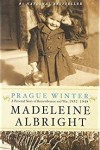 Madeleine Albright was the first woman ever nominated and accepted to become the Secretary of State in 1993. Wow! What a story! From the little Czech girl in “Prague Winter” to making history for women. What an intelligent person! She has written a number of books. One paragraph in the book I read resonated with me so strongly that I absolutely must share it with you:
“In the end, no one who lived through the years of 1937 to 1948 was a stranger to profound sadness. Millions of innocents did not survive, and their deaths must never be forgotten. Today, we lack the power to reclaim lives, but we have a duty to learn all that we can about what happened and why – not to judge with the benefit of hindsight but to prevent the worst of that history from playing out again.”
 True words! So, my dear readers and followers, we are NOT TO STICK OUR HEADS INTO THE SAND. Let’s open our eyes; a lot of what has happened back then, what I have written about in “We Don’t Talk About That” and Madeleine Albright in “Prague Winter”, is happening again and there are a lot of signs that worse may be to come. Madeleine Albright is working on a new book “Fascism” to be published in April 2018. “The author examines the economic, religious, racial, and cultural factors that are today dividing populations and fostering bigotry across the globe, while also looking at how demagogues from Mussolini to Duterte have attracted followers by exploiting fear, nurturing anger, and promising easy answers to complex problems,” according to HarperCollins, her publisher.
Do the people in power ever learn from history? Do they even KNOW the history or are vaguely interested in it? Do the people who elect them, have any clues? Maybe every generation has to make their own mistakes, have their own experiences, make their own history and create their own past. Will the next generation after them learn from it? Most likely, not. Maybe we resent or do not want to learn from or ‘copy’ our predecessors.
Somewhere I saw a quote, something like this: “When a boy is old enough to believe or even follow his father’s advice, he usually has kids who don’t believe him.”
Books published or read in 2016
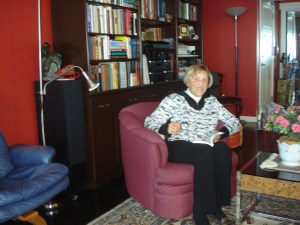
Looking back on 2016 I am amazed how much I actually got done. I have been busy. My collection of short stories, “Forget Me Not – A Bouquet of Stories, Thoughts, and Memories” was published in January 2016. It is a memorial to special people who have crossed my path – either in person or through their achievements. I dare to say that every single story carries some kind of message to the reader. At the very least it will make the reader think and maybe he/she feels like sharing his/her thoughts about the story with family or friends. It is about aging, adoption, blended families, babies, changing seasons, superstition, cancer, dogs, horses and other critters, escape, earthquake, flying, internet dating, island living, love and rape, roses, travels, war, and many other topics. It finishes with a beautiful fairy tale “The Weeping Angel” – for which, at one point, I received the First Prize in the form of another book: “Computers for Dummies.” Throughout the book, you find poems and pictures. A delightful book – perfect to give as a gift to YOUR special people, reminding THEM not to forget YOU. The easiest way to obtain this book is Amazon.ca.
The books I chose to read during 2016 have added greatly to my knowledge about history. Some of them upset me, robbed me of sleep since it was hard to believe people can be so blinded by promises, ultimately leading to a horrible war. One recurring thought was ‘do people never learn from the past?’ At the same time, I was crying over the fate of some people and keeping my fingers crossed for others to survive. As you can see, I prefer to read mostly “true” stories or history based on truth since that is what I write as well. The following are the books I read and since there are so many I will refrain from telling you about them. All are worth reading.
“All The Light I Cannot See” by Anthony Doerr. Pulitzer Prize, New York Bestseller list.
“The Witch of Napoli” by Michael Schmicker was a fun read.
“Goering” – The Rise and Fall of the notorious Nazi leader. By Roger Mansell. Incredible.
“The Glass Castle” by Jeanette Walls. A classic I had never read, but it is a ‘must read’.
“Moonrise” by Ann Victoria Roberts. This author has touched my emotions in many ways.
“The Rise of Nazi Germany” by Charles River Editors. I wanted to know more history.
The Gift “Awakening”, by J.P. McLean. Contemporary Fantasy, a new genre for me
- The Gift “Revelation”
- The Gift “Redemption”
- The Gift “Penance”
- The Gift “Betrayal
“POW # 74324” – Triumph through Adversity by Robert Stermscheg.
“Daffodils” by Alex Martin. An English love story set within WWI.
“The History of Germany From The Earliest Times by Bayard Taylor. Tough read!
“The Spy in Hitler’s Inner Circle” by Paul Pailole. The risks people took, unbelievable.
“Lunch with Charlotte” by Leon Berger. Unexpected happenings, finally talking WWII.
“How the (Bleep) Did I Get This Old” by Laverne H. Bardy. Need a good laugh? Get it!
“An Adventure on Two Continents” by Heinz H.G. Berger. A West Vancouver story.
“Journey of a Lifetime” by Trevor D. Cradduck. Not available for the general public.
There were a few other books. I remember the stories but I should have written down the titles. Plus, I read four substantial books in Germany in October (German language) and was fascinated by the content. I read several nights since I couldn’t sleep anyway. The time difference of nine hours is hard to overcome – your body is not fooled by the clock. The trouble is – when I got home to the North American Continent the same happened – in reverse! It’s said that for every ten years of your life it takes a day to re-adjust your body clock. C’est la vie!
 Giselle Roeder