The Fall of the Berlin Wall #BerlinWall

Berlin WallIt was in 1968 that my father and I had a chance to talk about his last will and testament. He lived in East Germany, I lived in Canada. East Germany was a communist country with strongly fortified borders, rows of barbed wire fences, mine fields in front of those and guard towers with sharp shooters present around the clock. Within the country you could move freely as long as you always registered with the police after arrival when visiting relatives in a different city for more than a few days. You also had to de-register when you left and register again when you came back to your permanent home. It was practically impossible to get a visa to visit relatives in West Germany – unless you were a 65 year old male, or 60 if you were female. Younger people were kept “in” since too many had escaped before the Berlin Wall had been built. Now, at the end of the sixties older people had a chance; – if they didn’t come back, no loss and one person less to pay a pension to.

Father would never get a visa for Canada but he got one to visit his second daughter, my sister in Hamburg, West Germany. I sent a flight ticket to her, she got him a West German passport in exchange for his East German one and he came to Winnipeg for three glorious weeks. He asked “Wouldn’t it be better to take the train from Hamburg to Frankfurt instead of flying? I am afraid I’ll be late and then I’ll have to hang on to the straps and stand all the way to Canada.”

We talked about a will. He did not have one since he did not know how to do it. His youngest daughter stull lived in East Germany close to them, one daughter lived in Hamburg and I, his oldest, lived in Canada. I tried to convince him to leave everything to the youngest since she would be the one to look after my parents when they were getting on and needed help. He thought it not fair and thought we, the two in the “West”, should have something as well.

“Dad, we don’t need it. We are both established and we couldn’t spend it anyway.”

Eastern money had to stay in East Germany. Even if we came to visit we had to exchange West money one to one for each day we stayed there, so any inheritance would be useless.

With a guileful expression he looked at me and whispered ironically: “My girl, you will see, it will change one day. The way things are going at home can’t go on. Sooner or later the wall will come down.”

“Dream on, Dad that will never happen.” I did not believe him. But I did convince him to make a will leaving me out and my sister in Hamburg agreed to it as well. He never felt comfortable about it but eventually he did leave us out of his will.

On the evening of November 9th I was resting on my couch in my cozy home in Vancouver reading and listening to a Mozart concert when my phone rang. It was my son:

“Mom, do you have the TV on? They are dancing on the Berlin Wall! Mom, hurry – switch your TV on, this is history in the making. You ought to see this! The East German Police have put their guns down, hundreds of thousands are streaming through Check Point Charley into West Berlin, people are hugging and kissing, dancing and singing and drinking champagne, they are hacking away at the wall, Mom, you ought to see this!”

My son in Winnipeg and I in Vancouver, connected by the telephone, sat up long into the night, ran up a huge phone bill, but it did not matter. The wall was coming down! The wall that had divided thousands of families for nearly thirty years, ours included. We shared these first hours and laughed and cried. I had taken him to Berlin when he was about twelve years old and we had looked over the wall from a platform built on the west side, almost twenty years hence.

My father had been right. Oh, how I wish he could have lived to see the day, I know that his tears would not have stopped running down his beloved face. He died in 1983, six years too soon.

Now we are close to November 9th, 2014 celebrating:

“Twenty-five year anniversary of the fall of the Berlin Wall.”


Escape to West Berlin #Escape #EastGermany

The 5th of October 19Escape55 changed my life forever. How? Let me tell you. I lived in East Germany.

I was a Phys Ed teacher. I loved my job and the school principal repeatedly reminded me to join the SED, the communist party. “How can you be a teacher if you are not able to pass on the ideology of communism to your students?” Without being a member you had no chance for advancement and risked your job security. But so far I had resisted the pressure.

On October 4th something drastic happened which drove me to the decision to leave East Germany like so many thousands of others were doing. Early the next morning I took the train to Berlin. Just outside Berlin proper, in Bernau, all the passengers had to leave the train, line up at a table to have passports checked by police and then continue on with the S-Bahn (city train) to the inner city. The “Wall” had not been built yet so the city train still stopped at some West Berlin stations. Waiting for my passport to be checked, the city train pulled in. When it started moving again I lost my nerve and started running towards it. The police had shooting orders for people trying to escape. Two shots were fired. They missed, either by accident or by design. We will never know. If witnesses claimed they missed on purpose the shooter would be severely punished, put in jail or even shot. Two Berliner men held the automatically closing train doors open and pulled me into the last wagon. I expected the train to be stopped…..

Those two Berliners told me to get out at the next station which happened to be in the “West Sector”. I had to wait for another train, one not going through the “East Sector”, to Marienfelde. This was the place where one had to register in West Germany. I was thunderstruck by the long line-up of people; everybody who had escaped this day was in line yet it was still only very early in the afternoon. Most had no luggage at all or only a small bag, some didn’t even have jackets or coats. I moved forward with a young dental assistant, a nice girl who hoped to be sent to the Black Forest since she had relatives there. I had no idea where I would end up. We stuck together and were given a bunk bed in a room with only five other bunk beds. I took the upper one and kept my coat on top of my blanket and my shoes close to the wall. We had been warned to look after our few belongings because things “disappeared”. Most other rooms had fifteen or more bunk beds. We felt so very lucky. But don’t even ask about bathrooms or showers, – it was all very well organised but very simple. There was an air of relief, but not much talking. After our experiences in East Germany nobody trusted anybody. We were afraid to say anything. What if the Russians were coming?

Most girls in our room were “processed” as it was called within a few days. Everyday new ones were occupying the beds. I was the only one kept there for three weeks. We had been told that on Oct. 5th over 16.000 people had escaped, not all through Berlin though. I was repeatedly interviewed by the Americans, the English and the French officers but in the end I could not tell them more than I already had. Actually, through their questions I learned about military installations on the Island of Ruegen I had not even imagined. Finally they decided to fly me out to Hannover while my final destination was supposed to be Dortmund. My first flight was not exactly a flight into the sunset but what all of us thought of as FREEDOM. New challenges were awaiting me in the “golden West” as we “easties” called it.

You want to know what happened on October 4th that drove me to leave my family, my hometown, the job I enjoyed, my beloved boat and all my kayaking buddies? For that, dear reader, you’ll have to read my book We Don’t Talk About That…

Book Reading – Parksville #WeDontTalkAboutThat

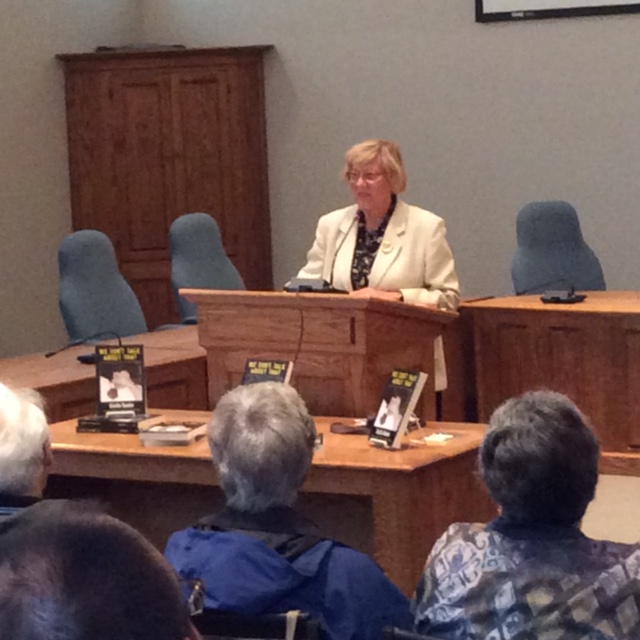
Book reading ParksvilleDespite the very rainy weather we had a good gathering in the Council Chambers at Parksville Library today. One lady who came to hear what I had to say remembered my home town, Stresow, where I spent my childhood and, in further discussion, it became evident that she came from the very same town where my father was born. What a small world it is. She confided that she had escaped rape by having short hair and dressing as a boy.

Book Reading Today #WeDontTalkAboutThat

Another pleasant evening with 23 people this time at the Nanaimo North Library for a book reading with some interesting questions and discussion. One lady bought a copy yesterday and read the whole book overnight in order to be informed when she came to the book reading today – another case of “could not put it down”! So many people wondering when the next part of my life will be revealed. Many thanks to Stephen Warren and Darby Love from VIRL who helped to make this event possible.

Answer to a question: #WeDon’tTalkAboutThat

Question markOne writer on a sub-group on LinkedIn posed this question:

“Who is the most memorable character in your book?

I did just that, the name I gave was “Gila” who was the heroine of “We Don’t Talk About That” whose story is an amazing story of survival. After several days had passed I went on to post the following on LinkedIn:

I am surprised how much text many of you wrote. For my part I tried to keep my posting very short. Now I may add a bit more of Gila’s story titled “We Don’t Talk About That“:
Christmas 1944 – it was the last year of my childhood but I did not know it then.
During the month of January 1945 the Russians made rapid advances into Germany. For my eleventh birthday nobody came to visit because people had been robbed or even killed by German deserters for clothing or money, everyone stayed safely at home. A few days later our teacher announced that the school would be closed, permanently. The Red Cross would turn it into a field hospital since the front was very close. We had heard the noise of the fighting for days now. Mr. Koenig had tears in his eyes when he, with a breaking voice, said “Good Bye children, may God be with you. We may never see each other again.” As we left he shook our hand instead of looking at the usual ‘Heil Hitler’.
That afternoon the church doors were wide open despite the cold. The organ was played ‘with all the stops pulled’ as the village folks said. And that was where the Russians found him, his wife sitting by his side. ……
It was very dark when some horrible screams woke me up. I thought it was a bad dream, but my dad whispered: “Please, be quiet, be very quiet.” We heard some loud cursing and the house door was opened and closed with a bang. The screams came from Helen and Betty. Several Russians had raped them. Their grandfather had tried to protect them and was brutally beaten. When he was unconscious they just threw him out the door and went on with their business. To our horror we found him dead and frozen in the morning. …..
A couple of days later all men and women between sixteen and sixty years of age were horded together, the unfit and nursing mothers were pushed aside, the rest were taken to Siberia. …..
The first Russians moved on and the next ones evicted everyone. We just followed all the other villagers with no idea where to go. We walked across a field where the mighty Russians had killed the last of the fighting German army. Body parts lay scattered. I pushed the pram with my baby sister. My mother called out “Gila, don’t look to your right.” Tell a kid not to do that! A soldier with his head beside him leaned against a fence. His legs were not attached but on the other side of the pram. This sight became a nightmare for me for many years.
Arriving at a house where about 40 women and children were standing around we asked if we could join them. One woman said “The more the merrier, that way we might get away with just one soldier raping each of us instead of a whole army.” The Russians locked us all into one small living room. One spoke a little German. Asked why the Russians raped young girls as well as old grandmothers he shrugged his shoulders, and said “Woman is woman. Has hole.” …..

The above is just a short part of the book. Gila, her mother and sisters walked on with hundreds of thousands of others alongside the Russian war machinery on their victorious march towards Berlin for three weeks, no food, no water, disease, lice; the dead and dying were just left in the ditch. …..

Starting towards the end of 1945 the rebuilding of some kind of order, school, farm work, the establishment of East and West German States, followed by Gila’s haphazard education to become a PhysEd teacher, kayak sport, escape to West Berlin, an unwanted affair, a confrontation with a convicted rapist on parole became all too much. Gila had just one wish: To get out of Germany, to get away, to emigrate, to be free, to start a new life.

See BOOKSTORE to purchase book. To FOLLOW my blog go to top of right hand column and click on FOLLOW button.


What happened to them? #camping #BalticSea #escape #kayaking

They were sleeping in four tents next to us. We were camping on the beautiful Isle of Hiddensee. Located between the mainland and the larger Isle of Rügen it was one of our favourite weekend and even holiday spots. Hiddensee was a narrow long island and you could walk from the high cliffs with the lighthouse at the Rügen side all the way down to the other end where it tapered out into sand banks. Starting to paddle or with a good breeze and able to hoist our five square meter sails it would only take us between three and four hours from Stralsund to Hiddensee. We would aim for about the middle of the island, a place called Neuendorf with the fishing harbour, surrounded by typical bright white romantic thatched island homes. These low houses with small windows were hunched down low to let the constant wind blow over them. We had to start walking on a sand bank for the last one or two kilometers and pull our boats until we hit deeper areas again. The island was quite narrow here and had dunes and a nice beach facing the open Baltic Sea.

May I see your ID

Show your ID

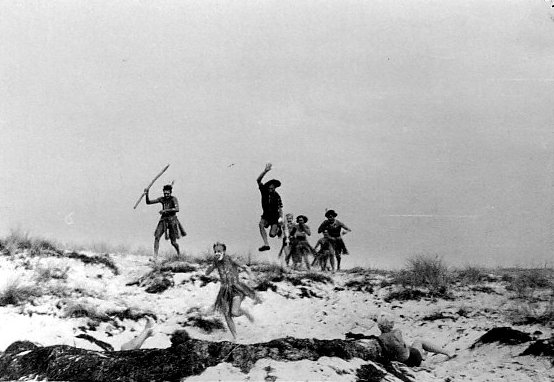
We were four girls in two boats and had two tents. We found a nice camping place adjacent to the nude beach. We were surprised to see fully uniformed policemen checking the passports of the nude people. Where do you carry a passport if you have no clothing on? While we were spending the rest of the day sun-tanning and swimming several other tents had gone up in a row next to us with five single kayaks placed upside down between them. Five very fit looking men in their twenties were organising their blankets and cook ware. When they noticed us next to them they called “Want to have dinner with us? Just soup, – but good company as a side dish and music for dessert. You’ll have to have your own bowls and spoons though.”

For several days they were busy exploring the island and the very few shops in Neuendorf and Kloster, the village closer to the high part of Hiddensee. They would sit on the dunes every night for hours and watch the military search light reaching out with bright long arms over the Baltic, starting at the lighthouse and coming back from the sandbanks.

Indians - 1

Tribal attack

Indians - 2

Dress rehearsal

We planned to attend a costume dance and were busy picking beach grass and making grass skirts. Intrigued they inquired what we were up to. “Can we join you?” We were delighted. Now we did not have to walk home in the dark on our own after the dance. We made more grass skirts and with lipstick painted Indian designs on our faces and bodies. The men had found some feathers to complete our costumes. We celebrated with a kind of dress rehearsal on the beach and a few drinks loosened our inhibitions. With lots of noise we entered the dance hall and celebrated with our own tribal dance. We scalped a few people, and at the end won first price for which we received a bottle of rum. The boys disappointed us by saying ‘good night’ when we suggested sitting on the dunes with them and let the bottle go around. “Tomorrow is another day” were their parting words.

We won first prize

We won first prize

When tomorrow came their camping places were empty. Tents gone, boats gone, not even a garbage bag left. It was as if they had never been there. Inquiring of other campers nobody had seen or heard anything.

What happened to them?

To find out order your copy of “We Don’t Talk About That” right now! Reading this book will make your head spin.


Granny’s Hands #WeDon’tTalkAboutThat

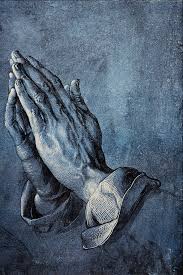
Durer handsMy treat for you today is reading a chapter from my memoir. It’s one of the many memories of my childhood.

Granny went to church every Sunday and her praying hands left an indelible imprint in my soul. She had grown up speaking mainly Low German and often had trouble pronouncing some words in High German. My parents wanted us to grow up with High German, preparing us for a better education. Granny tried hard to please her son, my father. I once listened to one exchange between her and Dad:

“Mother, – it is not ‘Gesus’, – it is ‘Jesus’.”

“Erich, you told me to speak High German to the children, and then the ‘j’ is pronounced ‘g’ like in ‘go’ and not as it would be in Low German ‘jo’.”

“In that case you are right, Mother. But ‘Jesus” is a name and it needs to be pronounced ‘Jesus’ and not ‘Gesus’. Would you say ‘Gohanna’ to Johanna, would you?”

“Oh, now I understand. I’ll remember not to speak to the children of ‘Gesus’ anymore.”


Many children had the measles and I got them too. My eyes hurt and I was very sick. I felt lousy, alone and sad, forgotten by everyone. The room was dark with the shutters closed. As the sunlight came through the slanted openings, I imagined it as long, silent fingers playing with the bits of silver and specks of brown in the dark blue wallpaper. I could even imagine faces in the shadows caused by the lilac trees outside – here and there a ship, and there was the good Lord himself on a cloud with some angels around Him. He had friendly, old eyes but He wiggled a finger at me attached to a long, sinewy hand. I was not afraid but just kept on looking at the imagery. The hand was white with a touch of pink and I could almost see through it. It was a beautiful hand.

The hand was cool and soft. I felt it on my forehead. It helped my eyes not to hurt so much but I did not want to open them, I wanted to feel those cool fingers. Was I an angel now, like those behind Him? It did not matter. I felt suspended between being and not being, I was floating. Please God, just a little longer….

Was it this plea or was it the voice coming from a distance, “She has quite a high temperature and she is delirious….”

All of a sudden, I was back in my bed, the perspiration trickling into my ears, which hurt, too. The long fingers and the streaks of sunlight were gone. There were no faces, no ships, no God, no angels on the wall, just that dark blue wallpaper with bits of silver and specks of brown. This used to be my father’s room. My bed was a black ebony sleigh bed. My father had told me proudly that it was his before he got married.

I opened my eyes just a bit and looked right into Granny’s wrinkled face. Her one hand was on my forehead and she took my hand in her other one.

“Did you have a nice dream, my girl? You smiled and you looked so happy.”

I just nodded – thinking she would laugh at me if I told her of the things I had seen. I felt that she belonged to Christel. She always hugged her, cuddled her, held her on her lap, stroked her wavy hair, and comforted her when she was crying. I was only allowed to just sit beside her, close enough, but never on her lap. She never stroked my hair.

Tears were stinging my eyes. I closed them again. Granny’s hand felt so good on my forehead and I wished she would not take it away. I thought of how beautiful her hands were, even though they were wrinkly or maybe because they were wrinkly. Her face was beautiful and wrinkly too. Often I had looked at her, wanting her to hug me so badly that it hurt. My mother did not hug me either, nor did my father. There was just a handshake and a light formal, “Good Night” kiss – nothing else. But I could not let anybody know or show how much I wanted to hug or be hugged – only babies did that. I was a big kid now, a kid ready to go to school. Maybe it was good to be sick. I could feel the hand on my head and it felt so good. I did not want it to stop.

“I want to look like Granny when I am a grandmother,” I decided.

My ears got worse and Dad had to go to pick up the doctor from the city. It was a good thing that he still had the motorbike. Granny had to put special drops into my ears at frequent intervals. The drops felt cool and tickled as they ran down into my ear canals. I asked where Mom was. Granny explained that she was not allowed to come close to me because I was contagious. Mom had never had the measles and when grownups get them, they could die. She also explained that the measles were dangerous for a new baby. Which new baby I thought but was too tired to ask.

“Don’t worry,” she said, “your mother often stands at the door and looks at you. She hopes you will get well soon.”

During my whole childhood, I had recurring ear infections and my ears are still very sensitive. Noise hurts, even drives me to tears, and I cannot stand windy days without a cover.

Book Reading and Signing

On Home Turf

Eyeglasses on Open BookI will be reading selected passages from my book “We Don’t Talk About That” and answering your questions at a Book Reading and Signing event in the Clubhouse at 6738 Dickinson Road, Nanaimo on Wednesday July 16th commencing at 8:00 p.m. We need to know numbers in advance so if you plan to join us please RSVP by leaving a comment in the “comment bubble” above – top right.