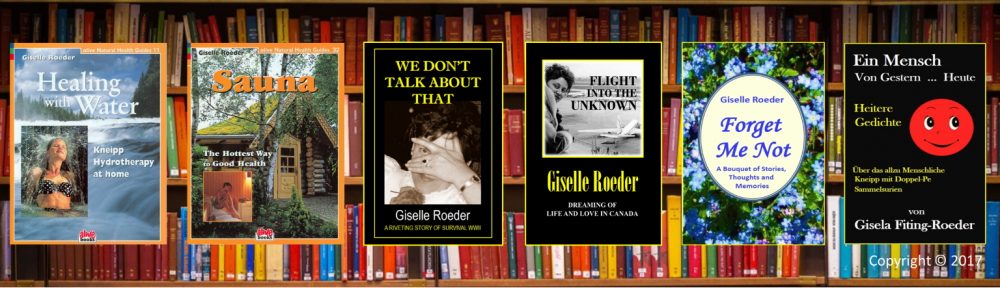
I’ve read the book and I would say that it’s so hard to put down once you start reading it, you seem to be able to see and hear and get to know all the people (not characters as they are real people) you laugh with them and cry with them, you can imagine the pain the heartache, I could go on but when you read the book you will understand what I personally experienced while reading “WE DON’T TALK ABOUT THAT,” I’ve read a lot of books but have never felt so many emotions as I did while reading this book
Tag Archives: History
Memories of little Gila, a brief history lesson:
The first of the “Nine Lives of Gila” – see “We Don’t Talk About That”:
 Gila lived her first 30 years in three Germanys. She can’t remember her first 3 or 4 years, but she knows what happened. Hitler took over in 1933 because he promised work and bread for the starving population. Criminals caused brawls and a lot of unrest in the big cities. Hitler told his friend Roehm to establish a new kind of army; therefore, in 1934, he created the SA, also known as the Brownshirts or Stormtroopers, to get the ‘Riff-Ruff’ off the streets. The SA developed into a new army over time. Hitler had his friend Roehm killed because he became too strong. An old general, who fought in WWI explained: “Peace? Peace is just an interlude between wars.” Hitler applied to have the Olympics in 1936 in Germany and, in his usual style, screamed: “We will show the world a recovered Germany!”
To instill pride in their history and their country again, the ‘Hitler Youth’ came into being. Hitler commanded: “I want our young people as swift as Greyhounds, tough as leather, and hard as Krupp steel.”
To entice the Germans to have more children, a “Mother’s Cross” was awarded for mothers of many children. After the fifth child, Adolf Hitler was their Godfather.
Little Gila learnt early on in her life, “not to talk about anything said at home.” Her father allowed her to listen with him to Churchill’s speeches every night on the UK radio.
 The ‘Brownshirts’ had been mostly bad boys, and they had no problem killing people. Everybody was scared of them. Rowdy groups in big cities started defacing and smashing shop windows of Jewish owners. Jews disappeared; they were either captured or took a chance to flee. The infamous ‘Crystal Night’ in Berlin was the height of the criminal acts, and the police lost power. Anybody speaking out against it, hiding or helping Jewish friends or had communistic ideas went to the new ‘Concentration Camps.’ These were not only populated by Jews, as is a common belief.
Mentally or physically disabled people were picked up and brought to special sanatoria. Relatives were told they would be looked after – but they were put to sleep.
A hardly known fact: Unwed pregnant girls, shunned by their families, could apply to be taken into ‘special’ homes. Their babies were placed with Nazi couples right after birth. The mothers had no say in it, even if they expressed their desire to keep their child. Or they would be told the baby died during birth.
Hitler wanted to breed an “Aryan race” – tall, blond-blue-eyed people. Goodlooking blond and blue-eyed girls were enticed or ordered to go to exclusive homes, and tall, blond and blue-eyed Nazi officers would ‘father’ their babies.
Such was the background created by the Fuehrer to ‘clean up’ devastated Germany and build a 1000-year Reich.
Then there were whispers of war. The invasion of Poland in September 1939 was the beginning of a horrible war. The Brownshirts came and confiscated Gila’s horse, Lotti. When she was told ‘the Fuehrer needs it,’ she asked the officer: “Can’t he take another horse?”
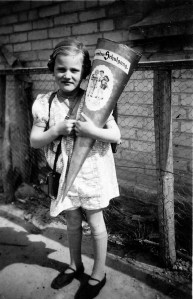
My first day at school
Gila started school right after Easter 1940. As was a German tradition, she looked forward to receiving the “Schultuete”, – the ‘Horn of Plenty.’ Sadly, there wasn’t much in it. No chocolate, just some apples from last fall and a package of candies.
Gila’s first train ride was a trip to Stettin in 1941 to visit her Grandmother’s brother and his wife. They visited the harbour, and many ships were waiting to leave. Gila’s uncle had Jewish friends, and they were able to get on the last ship sailing to America, but no children were allowed. Their son Gerhard stayed with Gila’s aunt and uncle. Sadly, that ship was torpedoed and sank. Gerhard grew up with them and was later declared their son after the war. No problem, all papers were lost due to the eviction in 1945 by the Polish army.
From her home, Gila could always hear the bombers flying to Berlin. She and her family would hide in the ditch of a field and watch the fire in the sky after dropping their deadly cargo over Berlin. Black-out curtains had to be in place. Older men unfit for war became the “Homefront” to keep an eye on everybody. The Hitler Youth kept an eye on the old guys. Nobody knew who an informer was.
1943 – Gila’s father was conscripted into the army. Ration cards limited food supplies, causing a black market. Aunt Anna came from Berlin asking for ‘cow shit” to grow tomatoes on her balcony.
July 20, 1944 – there was another attack on Hitler. Again, like many times before, he was not killed. Seven thousand people, Hitler called them conspirators, were shot; women, children, relatives, whole families were wiped out.
At the end of January 1945, Gila’s teacher told the children the school was to be closed to become a field hospital as many wounded expected. Only 5 kilometres away, the mighty Russians were fighting the last of the German army. When the Russians invaded Gila’s village on February 4th, 1945, she watched but lived through their atrocities, rape and murder. Gila’s childhood was over when she was only eleven years old.
It was the end of Adolf Hitler’s 1000 year Reich.
“Katharina: Fortitude”
 I just finished reading this book. All along, I was wondering how the author, Margaret Skea, would have been able to find so much material during her limited time in Wittenberg. I asked myself repeatedly, “Is this fiction, based on truth? Is this a biography of Katharina von Bora?” Or is it “intelligent fiction?” When I read the author’s comments at the end of the book and learned that IT IS fiction, I couldn’t believe it. Written in the first person, it was so real, I was Katharina, or I was next to her, holding my breath, prayed with her, felt her despair… What an exceptional writer! If I had the time, I would want to read every one of Ms. Skea’s books. Notably, the prequel “Katharina: Deliverance,” telling of her childhood in a convent, her vows as a nun, her escape, her meeting with Dr. Martin Luther, the former monk.
Like ghosts, the people in the book are occupying my head every hour of the day. How did Ms. Skea, the English-Scottish writer, ever come up with the idea to write about this German woman, the nun who became Mrs. Martin Luther? How did she get to ‘know’ her and the people around her so intimately? Are there history museums in Wittenberge with lots of details about the 16th Century and Dr. Martin Luther, the reformer standing up to the mighty Catholic church and the Pope? Did she find a book that she translated? This idea ran through my head because it is absolutely incredible how anyone could write this story and transport the reader back into THAT time, feel close to the characters, the setting, the history… I am in awe. King Henry was also starting his ‘reform’ in England because the Pope would not allow him to divorce his Catholic wife. My honest opinion? The beginning is a bit slow, some German words don’t make much sense, ‘Wirtschaft’ for one – that word has many meanings, but Weddings are not one of them.
When I questioned the author, here is what she writes:
“To give you a bit more background to the fact/fiction division – I didn’t want to write screeds at the end – it is fiction, but all the key events actually happened – I just had to flesh them out and try to bring them alive.
We know Frau Jessner was fined for abusing the Luthers publicly, we know they had a pet dog named Tolpel, we know the land Katharina persuaded Martin to buy, we know a lot of the discussions that were had at Dr. Luther’s ‘Table Talk’ and some of Katharina’s contributions to them etc, etc.
We know a lot of what she did, but not why, nor do we have documented evidence of what she thought. I worked backwards, trying to imagine what sort of a character she must have been to do this or that. I loved the experience of trying to see it all through her eyes. Obviously, the interactions with her women friends were the most fictional bits – but again we know a lot about who was in the Lutherhaus and roughly when, and rough dates for miscarriages for her and for her friends and rough dates for the deaths of friends and of children. Ditto for family deaths, the visit of her brother Hans and so on. I did have a fairly tight framework to work to – which (mostly) helped!
I guess you could say it is a complex blend of fact and fiction. Great news for me if, when reading, you couldn’t see the seams between them!!”
No, I couldn’t see the seams between them. I didn’t know very much of Katharina, Martin Luther’s wife. Just that she was a former nun and bore him seven children, of which four lived. Now, learning of her extra-ordinary life with this controversial man, I want to know more about him, the Reformer of the Catholic Religion, Dr. Martin Luther, one of the most important and unforgettable men in church history.
Do I recommend this book? Wholeheartedly, even if partially fiction, it provides an intimate look into the lives of women and the history of the early sixteenth century. Margaret Skea, the author, is known for ‘knowing her history’ – she has written several other historical novels.
Two Sides of WW II
This is a letter I like to share with you written by a Russian writer, a lady who writes books from “the other side” – telling stories of what ‘her people’ endured with the Nazis. She read my memoir, and this is what she had to say:
 Dear Giselle, I read your book, “We Don’t Talk About That.” Was there anything I didn’t know before? Factually, nothing (I touch this subject in my books as well). Emotionally, a lot, overwhelming, goosebumps all over the body most of the time: at some points from horror, at others – from joy there were lovely, loving, and supporting moments with the people you met, with the members of your family, and even some enemies (the kind doctor). It took me some time to gather the courage to write to you because there was an overwhelming feeling – shame and guilt for what my people – Soviets, Russians – made to your people, especially to the women, children, the civil population at large. Reading all these details was devastating to me. Some stories shattered my heart. Many brought me to tears, one of them when your parents reunite after your father returned from Siberia. I’m so glad he had. I’m thankful for your understanding (as I feel it) that the Soviets mirrored what Wehrmacht and SS troops committed in the Soviet Union. Most likely, there were no mass rapes, not with such brutal outbursts at least, but rapes they were. The lives of ordinary people – on all sides – were trampled and destroyed. I’m proud of you, Giselle. Of your battle to survive, of remaining human, supporting, and kind at the time when many broke, of the achievements of your life. I expressed my impression in my review on Amazon. Thank you for your book, which is a rare glimpse at the subject that was taboo for so long.
I checked her name, Marina Osipova, on Amazon.com and found a listing for her book. I read as much as was possible by using the ‘Look Inside’ feature. It is a book I will read.
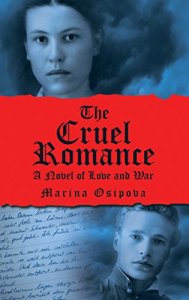 The Cruel Romance tells the story of four young people on their different paths through WWII. The fates of a Russian country girl, a Soviet intelligence officer, a German violinist, and a Russian intellectual are irrevocably intertwined in the war not of their choice, forcing them to navigate the unconscionable moral compromises of life. Who will survive? And, at what price? The story’s conclusion is set in our time.
Banned Book Week September 23rd – 29th 2018
I must say I was surprised when I saw this announcement placed by “Book Club Mom.” I couldn’t believe that even a book, written by Margaret Atwood, “The Handmaid’s Tale” had been challenged and banned before it was made into a TV series and a movie. Ms. Atwood had started this book in 1984 when she lived in West Berlin before the fall of the infamous Berlin Wall. Another book I would never have questioned was “Mockingbird” by Kathryn Erskine, a book about a young girl with Asperger’s disease. No, NOT the one written by Lee Harper “To Kill a Mocking Bird.” Maybe I can understand that books about sexual orientation had been banned when they came out. It was probably too early for the topic. Now, it wouldn’t be a problem.
Until last week I never thought that there were books today I couldn’t order or buy. But it happened. I tried to order an Art Book from Amazon.com – a coffee table book with a collection of paintings by an ‘Unknown artist’ – Adolf Hitler. A USA art collector had published only a thousand of it. I had seen a documentary on television about Winston Churchill and was intrigued by his hobby – painting – a hobby he shared with this other artist with an infamous name. It seems that both men, under tremendous stress, could forget the world they lived in when painting. I could read up on both artists through Google/Wikipedia and even see paintings of both artists which sold by auction for 6-figure prizes.
So? I checked Amazon.com. They listed several used books ‘Adolf Hitler, the Unknown Artist.’ Naturally, the thousand that were printed decades ago were long gone, and now people tried to make a buck by offering theirs for sale. The cheapest listed and marked ‘in good condition’ was $168.98 US including shipping. They did have several more for more money. I put it in my shopping basket and proceeded to ‘check-out’ – curious what would happen. I thought, ‘In the end, I don’t have to buy it.’ I found out that Amazon did not own any of those books, private sellers had listed them on their site.
When I proceeded to type in my address I was told: ‘We cannot ship to Canada. Give us a different address.’
What? Not ship to Canada, a multi-cultural country, respecting every religion, color, creed or whatever. Not allowing an ART BOOK to cross the border?
I followed up by contacting ‘chat help’ at Amazon.com. I learned some amazing facts about banned books. But the help person was helpful and connected me with Amazon.ca after he had found out that they had just one copy of the book that I was looking for.
I had a chance to follow a link to look at it and when I saw the price of $1.598.99 Canadian I quickly went back to my chat person and told him:
“Thank you for helping me, but the price for that book is out of my league.”
He apologized, and his final comment was, “It’s not Amazon, they are private sellers, we also cannot buy these books. They are out of print, and a private owner can charge whatever they want.”
Out of print, banned or book burnings I remember from the Nazi time. Are we getting there again?
I’m Tickled Pink – I’m Pickled Tink
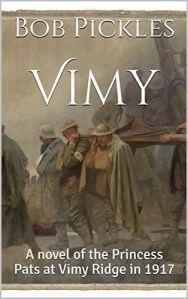 Wow! This blog post relates to a recent e-mail I received from Bob Pickles, the WW I history writer. But first our history:
On June 21, 2014, Bob Pickles wrote a review of my memoir ‘We Don’t Talk About That.’
“Giselle Roeder’s book is a vital piece of the jigsaw of suffering in World War II (& representative of civilian suffering in all conflicts). It could well have been a story of the tragedy endured by Jews, Gypsies or Polish intelligentsia perpetrated by the Nazis. If it (the book) were not so harrowing, it should be desired reading in schools & given the same historical, literary importance as “The Diary of Anne Frank.” To be read alone with a strong drink perhaps. – (it is) A fine testament to the unquenchable spirit of survival & hope with the help of a few ‘angels’ along the way.”
This is just an excerpt from his review. Reading it gave me goose bumps. I thanked him with all my heart and this started an occasional e-mail exchange. He was not happy with the ending of my book – so he has been encouraging me to write a sequel. He is not the only one. Many of my readers keep asking. A now ninety-year-old lady, who bought and gave away fifty-seven copies of my book, begs for the continuation to read before she dies.
A few months ago Bob Pickles asked me for help with translations of German expressions for the newest book in his series of WWI, “The Foster Family in the Great War.” I happily obliged. Since I didn’t know many of the profanities soldiers might have used I had asked several German-speaking writer friends. One was Elisabeth Marion, a WWII history writer. Her most famous book is “The Night I danced with Rommel.” Bob Pickles was happy with my translations. I thought nothing of it, I love helping someone. Anyone!
A few days ago I received a surprising e-mail from Bob:
Hi Giselle, just to let you know my latest (8th) WW1 novel is published on Amazon as both a paperback and as a Kindle edition. Entitled “Vimy” – a novel of the Princess Patricia’s Canadian Light Infantry’s attack on Vimy Ridge 1917 – I have dedicated it inside to you.
If you “Look Inside” the book on the sample on Kindle, the parts you kindly translated into colloquial German are found in the first few chapters.
Wow! A book by Robert S. Pickles, a serious UK history writer, dedicated to meee? Never, ever did I think any book would ever be dedicated to me.
I’m tickled pink – I tink I’m pickled. Thank you, Bob Pickles. I will recommend your book to the Canadian Legion; I would think a number of the Canadian veterans will also be tickled pink to read about the Princess Pat’s Light Infantry role at Vimy Ridge.
Review of my Memoir brings Tears to my Eyes
Nikki Landis, a Goodreads author, reviewed my memoir “We Don’t Talk About That: An Amazing Story of Survival”
Her rating: 5 Stars.
Nikki Landis is an award winning author of about a dozen books. She is well known for her “Fight for Light Novels”, “The NightWatchers Saga” and the “Freedom Fighters Series”. In 2017 she was the proud recipient of the IPPY Gold Star for her latest book “Refugee Road”. I have just started to read it and am fascinated.
Nikki is not only a prolific writer, she also reads more than anyone I know, and reviews all the books on Goodreads. Plus, she is a wife and the mother of five boys (7 years to 18!) and works full time. How does she do it? Do her days have more than 24 hours? Oh, I forgot – the night also has 12! Funny! Thank you, Nikki, from all my heart.
Read Nikki Landis’s review:
Read in Aug 2017
Some stories must be told, no matter how disturbing, horrible, or unbelievable they may seem. Some truths devastate because you can’t imagine how they are possibly true. You DON’T WANT them to be true. How can such brutality exist? How can one individual possibly survive after so much horror? How much can the human spirit endure and bounce back from the brink of destruction and continue on?
This book, I think, is probably one of the most emotional and life changing stories I have ever read. It truly touched my soul. I have the utmost respect for the author and her courage, bravery, and willingness to step forward and tell the truth about the shocking and brutal events of her life. She is, WAS, a victim. Her family were victims. Her friends and neighbors. In fact, many German women were and yet they survived. They pushed forward. They endured the despicable and impossible, and they persevered.
This book is not an easy read. I had to stop often, take a breath or break, and come back to the story. Over several days I read and witnessed the horrific events that changed a nation and destroyed a country. As an American woman in 2017, what do I truly know of suffering? What do I know of survival, fighting with everything I have in order to make it through each day? What do I know of living in fear for my life or waiting for the next man to knock on my door, ordering me to disrobe? What do I know of losing all that I own, of being displaced without a home or country, and losing everything, including the people I love? What do I know of starvation?
The answer is simple. I do not. But by reading this story, I have an idea. My heart just aches. I’m devastated. I cannot imagine enduring for even one day what the author and these other women endured for months, years of their lives. How did they go on? How did they later marry and have families? How did not lose their very soul to such inhumane acts?
The story does not end there. The author takes us on a journey of self-discovery and the search for freedom. I found myself cheering her on throughout the book, hoping that she would finally find peace, love, and happiness. I don’t think you can give away spoilers in a novel like this. It’s a true account of suffering and perseverance, of losing everything and finding what truly matters, and because of that, I am happy to say I think the author found what she was looking for in the end.
Chronicling the first thirty or so years of her life, the author lays out life in the 1940’s and 50’s and her youth, her family, and life before the war. Once the war starts, it’s a shocking read. Be warned, this novel tells the brutal truth and is in parts almost too much, but only because of content. The way in which the books is written, in a narrative that feels like you are listening to a close friend, is the only way to get through the stories.
There is a lot of wonderful historical detail from life back in that era, landmarks, cities, geography, and much information about the war and its effects on the German people. For me this is one of the most interesting parts of the book. You hear much growing up about World War II and its effects on the world, the atrocity of so many lives lost, the hatred of the Jewish people, but I don’t think I can recollect much learning in school about the German people and their struggles. It’s wrong. We can’t forget as a society what happened. We can’t condone what happened. We can’t let it happen again.
WE CAN’T FORGET.
Stories like this must be told and published. They must be shared. They need to be read. What hope do we have for humanity if we forget, if the dust covers the words of these atrocities and God forbid, history tries to repeat itself? No, we can’t let that happen. And the author is right to share this story, to talk about what happened, and to ensure her words are written down for all eternity. In her own words, no embellishment, she describes the gritty and grueling aspects of her life from start to finish. There’s no other way the story could be written.
I have a much better understanding of history now. Such experiences must mark a person for life. This is a memoir I would recommend to everyone, but especially I will recommend to the women I know. It’s an emotional, courageous, and extraordinary story that MUST BE READ. I highly recommend purchasing this book and owning a copy for yourself. “We Don’t Talk About That” is truly an amazing story of survival.
Mentally overfed but feeling undernourished
Is there just too much information fed to us by the media? I think they have a dilemma too: Too much and too many serious things are going on in the world. Syria, Iran, North Korea, England, Russia and last but not least the USA keeps us breathless and, in many cases even frightened. Hardly a day goes by when we do not get upset over a new announcement, and it hardly ever is about something we would emotionally get involved in: some good happenings in our own backyard.
 I don’t want to add to it. I am just a person who, after writing the memoir “We Don’t Talk About That” – the years growing up under the Nazis, and then later under the Communist Regime in East Germany – who really is OVEFED but UNDERNOURISHED by the present political situation. I would like to stick my head in the sand and write another book, a happy one! But that is dangerous and surely not advisable.
Talk about a happy book! It was on a flight from Hawaii to Canada when I got chatting with the stewardesses in their Business Class galley kitchen. Naturally the talk included the question “what do you do…” and my writing career came up. There was a time when “I did not talk about that” – but now, finding a willing ear to listen, I can’t shut up. One of the ladies was very keen on my title “We Don’t Talk About That”. She had serious questions. Later, she went on to tell me about her aunt who had written a similar book, “Prague Winter” – and highly recommended I read it. I Googled it, found it, read it, and was amazed when I found out a lot of information about the writer: Madeleine Albright. I was not familiar with her name.
 Madeleine Albright was the first woman ever nominated and accepted to become the Secretary of State in 1993. Wow! What a story! From the little Czech girl in “Prague Winter” to making history for women. What an intelligent person! She has written a number of books. One paragraph in the book I read resonated with me so strongly that I absolutely must share it with you:
“In the end, no one who lived through the years of 1937 to 1948 was a stranger to profound sadness. Millions of innocents did not survive, and their deaths must never be forgotten. Today, we lack the power to reclaim lives, but we have a duty to learn all that we can about what happened and why – not to judge with the benefit of hindsight but to prevent the worst of that history from playing out again.”
 True words! So, my dear readers and followers, we are NOT TO STICK OUR HEADS INTO THE SAND. Let’s open our eyes; a lot of what has happened back then, what I have written about in “We Don’t Talk About That” and Madeleine Albright in “Prague Winter”, is happening again and there are a lot of signs that worse may be to come. Madeleine Albright is working on a new book “Fascism” to be published in April 2018. “The author examines the economic, religious, racial, and cultural factors that are today dividing populations and fostering bigotry across the globe, while also looking at how demagogues from Mussolini to Duterte have attracted followers by exploiting fear, nurturing anger, and promising easy answers to complex problems,” according to HarperCollins, her publisher.
Do the people in power ever learn from history? Do they even KNOW the history or are vaguely interested in it? Do the people who elect them, have any clues? Maybe every generation has to make their own mistakes, have their own experiences, make their own history and create their own past. Will the next generation after them learn from it? Most likely, not. Maybe we resent or do not want to learn from or ‘copy’ our predecessors.
Somewhere I saw a quote, something like this: “When a boy is old enough to believe or even follow his father’s advice, he usually has kids who don’t believe him.”
“Madame Pele – the Fire Goddess”
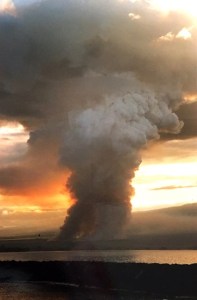 The recent video of a tremendous fiery lava flow into the ocean on the Big Island of Hawaii was making the rounds on many social media sites. (also on my Facebook sites) It’s no secret the lava is flowing all the time anyway. Cruise ships, leaving from Kona, would make sure of sailing past at night to treat their guests to an unforgettable sight. At one time, I was on one of the ships. This new SUPER flow started just after New Year’s 2017. It went on for several weeks until a huge part of the cliff broke off and closed the exit. The massive flow of the boiling, liquid lava found a few new outlets – but nothing to compare with the fireworks of the previous weeks. I wonder what happened that made “Pele” so terribly angry!
You don’t know her? Pele’s mysterious story intrigues me. Naturally, there are several versions but I’ll tell you my take on it. Pele was born and grew up on Tahiti with brothers and sisters and parents who were “gods” of some kind. She had her share of family problems because of her fiery temperament. As a teenager, she seduced her older sister’s husband. Enough was enough and her father threw her out. Her brother gave her a canoe and she found a way to a small group of islands. With her “Pa’oa”, a divining rod, she tried but couldn’t make a “fire pit”. So she went on and lived on Kauai for a short time. Her furious sister, the ocean goddess Namakaokahai, had followed, found and attacked her, and left her for dead.
 Pele recovered. She went on to Oahu. Here she dug several fire pits. The ocean goddess, her sister Namakaokahai, flooded them to drive Pele away. One of Peles Oahu craters is the well known “Diamond Head” in Honolulu. After a brief sojourn on Molokai, she fled to Maui. We are still in awe of the huge Haleakala crater she built on this island, extinct now for many years but famous for tourists who drive up in the middle of the night to experience an unforgettable sunrise. Tip: Dress warmly! Baby, it’s cold up there…
Namakaokahai, her sister, did not give up. She came to do battle. She killed Pele near Hana where a small hill is supposed to be her grave. Pele’s spirit, now a Goddess, made a home on the Big Island of Hawaii. Mauna Loa had thirty-three eruptions since
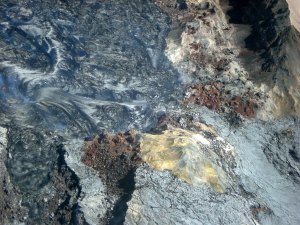
Awesome! The Earth is boiling!
1843, the last one in 1984, is quiet right now but not to be trusted, and Mauna Kea, measured from the ocean floor higher than Everest, often covered with snow, are distinctive volcanic mountains. Pele made Mauna Kea her home and built her final fire pit, high enough that no ocean waves could reach it: the Halema’uma’u crater on the summit of Kilauea mountain. Kilauea volcano is one of the most active volcanos in the world; millions of visitors visit Pele’s last home year after year. The area of many square miles with several calderas, containing boiling lava, occasionally unbelievable fireworks, and constant fumes of sulfurous smoke, is now a National Park.
The Hawaiians still believe in Pele. To show respect, they talk about her as “Madame Pele”. There are stories about how High Chieftess Kapi’o lani, converted to Christianity in the 18th century, tried to prove that her new God is stronger than Pele. She threw something into the caldera – and was not killed as everybody expected. Missionaries ate the red berries “kapu” (forbidden) for humans and nothing happened. They proved a point and slowly Christianity was accepted. But – Pele is still very much ‘alive’ in the minds of Hawaiians. Some claim they have seen her, either as a tall, beautiful woman or as an old lady with a white dog, begging. If you do not share with her, you are severely punished. For years and years, volcanic eruptions were common and since 1983 a never-ending flow of lava pours into the sea.So far, Pele has added 220 hectares of land to the Big Island of Hawaii. Not only that, a new island is growing under the ocean, and the scientists have revealed that it is already close to showing itself above the waves.
I am fascinated by the lava. There are two distinctive types: the a’a lava, dense, crusty, up to ten meters thick, slow-flowing and the pahoe-hoe lava, fast flowing over the a’a, winding, twisting and finally, when cooling, looking like ropes. Caves and tunnels are created and the most famous tunnel, one even tall people can walk through, is located 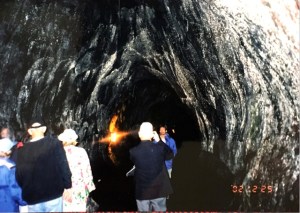 on the Kilauea summit. People have built a small community on this mountain: you can stay in an hotel, spend hours in a museum, buy and write postcards and post them right there in a small post office to get the special stamp. Living in harmony with Madame Pele? Hmm, I don’t know.The Hawaiians warn you about ill health or other serious problems if you take any pieces of lava or even black sand from some beaches on the island. I talked to the lady in the post office about it. She got quite passionate and, to convince me, she opened a door to a room full of unopened parcels, shelves full of letters from all over the world. Tourists, who didn’t heed the warnings, had sent back what they took away. I was able to read some of the letters, letters from people who regained their health after having sent Pele’s goods back. A huge pile of lava pieces next to the post office was lava sent back in already unpacked parcels.
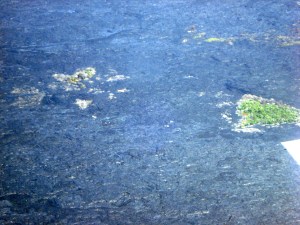
Jack’s house was spared – he still lives there
There used to be a road to drive around the whole volcano area. We did that drive once – but a year later, when we came back, the road was gone and meters of lava covered it. A whole small village was covered with lava, but one stubborn man, Jack, refused to leave his house on the hill. Incredibly, the flow of lava divided, surrounded his house and the house remained untouched. A green spot on a mountain of black! The same happened to a kind of spiritual circle. No wonder that superstition is ripe. We used a narrow path from the summit to the crater and were warned not to step off to either side. Sulfuric little puffs came out of the earth and, being curious, touching the ground, noticed it was hot. At one time, a teen had tried to run and pass other walkers on the path, sank into the ground and nobody could help. Depending on the daily forecast, this path and the road to the crater is often closed.
The last time I visited Pele’s home was in 2011. This time, flying over it instead of driving up to it, gave me a new perspective. The Big Island is made up of hundreds of square kilometers of lava flows. It is incredible how people have built villages and even 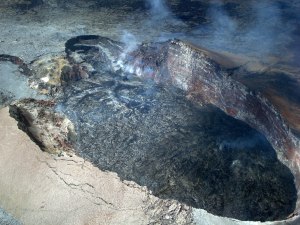 cities on this volatile ground, created many farms, beautiful gardens, airports and many new roads. The lava provides a fertile ground once men with their big machines have a go at it. The birds do their thing with droppings containing seeds and one can only wonder about the power of nature: create, destroy, then recreate. But the might of the volcano can not be harnessed. Looking into the crater from above, it’s a boiling gray soup. And, when Pele gets mad, beware!
If you like to see more, click: http://www.picturesandplanetickets.com/2017/02/08/chasin-lavafalls-hawaiian-lava-boat-tours/
Walls and Walls and more Walls?
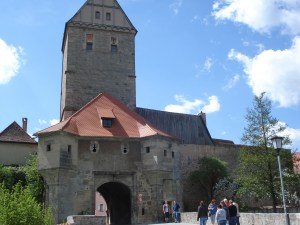
Walls can surround you anywhere. You can build a wall around your heart. People build emotional walls around themselves. Your garden may have a wall for privacy. We had a wall built to shore up our garden against landslip. My favourite city of West Vancouver has a Seawall, the most wonderful place for walking or jogging. I have visited a great number of cities surrounded by walls, mostly built during the last two thousand years to keep out enemies or marauders. Surprisingly, many are still in good shape. And last but not least, I have lived and worked in the beautiful harbour city of 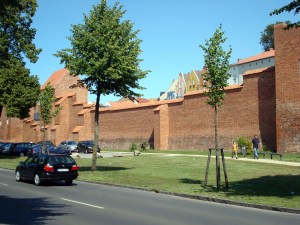 Stralsund at the Baltic Sea with a city wall which was rebuilt after heavy bombardments during WWII. Lest we forget! This wall is not for protection anymore – but primarily for its beauty, history, and tourism. (My guess!) Stralsund is now listed with UNESCO. You find other places with walls surrounding them along the Romantic Road and many other places in Germany. Some even have moats with drawbridges in front of the wall.
Some medieval cities have a small little door next to the big gate which was closed at dusk. A resident, coming home too late to enter through the big gate, had to make himself known to the gatekeeper. The gatekeeper usually lived in a small room above the gate. Giving the right name or password the small door would be opened. During a conversation about religion my old friend Fred had asked me:
“Giselle, do you know how a camel gets through the eye of a needle?”
Fred was a Sunday school teacher. When he asked me he was referring to the Bible, Matthew 19:24. I knew the term but I had no answer. That’s when he explained that the little door next to the gate in the city wall of Jerusalem was called “Eye of the Needle”. During a late arrival with a camel, both man and beast had to crouch and it was very difficult for the animal to get through. Jesus compared it to the difficulty of a rich man getting into heaven.
The most famous and longest wall in the world is the ‘Great Wall of China’. I have climbed this wall to the highest point as the only woman of my China Tour group a few weeks after the horrific happenings in the year of 9/11. The trip to China was the most interesting trip I ever did. Climbing the wall started out easy enough but got harder as the stairs got steeper and narrower. With my western shoe size, I had been walking sideways. At one point – by just inches – I almost got the boot of the man in front of me in my face. Respectfully, I put a few more steps between us.
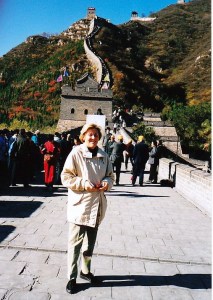 The part of the ‘Great Wall’ my group traversed starts not far from Beijing and was built to keep invading armies out. It runs on top of a steep mountainous landscape. Invaders would be seen early and would hardly have a chance before being destroyed from above. Needless to say, the views are stupendous. The ‘Great Wall of China’ is supposedly one of the very few constructions on earth seen from space. It took many Emperors, soldiers, and criminals over 2000 years to build it. Most of the existing wall was built during the Ming Dynasty (1368-1644) and, naturally, it has been repaired constantly ever since. It measures 8,851 km (or 5,500 miles) but in ancient times, all the different sections together stretched over 21,000 kilometers.
Another well-known wall to most of us is the infamous “Berlin Wall”. It was built by the German Democratic Republic (DDR) during the night of August 13th, 1961. To this day it is a puzzle how nobody had known and nobody ever saw or heard the trucks bringing masses of rocks, blocks, barbed wire and fence materials to the different locations. To build this wall was the only way to stop people from fleeing to the west. Parts of the wall ran along the middle of city streets dividing neighbours, families or friends living in houses on either side. Imagine a wall with glass pieces and barbed wire on top where we have a yellow line to divide the traffic. Thousands had fled the DDR every single day (I was one of them) and more were trying to escape after the wall was built by digging tunnels, even constructing a balloon, swimming across lakes and needless to say, many lost their life trying. The East German police had strict orders to shoot to kill.
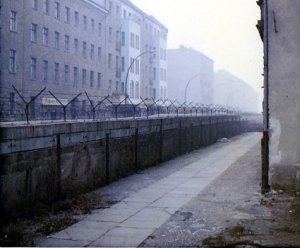 The Berlin Wall was just one part of what became known as the “Cold War”. After the Berlin Wall had closed the biggest ‘hole’ to stop the escapes, construction of a wall with mine fields, and guard towers was built around the entire communist controlled part of Germany. It was probably the only wall ever built to keep people “in” and not to keep the enemy “out”. Just as nobody knew that this wall was going to be built so nobody expected it to come crumbling down during anyone’s lifetime. Incredibly, during a huge mass demonstration on the eastern side of the wall when everyone expected the Russian tanks to crush them, nothing happened and the East German police, guarding the wall, put their guns down. The people stormed the wall, started hacking away at it and once a section broke down, the rush to get through before all hell would break loose, filled the night with screams. Screams turned to laughter as people were met by the waiting crowd on the western side with hugs and tears. With music and song punctuated by champagne corks popping, they started dancing on the wall. The night turned into the party of all parties, never experienced or dared to hope for, uniting people and families after nearly thirty years of being kept apart.
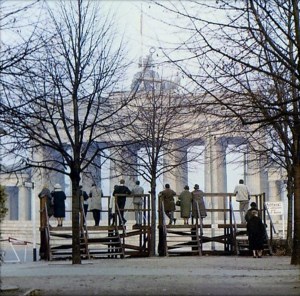
Brandenberg Gate
On June 12th, 1987, at a speech at the Brandenburg Gate in Berlin, President Ronald Reagan had called out to Mikhail Gorbachev,
“Tear down this Wall!”
It happened unexpectedly on the 9th of November 1989. It was the end of the Cold War, the unification of the two Germanys and it started the break-up of the mighty Soviet Union. Twenty-seven years of friendship, rebuilding and a never experienced quality of life for many countries followed. Today, we ask ourselves what may lie in our future now.
Donald Trump promised during the American election campaign to build a wall along the Mexican border. Would it become the most infamous wall of all the walls in the world? From the English songstress ‘Adele’ to Pope Francis and many others, cries like “Don’t build walls, build bridges” are heard. According to Donald Trump, his will be the highest, the meanest, and the longest wall ever. Will it rival the Great Wall of China and will it be seen not just from the ‘Moon’ but from ‘Mars’ as well!? Just kidding…
 Giselle Roeder