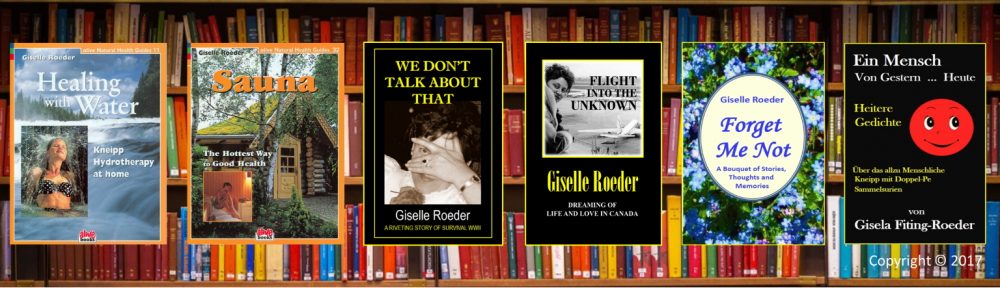
In this video I read a Christmas story found in my latest book – “Forget Me Not – A Bouquet of Stories, Thoughts and Memories” which I hope will be generally available to all my blog followers early in the New Year. I will be sure to post further details in due course. In the meantime I wish you all a very Merry Christmas and a Happy New Year.
Tag Archives: Book
Interview on CJOB, Winnipeg
I was interviewed today by Greg Mackling of CJOB 680 in Winnipeg. You can hear the interview on YouTube at https://youtu.be/a0gjX3cIAoU
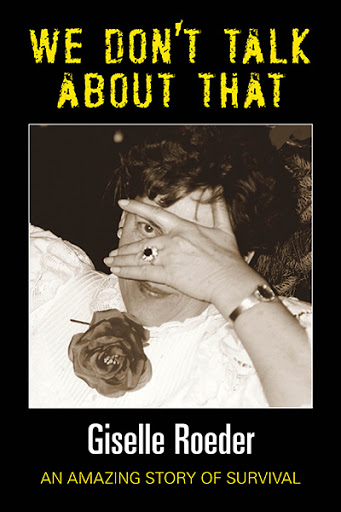
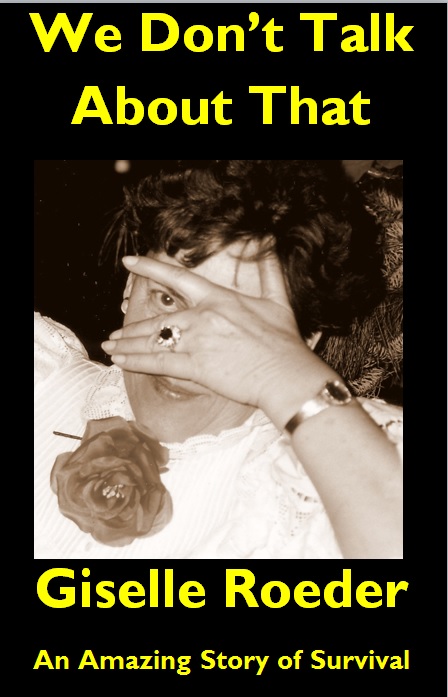
Many thanks to Greg and the staff at CJOB for allowing me this opportunity to talk about “We Don’t Talk About That”
Part 3 – “The Water Doctor”
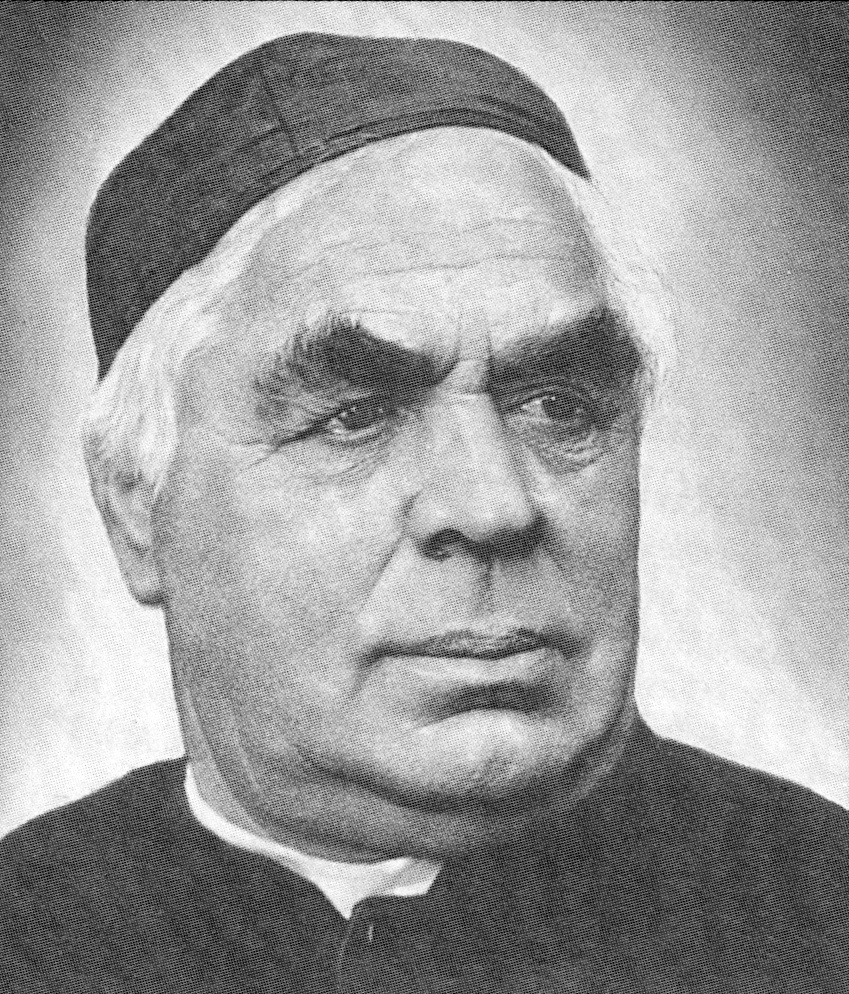
Sebastian Kneipp was by no means the inventor or the first one to use ‘water’ for healing. The Persians used water therapy 5000 years ago, the Romans did several hundred years ago followed by a decline caused by an outbreak of venereal diseases. (Too many unwashed bodies sitting in the same pool) Two medical doctors, Father Siegmund and son Johann Siegmund Hahn are credited with bringing the idea of using water to improve health back to life in the very early 18th century. The little book “The Effect of Water unto and into the Human Body” (loosely translated) was the next BIG step in the developing water therapy. Before S. Kneipp discovered this book and used its recommendations, got well and is now known as “The Water Doctor” several other personalities using their own form of water therapy need to be mentioned.
A farmer’s son, Vincent Priessnitz in Austria with similar experiences as the later living Kneipp. Johann Schroth, who developed the “Schroth Kur” involving some water therapy, extreme fasting with very light vegetarian food, walking and interesting ‘dry’ and ‘wet’ drinking days. The ‘wet’ days starting with a glass of light wine. This “Kur” is still offered in Oberstaufen, Bavaria and people from far and wide attend. Another, a very sick man coming from USA was Benedict Lust who spent time with Father Kneipp as well as attending the Oberstaufen Kur, got well and started the “natural healing movement” in America. He studied medicine and became one of the founders of modern Naturopathy on his continent. There were a number of others, especially in the UK, who contributed to the development.
Father Kneipp started out with just cold water. He insisted to get warmed up before any treatment through wood splitting or fast walking and having a bed rest covered in blankets after the treatment to induce the body to heat up and sweat out the disease causing impurities. The rule is “no cold treatment on a cold body.” To go back to bed for up to an hour after any prescribed water treatment is still followed to this day. The reason is to get the body to respond, create warmth and thereby also affect the immune system. During the last twenty years of his life (he died 1897) Father Kneipp gradually changed his approach. As he saw not just tough hard working men but more and more aristocrats, weaklings in his estimation who had to be ‘built up’ he came from cold water to alternate and from full body immersion or ablutions to partial body treatments and warned ‘no two treatments on different body parts one after the other.’ So if the legs were treated in the morning you did not get a treatment for the arms or the upper body until the afternoon. There should be at least three hours between applications. For physiologic reasons the medical profession confirmed the wisdom of it, once they got involved.
“I bequest my system to the medical profession with the challenge to keep it, improve it but mostly, make it accessible to all.” That was written in his testament. Over the years following his death there were disagreements between the Brotherhoods who had received his sanatoria and different doctors. After WWI wounded and recovering soldiers were sent to Wörishofen for rehabilitation. During the time of the Great Depression until after WWII there was a decline but the flood of wounded soldiers during and after WWII caused a resurgence of the “Water Cure”. A few years after the West German Republic was founded and life had stabilized, the German Insurance companies paid for a “Kneipp-Kur” for their members when prescribed by a medical doctor. It proved less expensive than other methods of rehabilitation. In the nineteen-eighties the Insurance companies even started to build their own sanatoria. The Austrian Government approved a study with 15.000 people led by trained Kneipp-Doctors which proved without a doubt that the group treated with conventional PLUS Kneipp treatments recovered much faster than the group treated the old way and reduced the health care cost by three times.
An International Kneipp Organisation and a Kneipp Doctors Association were founded before Kneipp died and they encompass now thousands of people worldwide. You’ll find Kneipp groups in almost every German town and in most of Austria, Switzerland and other European countries as well as Africa. More than anywhere else Kneipp Spa sanatoria are all over Germany, often the treatments combined with climatic or terrain cures. The full “Kur” consisting of three or four weeks, requires one to be under medical supervision, and now rests on five pillars:
- Water: Treatments consisting of all forms of water: Cold, warm, alternate, steam; full body treatments or partial treatments with water from washings, immersions, ablutions, packs, body wraps partial or full treatments according to the health issues diagnosed and prescribed by a certified Kneipp doctor. They are administered by a certified Kneipp Therapist.
- Herbs: The use of the healing power of herbs inside and out. Herbal infusions or extractions in all bath treatments.
- Food: Simple, healthy, wholesome nutritional food, diet if doctor recommended. Herbal teas although Kneipp also allows a wheat beer on occasion. At this point I would like to mention that Kneipp was the first to collect and catalogue herbs and healing plants which became the base for what we now know as “Naturopathy” and “Homeopathy.” Another man very much involved in this development was Kneipp’s former patient, Benedict Lust from America who is the “Father of Naturopathy” in USA.
- Exercise: Active and passive exercise. All forms of exercise from yoga to walking, biking and everything in between. Passive exercise consists of all forms of massage used to increase circulation.
- Emotional and spiritual balance: Kneipp said: “In all my years of treating people I have never found any healing taking place until emotional and spiritual balance was restored.”
“DO NOT FORGET YOUR SOUL”
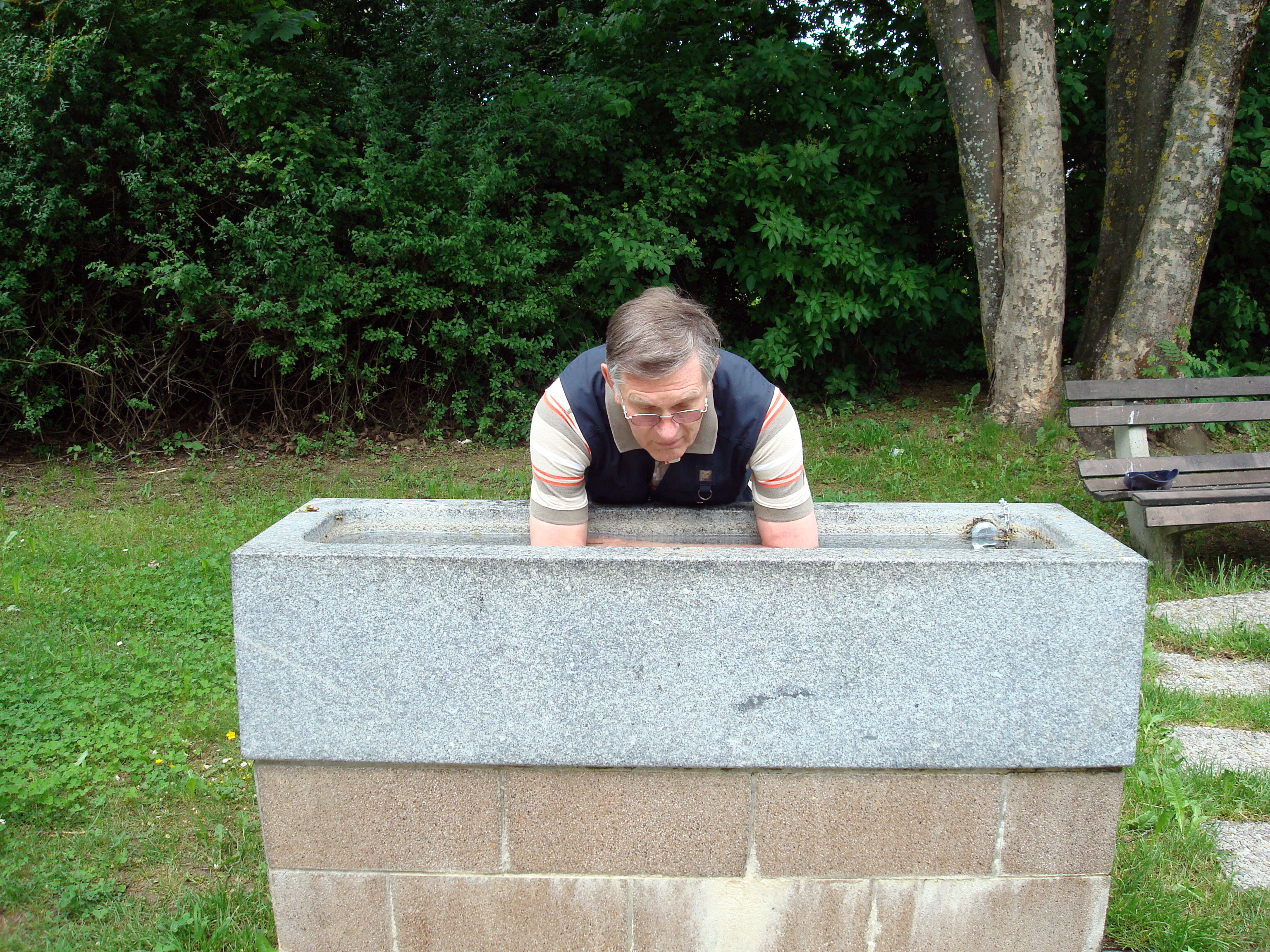
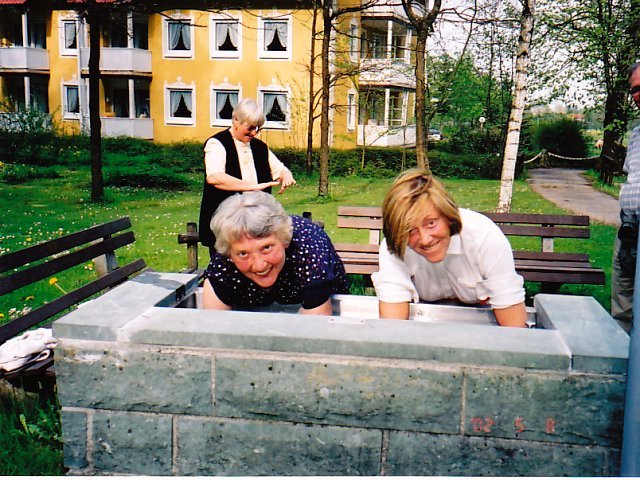
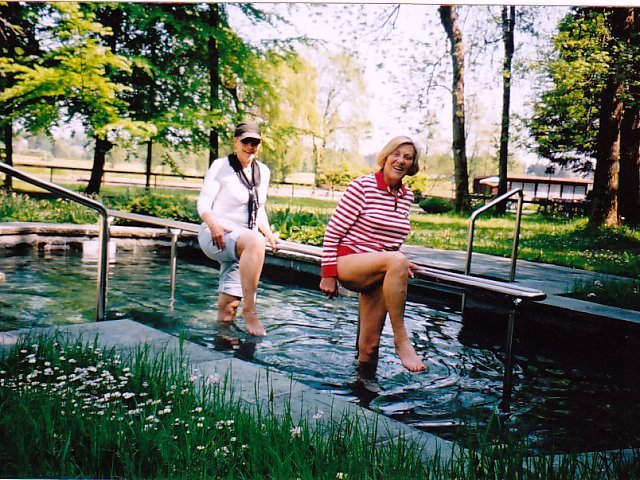
The easiest water treatments are the ‘water stepping’ and the cold ‘arm bath’. All Kneipp Spa cities and most Kneipp Groups in villages and towns have established water stepping sites along their hiking and walking trails in forests, meadows, and many resting places in parks. After a good hike the water stepping is very refreshing and surely will avoid swollen and tired legs. The water usually comes from a stream and is quite cold. You walk through the basin two or three times like a stork, lifting the leg out of the water for an exchange of air-water, air-water until the cold “bites”. Now it’s time to get out and walk on the adjacent lawn until your feet are dry and starting to get warm; sit down on a bench and put socks and shoes back on. Just use your fingers to rub the place between the toes dry to avoid the moist warm spots that fungus likes.
Usually next to the stepping basin is also an arm bath trough. A sign tells you NEVER do both, the stepping and the arm bath. Many people prefer the stepping for the incredible feeling of wellbeing. The arm bath feels refreshing as well, it especially clears your head, lifts your mood, and in general is good for your heart, lungs, brain. Take a deep breath before you dip your right arm in first, followed by the left and e-x-h-a-l-e deeply. Now breathe normally. Count to about twenty or thirty or wait until the cold ‘bites’. Lift the arms out, stroke the water off with your hands and swing the arms until dry while walking around on the nice lawn next to the stepping basin. Make sure the hands and arms get warm again. It feels good to wear a long sleeved shirt or something of that nature after the bath.
In both cases, water stepping or arm bath, – do not use a towel to dry the skin! Stroking the water drops off and letting the air dry you, is the water doctor’s prescription! By the way, you can do water stepping in your bath tub and a cold arm bath in your sink at home.
For detailed advice on how to use water for healing at home, order my inexpensive booklet with photos from: https://giselleroeder.com/bookstore/ or send me a message on my FB page https://www.facebook.com/WeDontTalkAboutThat since I still have a few copies for the special price of $7.00 plus (approximately) $4.00 postage.
German Unification Day
The People of Germany have a special cause for celebration today! It’s their “Unification Day”. East and West Germany were two countries since the close of WWII. They were united in 1989 and are happy to be “ONE COUNTRY” again. For me, having lived through WWII and seen the total devastation but emigrated to Canada in 1963, it is absolutely amazing what and how much the people of Germany have achieved. From saving and cleaning each brick from the rubble their cities were, rebuilding totally destroyed ones and now enjoying one of the highest living standards in the world. My sister tells me not to be blinded by the luxuries visible because despite all, there are many pensioners and unemployed who have trouble making ends meet with the high cost of living and expensive rents. And still, the country is a strong pillar in the European Union, maybe even the strongest.
When I saw the photo of this tree this morning, placed by someone on Facebook, I couldn’t help but think of the divided Germany and the long years it took to grow together again. Just as the tree shows the healthy growth on top of the united two halves, so does Germany. Let’s hope the roots are strong enough to hold up the ever growing ‘crown’. For me, – the 5th of October is also worthy of memory. It was the day I escaped East Germany. To this day my heart beats faster just thinking about it. Hundreds of thousands escaped to the ‘Golden West’ risking life and limb. Finally, they built “the wall” to keep their people ‘in’, not to keep unwanted people ‘out’.
For you, who want to know more about the history and rebuilding of Germany since WWI, through WWII and the after effects without reading large history books pick up my compelling book “We Don’t Talk About That” with the compressed political background easy to understand and, as some readers say “understand for the first time” why and how it all happened. The story you’ll read is one of an ordinary German family which stands for thousands of others who lived through the same trials and tribulations but to this day ‘don’t want to talk about that’.
The Germans have a very good reason to celebrate their special day. Nobody, absolutely nobody, ever expected it to happen; to be able to climb, dance on or hack at, scrape and tear down the Berlin Wall, without any shots fired, without another war happening.
TO BE UNITED AND BE ONE WONDERFUL COUNTRY AGAIN…
How Reading and Writing Influenced my Life
An on-line interview with Tina Frisco:
‘Little Red Riding Hood’, ‘Hansel and Gretel’, ‘Snow White and the Seven Dwarfs’ and ‘Rapunzel’ were the fairy tales my grandma told or read to me many times when I was a small kid. They stuck in my head and I believed they were true stories. These stories had a huge influence on my imagination. Even today I take some television shows to heart in such a way that I lose sleep over murders or behaviour unexplainable to me and I have to be reminded: “Don’t get upset, – these are just stories…”
Tina Frisco had definite questions for me and she made it easy to give her open and honest answers. Maybe for you, my reader, they provide a glimpse into my “inner workings”. Enjoy!
http://tinafrisco.com/blog/guest-authors-artisan-garden/giselle-roeder/
Kids and Kittens
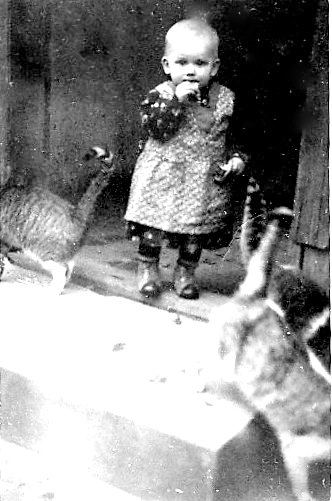
Cats were always around when I grew up. Mother had her cat ‘Molly’, Father had a gorgeous but fairly old cat ‘Peter’ he had owned already as a bachelor. Granny, who lived in the “Granny flat” part of our house, had a cat she called ‘Katzi’. They all were free to come and go and also choose who they wanted to play with, or sit with, or be stroked by. Katzi and Molly preferred to stay away from us children. Essentially they were “mousers”, – meaning they were not ‘house cats’. Tthey lived in the barn or stables of our small farm, hunting mice and rats. Sometimes Father would put a cat down into the root cellar when he had seen mouse droppings. They did a rather good job in doing what they were supposed to do. They did not eat all they hunted. Sometimes Father found a row of dead mice or rats lined up, the cat sitting there, looking up at him expecting a ‘thank you’, which they promptly got in form of words and strokes. To me it always seemed his strokes were worth more than ours.
My cousin Renate’s cat had several young kittens when I was nine. My sister Christel and I each got our very own little kitten. Christel’s cat was all black with yellow eyes; mine had a white underbelly, white boots on its hind legs and white shoes on its front legs. She otherwise had a mottled grey coat, but also had one white ear and a white nose. I called her Mooshie. I loved her more than my dolls. Often I dressed her in doll’s clothing and let her sleep in my doll carriage. Once, she got scared and jumped out and tried to run away. She repeatedly stepped on the dress she wore and tumbled about. It was very funny and we laughed heartily. My father happened to see the cat and gave me a good lesson: “If you love Mooshie, you won’t do that again. If she has to defend herself she will not be able to do so and if she climbs up a tree she will not be able to come back down.”
That happened in the same year when my mother’s cat Molly had a very bad eye infection and my father had to shoot her. It disturbed me greatly. He explained he was being kind to the cat. He cried when he shot his own old cat, Peter, a year later, when it was full of arthritis and could not walk anymore. Peter looked my dad straight into the eyes as if he knew what was coming. It was a very emotional moment for me. I will remember the expression in Peter’s eyes forever. I always wanted to have a cat like him.
One sunny afternoon we older kids were sitting on the broken steps leading up to our house and talking about this and that. The weather was very warm and we were bored. Looking up I saw my cat, Mooshie, coming towards us carrying what I thought was a mouse. She came right up to me, put the little thing down in front of me, looked me in the eye and said, “Meow” with a question mark.
“Mooshie”! I called out, “What is that?” She looked at me again and, after another “Meow,” left us, walking away purposefully.
We were amazed, not bored anymore. I picked up the little squirming thing and everyone agreed it was a baby kitten. It did not even have its eyes open yet, was naked and looked weird. After a few minutes, Mooshie came back with another one. She repeated the scenario with the “Meow” and left again. This happened two more times. When she had brought four of those little critters, she stayed with us and started licking them. Mother had heard our excited voices and had come to see what caused the racket. She was very helpful and understanding when I said I needed to have a bed for the little cat family. She brought a carton and an old baby blanket. We made a little nest and placed the kittens in the middle. Mooshie jumped in and curled around them. The babies found the food supply and suckled. It was fascinating and we watched for a long time.
It must have been a week later when Christel’s black cat, “Moorly”, a sister to mine, had babies as well. She had been smart and had them in Christel’s doll carriage in the house. She refused to move out of it, scratching and biting. None of our cats was allowed to stay in the house overnight. Even when it was raining or snowing, they were grabbed from the warm cozy place on the sofa or on a lap and heartlessly placed outside the house door. Father or Mother, whoever did the deed that evening, would put us off with, “There are enough warm places in the stables and barns; they know and they’ll be all right.” Christel agreed to have her doll carriage put in the barn so that the cats could stay in it. The bedding was all ruined but that was no big problem. It was simply replaced when Mother knew Moorly was in the house for her milk. The cats always got milk and the same food we had.
It was fascinating to us how they developed from little naked blind mouse-like beings to the cutest playful kittens. Day and night we were talking and thinking of our little babies, no more boredom, and naturally we assumed we could keep them all. What a shock when our parents explained to us it wasn’t possible, – all of them needed to go to other houses. One by one they were picked up and we shed a tear or two when it came to the last one. Our only consolation was we knew all the people and they promised we could come and visit any time. I don’t remember if we ever did. The bombing had increased and the on-ground fighting of WWII had entered into Germany and everybody had other worries, even we children had to face it. Life changed dramatically.
Those were the cats of my childhood. The story is an excerpt from, and you can read more of the particular time in my book “We Don’t Talk About That”. There were other cats in my life later: Prince Eugene, another Mooshie, Minka, Max, two little goats and several poodles. But they will appear in my second book, the sequel to “We Don’t Talk About That.”
Books, Books and More Books…
Next to dogs books are my best companions. They don’t fight with me and when they ‘annoy’ me I can just close them and put them away. The material I have read might go around and around in my head; sometimes I understand but always I want to know more and I open them up again a day or a few hours later. Even a book I don’t totally like I will finish because I know there must be a reason the writer wrote it. I dissect the story. I sometimes think about how I would re-write it, or parts of it. But that’s not what I wanted to talk about today. I want to tell you of the books I have read so far this year. Most of them have a connection to my own book “We Don’t Talk About That”. My writing created an incredible thirst in me to know more about war history, especially WW I and WW II. So I started reading instead of writing my next book.
“The Officer’s Code”
Lyn Alexander’s way of telling a story puts you right into it. You identify with one of the characters and you become that person. In this book you re-live the life of a young English man who could not satisfy his father since he did not like to study law and take over the family practice. He failed and as punishment was sent to Germany to study in Heidelberg and “prove” himself. He married a German girl, changed his name to his mother’s German aristocratic name ‘von Schellendorf’ and fought on the German side during WWI. An incredible story based on fact and fiction .
“The Versailles Legacy”
This is the second of four books in what is known as “The Schellendorf Series” by Lyn Alexander. It puts us in the picture of a Germany in tatters and the impossible hardships imposed on the country by the ‘Versailles Treaty’ after the war is lost. The German Representatives argued the stipulations laid on Germany would be counter-productive. A young Austrian WWI corporal, Adolf Hitler, promised jobs and bread and peace for all Germans and his hypnotic speeches swayed many mistrusting Germans to vote for him because they had nothing to lose but everything to gain. The years between 1920 and 1939 lead to WWII.
“The English General”
Once you read those first two books you cannot help but want to read the third one. The establishment of Hitler’s ‘Thousand Year Reich” brought many changes. The old military, the Reichswehr, with the former generals in charge tried everything to stop the new developments but one after the other mysteriously disappeared or was killed. They also plotted to assassinate Hitler but he always got away. One of Hitler’s close allies established the “Brown shirts”, known as the SA which numbered in the hundred-thousands already during the 1936 Olympics. The young Englishman became a German General and deeply ingrained within him was “the Code of honour”. We see him struggle with blackmail by his birth country while once again fighting for Germany during WWII.
“The Ghosts of War”
This, the fourth book in the ‘Schellendorf Series”, finally helps us understand a lot of what happened when the Allied Forces entered Germany. Imprisonment, lies, deceit, interrogations, and, to top it all off, the Nuremberg Trials where the blackmailing English arranged that the famous lawyer, the father of our by now beloved General defends him. His return to England, the ups and downs during the years after 1945, and his secret visits to Germany.
I never mentioned General von Schellendorf’s wife but she plays a huge part throughout all four books, love, deceit, lies, divorce, her re-marriage and abuse by her demented father. At the end of book four we hope for reconciliation and maybe a joint new venture in Heidelberg. Once you read these books and you travel to this wonderful city you’ll know it. These four books feel so “real” that you think you lived through it all. In time I’ll read them again.
“The Night I danced with Rommel”
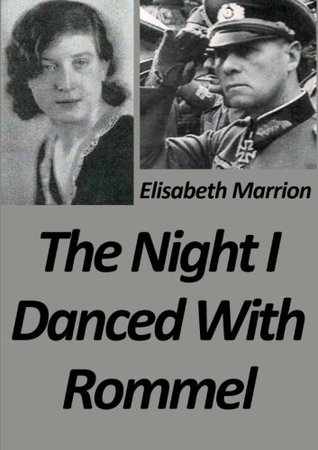
Elisabeth Marrion wrote this heart wrenching memoir of her mother’s life. Married to a soldier who fathered a baby every time he was on leave, her mother had to look after and somehow provide food for five small children. Dealing with the bombing of her hometown of Hildesheim, and being a hands-on woman a lot of neighbors relied on her. When her husband was transferred to Africa to fight alongside General Rommel she was relieved of the scary thought of him being killed in Russia. As the story moves on General Rommel’s Regiment happens to be stationed in this city for a few days on their way to France and she was singled out by him to do the first dance during a party the towns-people organized to honour him.
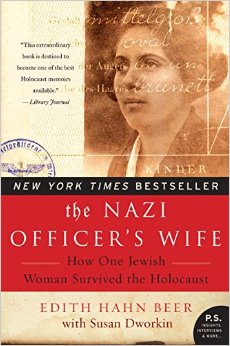
“The Nazi Officer’s Wife”
Two authors, Edith H. Beer and Susan Dworkin told the story of Jewish women who married Nazi Officers to save their lives. In many cases the husbands had no idea they were Jews. These women were known as “U-Boats” or “Submarines” living normal lives when they were everything else but normal. This story is gripping, has been made into a movie, documentaries and has received worldwide accolades. It is hard to believe what the author, Edith, has endured during the time of the Nazi take-over of Austria to the end of the war living in the Russian occupied Germany. I had no idea that these women even existed and was touched to my deepest soul after reading this book.
“In the Garden of Beasts”
Eric Larson does not need an introduction. In this book he tells the story of the American Ambassador to Berlin during the early years of Hitler’s reign. The book is based on hundreds of letters to the American President, the diaries of the daughter and one is overpowered by the incredible research Larson must have done over several years to write this book. It is rather a lengthy book and towards the end I felt as if I myself went through WWII again. Exhausted.
“Louisa Elliot”
How I loved this book by Ann Victoria Roberts, a gifted writer! The novel is set in York in the 19th Century and involves a family drama that sometime just takes your breath away. Despite the fact that it has about 700 pages (e-book) I was sorry when it ended. Not a surprise to me when I found out that it sold over a million copies when it first came out. Luckily there was another book for me to read following this one, called
“Liam’s Story”
Also a big book and I tell you, this one occasionally makes your blood boil. How can a writer write books that you simply cannot put down? How can she make you identify and suffer with the protagonist? How does a brain like Ann’s work to come up with these tales just because she happened to find a small diary of a family ancestor? Each novel can stand on its own but read “Louisa” first…
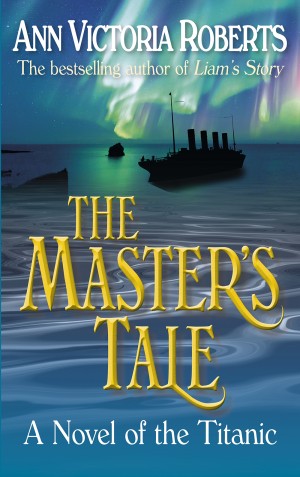
“The Master’s Tale”
Another Ann Victoria Roberts book – this one is based on her research about Captain Smith, Captain of the unsinkable “Titanic”. She portrays the rich and famous guests, the interactions of many of them, love triangles, affairs, and intrigues. When the ship hits the iceberg you can hear the cries, you will feel the cold water and you see the listing of the big ship from your life boat and finally see it disappear as if it had never been.
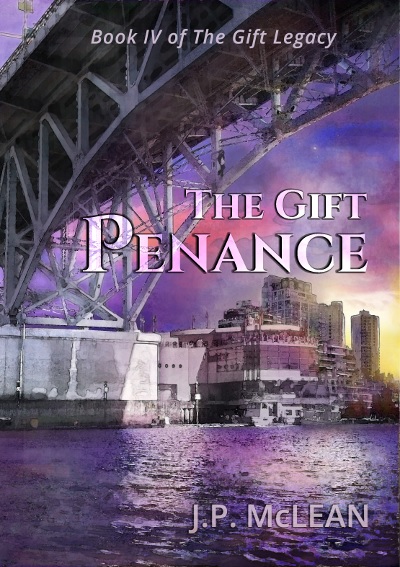
“The Gift Pennance”
Jo-Ann McLean writes ‘thrillers’. I have never read thrillers and cannot recall how, or when, I read a couple of chapters of this book on Linkedin, Amazon (Look Inside) or perhaps came across Jo-Ann’s website. Because it involved kayaking I wanted to read more. The story is set in Vancouver and since I know and lived in this fair city I was intrigued. When I started reading I realized I had never ever read a book like it, totally fictional and an imagination I can only marvel at. Some scenes in it caused me to contact her (bless the Internet!) and ask what her family or her husband thinks about some of the scenes. This book is part of a series, the previous one is the “Gift Legacy” but I have not read it.
“North of Normal”
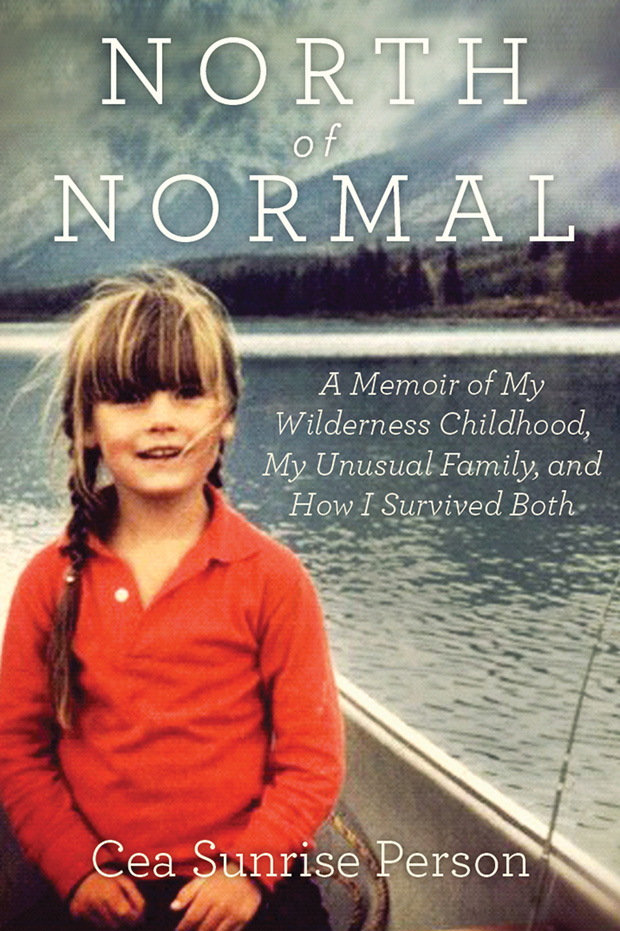
Cea Sunrise Person took seven years to write this shocking memoir of her childhood, growing up during the ‘counter culture’. Her grandfather moved the family from California to the North Country wilderness. They were growing pot, smoking and selling it, living off the land, fishing and wildlife. Periods of plenty changed with periods of hunger. Little Cea’s home was a tipi/tepee shared with her very young mother and a number of other adults who thought nothing of nudity, open sex, changing partners. Cea invented her own games and amused herself without contact with other children until she had to go to school. Seeing the first pair of underpants and a fancy frilly dress made her realize that there was another life out there and she had only one wish: To survive the crazy life she was living and her ‘crazy family.’ After her book was published her friends asked her: “How did you ever turn out so normal?”
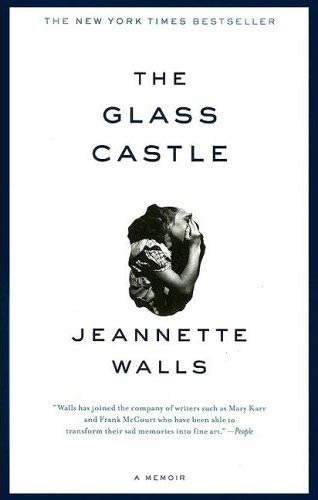
“The Glass Castle”
I had no idea what living in the sixties for the people who chose to live the ‘free life’ was like and I must admit that the book “North of Normal” had deeply disturbed me. Friends, whom I told about it, encouraged me to read ‘The Glass Castle” – a similar book by Jeannette Walls. The language is not quite so vulgar because Jeannette’s parents were actually educated, but they chose a life of nonconformity, poverty and their children had to fend for themselves. When hungry the older two went through garbage bins and ate what others had thrown away. Their clothing was bought in Thrift shops. They were dirty, they smelled and other children did not want to have anything to do with them. Jeannette could be compared to Cea in ‘North of Normal’ as both girls were trying to get an education and create a better life. Both succeeded. Paramount bought the movie rights to this book. It has been a bestseller for years and Jeannette has been interviewed repeatedly.
“We Don’t Talk About That”
This is the book I am re-reading now. It came out in April 2014, I have read it before, but I am surprised how it “gripped” me again. Another one of those books “hard to put down.” I am so sorry not to have more time to read. But I have to write. My readers are constantly reminding me and asking “when is the sequel coming out? Are you writing it? How far into it are you?”
I have given you a number of fantastic books to consider reading. None of them will disappoint you. So, – find a cozy corner and READ books – books – books. Live in a different world for a while, a different time zone, on a different continent or even a different dimension. Enjoy!
Paddling the ‘Broken Islands’
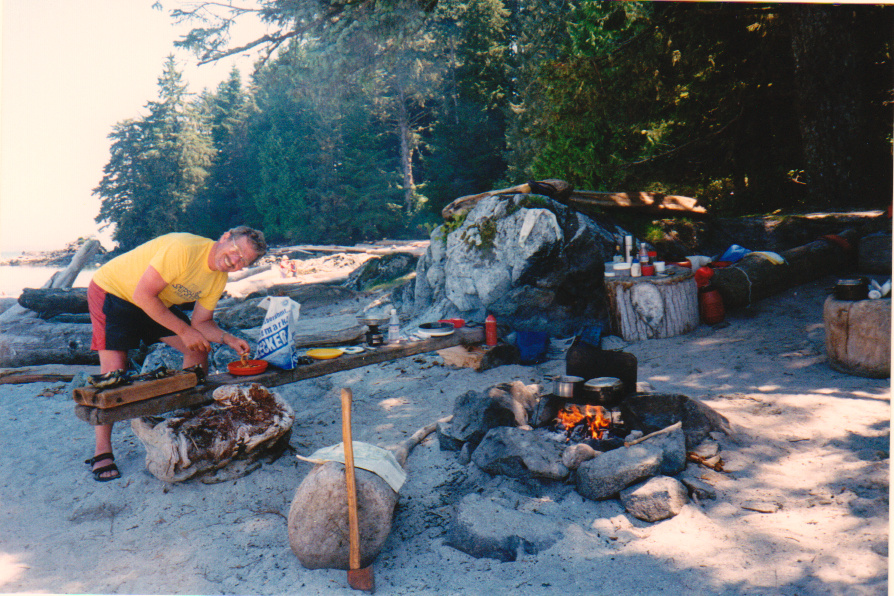
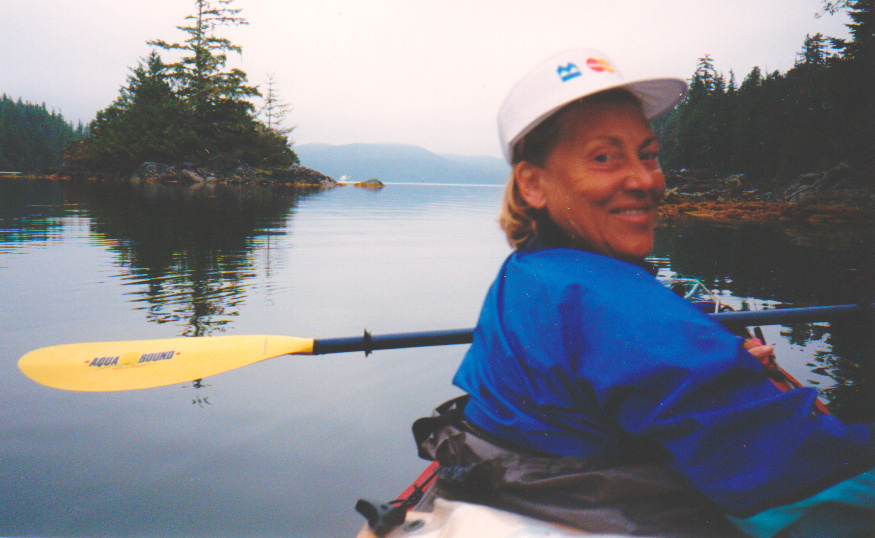
I have to share a very much appreciated review of my book “We Don’t Talk About That” from my good old friend, one who has written books and many essays himself, one who has started the first kayaking club in eastern Canada and tried to teach me to ski on Grouse Mountain on the west coast; one who has started and established architecture courses and taught at the university, involved in building an opera house and did all kinds of other incredible things. One thing we did together was a weeklong kayaking trip through the ‘Broken Islands’ starting in Ucluelet, B.C. on the west coast of Vancouver Island.
I will never forget how I carried all our supplies to the boat close to the ocean where we were to take off. Gerhard had left to find a parking place for his car. Returning on my second trip with another arm full of ‘stuff’ I saw hundreds of seagulls ripping into our food bags, nuts and dried fruit was all over the place. I had to fight them off while I saved what I could. When I finally had everything piled up next to the boat the ocean had left, – the ebb tide had set in and I stood next to the kayak on the sand watching the water retreat farther and farther. Quite a helpless feeling!
I will also not forget how we had a fishing line attached to the kayak and all of a sudden the paddling seemed harder. Wow! A good sized salmon was on the line and fighting to get off. As my friend started to reel it in it took just a moment and an eagle dove down and stole our supper. We had to cut the line, we had no choice. Camping on different small islands we harvested mussels and oysters, cooked them in ocean water and sometimes shared them with other campers.
Paddling towards a huge big rock off the coast we heard the howling of sea lions. As we came close one giant stood up and apparently gave a loud order and at least a dozen of them dove into the ocean and stood like a wall in front of us, bobbing up and down in the waves but never taking their eyes off us. I was scared and wanted to paddle away but Gerhard kept his course and only just during the last moment steered away. I am sure those beasts would have capsized our kayak and we would have drowned.
It was my most exhilarating and exciting kayak adventure in the waters of the Pacific Ocean. Sometimes we had to fight huge waves but we made a terrific team as we were both experienced paddlers. Gerhard, an Austrian by birth knew the ways of the ocean while I was used to paddling on the Baltic Sea even though my kayak competitions were mostly on lakes and rivers of Germany.
Memories. And now Gerhard read my book. I was anticipating some critique from this widely read and educated man. I want to thank him from the bottom of my heart for what he had to say:
Giselle,
Finally I purchased your book. I started reading and couldn’t put it down. It isn’t just good it is very good. It is gripping, even though I have heard much of the story from you over the past twenty years. It is good to see the story did not change. It is well organized so that one knows who is who as we meet them over the years of age, old rural bliss, looming disaster, cataclysm and redemption.
You may have started a new genre with this book. It is not often we encounter a book showing fortitude and heroism amongst the despised losers of a bitter war, together with kernels of humanism remaining amongst the unspeakable brutality of vengeful victors when they encounter the only ones left: the innocent. Everyone should read it.
Gerhard S.
Hot weather and cold water
Is it warm or hot enough for you when the thermometer reaches more than 30°C/86 Fahrenheit? Do you still feel energetic and go about your day with enthusiasm? Is the sweat not yet running down the side of your face, from the hairline above your forehead and, when getting into your eyes, cause a burning sensation? Can you still sleep comfortably without air conditioning? Are your ankles swollen and hurt? Do you suffer from light-headedness or do you have constant headaches? Here are some tips from my book “Healing with Water”:
One solution for many of these problems is COLD water. Simple ‘treatments’ like a cold arm bath, a cold leg rinse or wading like a stork in cold water will provide some relief. Always do just one of the following, never several of these ‘treatments’ one after the other. There should be at least 4 hours between them:
-
Fill a sink with COLD water. Bent over it and insert your arms (right one first) covering from hands to over the elbows. Keep the arms covered with water to the slow count from 1 to 30 or even 40. Lift the arms out, stroke the water off, swing them dry. This ‘treatment’ is refreshing and relieves pressure in the head and upper body. If you have access to a garden hose use it to rinse your arms all the way up to the shoulder, (right one first) hold for 15 seconds, move back down and do the left in the same way.
-
Fill half the bathtub with COLD water to knee height. Walk in there on the spot by lifting one leg after the other completely out of the water so that you have an exchange of air and water. Do this until you feel “it’s enough” or 2 – 5 minutes. Carefully get out of the bathtub, stroke the water off your feet and legs and walk on a towel until they are dry. This has a fantastic effect on the circulation, helps with the lymph flow/swollen legs, and is very refreshing. If you want to save water you can keep it in the bath tub and add ice the next time you want to use it. You could also use a large pail filled with water, sit on a chair in front of it, insert the legs and lift one after the other out and back in as if you are walking.
- Instead of the bathtub you could also just let cold water run over your feet and ankles when suffering from swollen legs. You will know when it’s long enough. Again, just stroke the water off and let your feet air dry, possibly elevating them by lying down.
- If you have a garden and a garden hose available, use it to run the water slowly up your legs, starting with the right foot and go as high as possible above the knee. Move the stream of water around on the leg so that it is totally covered with a ‘water mantle’. Move the stream of water down and then up the left leg. If you cannot stand, sit on a chair and do the same.
- For swollen legs and a better sleep you can wrap both calves in COLD towels and cover with a thicker dry one to keep the bed from getting wet. Should you fall asleep take the wraps off when you wake up, otherwise take them off when they feel hot since they will absorb the heat from the legs, usually after about 30 minutes.
- Another way to treat hot feet/swollen ankles at night is using “wet socks”. Take a pair of knee high cotton socks, soak them in ice cold water, wring out slightly so they don’t drip, pull them on, right leg first; take a pair of larger dry socks to pull over the wet ones. Take them off when you wake up or when they feel warm/hot. Your body will tell you when it’s time!
- Should you be one of the lucky ones to live close to a stream, lake or the ocean, try to walk in it at least once every hot day. If the ground is covered with pebbles wear a pair of cheap plastic sandals.
- It’s important to stay well hydrated. If you normally drink about one and a half litres of liquid go ahead and almost double it. You lose a lot of moisture through perspiration. You may not even be aware of it since it evaporates into the hot air. The more evaporates, the more likely your skin will dry out and form a lot of wrinkles…
I wish you a good and enjoyable summer, stay coooool…..it’s better for your heart!
“In My Own Words” #memoirs #books #writers
A special event to chronicle four memorable memoirs at the West Vancouver Library
“We are always excited to celebrate literary talent” said Information Services Department Head, Pat Cumming. “For this panel we gathered an entertaining range of personalities, adventures and stories. Having the always enigmatic Eric R. Brown (author of the Edgar nominated novel ‘Almost Criminal’) on hand to moderate the panel is the icing on the cake. It’s going to be a great night.”
And ‘in my own words’, it was, so much so that I was not able to sleep the following night. There was so much to process, so much to digest and so much to think about. It was exciting to meet the other writers, first for me was Judy McFarlane, a calm and quiet pleasant woman, then I was startled by the gorgeous long-legged creature Cea Sunrise Person and, luckily, meeting former Judge David Roberts brought me back to earth. The room slowly filled up, the four of us were seated facing the audience and after Eric’s welcome address and the introduction he explained the program of the evening. Each writer had to read a 5-6 minute piece of their book after which he would ask the reader questions relating to the memoir for 15 minutes. At the end of the over an hour long program there would be time for questions and answers, interacting with the audience.
I was appointed the first to read because “your memoir goes back the longest time”. From my book “We Don’t Talk About That” I had chosen the story about the miller who had no flour but my family was hungry and I decided I should go and ask him anyway. He must have felt sorry for me because he told me to crawl under the millstones and sweep up the powdery dust. He told me that one has to eat 400 pounds of dust anyway before one dies and this stuff would still be good with the bran in it to cook soup or bake bread. Then he asked me if I was hungry. Hungry? What a question! I was always hungry. He invited me into his house to have a sandwich. I was apprehensive because if my experiences with the Russians during the invasion but he seemed so nice I wanted to trust him. While he busied himself he asked me to tell him about me. I couldn’t. He kept prodding and all of a sudden it all came tumbling out of me, it was as if some flood gates had opened. I told him about the Russian invasion, what they did, how we lost our home, the walk to nowhere next to the Russian war machinery towards Berlin, the diphtheria and the sleep in the strawberry patch, the train and the murder of the young woman and her daughter, what the murderer did to my mother and how the next morning she pushed us out of the moving train and more of the cruelties to which we were subjected. The miller had one hand on the bread, a knife in the other, stared at me and just said: “Oh my God…”
The questions from Eric, who apparently had read all the books, were about writing a memoir like this, how I remembered, how we dealt with and survived the horrors of rape and murder and starvation and how years later my life took a different turn.
The next one to read was Cea Sunrise Person, the youngest of us. Cea was born into an unusual family consisting of grandparents, aunts and uncles, grew up in the wilderness and in teepees living from the land and nature during the so-called counter culture. I assume it is safe to call it the hippie time with its sexual freedom, nudity and drugs. For me a look at a totally new way of life I had never been able to comprehend. I also had never met anyone who was involved in it. She mentioned several times that even as a child “I always felt I did not fit into it”. In my mind remains the question how she, as a very young child, would know that and how and when or at what age was she able to compare her life with another? Reading several chapters of her book “North of Normal” online I was intrigued by her memoir and it was mainly “SHE” and her story that had kept me awake that night. To really understand I guess I’ll have to read her book. As a writer of a story I never told for seventy years I know it must have taken guts for her to tell all and open herself up to judgement. She says “it took me seven years…” Yes, Cea, I believe it. She read a story from her book about being invited to a birthday party, had no idea that she needed a gift and decided to give away her most beloved item, she also had no dress and on arrival naturally felt totally out of place. By chance she happened into the room of the birthday girl, saw a dream dress on the bed, took off her t-shirt and tried it on. It was too small but the picture she saw in the mirror took her breath away….It was sad how the story ended. She went home in her old outfit and took her unappreciated ‘gift’ with her. For a child of about five (?) it must have been heartbreaking. But let me tell you, Cea went on to become a model at thirteen, lived in New York, Los Angeles and Paris, she modelled in Munich and even then “I felt like a freak, never fit in.” Now she is married, the mother of three and people who read her memoir wonder “how were you ever able to become so normal?”
David Roberts, a former judge and attorney wrote “Letters to His Children from an Uncommon Attorney”. Cea was a very hard act to follow but within minutes David had the attention of the audience. He had picked a humorous story to read and there was not a person in the room who did not join in the laughter! Let me try to somehow piece it together. For some reason David had to go to a liqueur store and as he entered he glimpsed a man standing not too far from the entrance holding out a cup. He briefly thought of the people needing to beg and avoided looking at him. When he came back out with a huge bag with bottles in his arms he pushed the door with his backside and then dropped the change of three quarters he had received, into the man’s cup. He was surprised and shocked when he heard a splash and now, glancing at the man, was told “My goodness, I am just holding my coffee and waiting for my wife…” The voice sounded familiar and the man was also known to him: Another judge! The 15 minute interview by Eric following the laughter was surely a release of tension in the room caused by the previous readers. It revealed that David had four children, three boys and a daughter. He often told them stories from his life and it was the daughter who had told him “to write it all down before you die.” The result is this at times humorous and at times harrowing memoir of a father, a husband and an attorney.
Last, but not least, it was former lawyer Judy MacFarlane’s turn to read from her book “Writing with Grace”. One could be under the impression she had written guidelines to write with ‘grace’ and be surprised to learn that it was a twenty-four year old girl with Downs Syndrome named Grace Chen who had come to seek help with a poem. The mother of this girl was in the audience and was introduced. It was heart wrenching when Judy read about Grace telling Judy “My real truth is too scary, I like to hide my real truth” when talking about her poem and Judy is taken in by the earnest desire of this girl to become “a famous writer”. When Grace was born the grandfather had told her parents ‘put her away and forget about her’. Judy traveled with Grace when she gave her own book to this grandfather. Judy read a piece about Grace’s memories about the Titanic, what happened, her fears, a helicopter coming to save the people.
The book Judy wrote about her involvement with Grace is an account of her own and others prejudices and the often dark history of Downs Syndrome. The book is called inspirational, exceptional and I am sure of great interest to all people having to deal with this disease that is no disease and not a birth defect but, according to the Canadian Down Syndrome Society ‘a naturally occurring chromosomal arrangement that has always been part of the human condition’. I could tell by Judy’s tone of voice that the story of Grace is still deeply troubling her and close to her heart.
Check out the books on Google by name or title. I think reading any one of them will enrich your life. The evening when all of us writers came together will long stay with me and I am extending a big THANK YOU to the West Vancouver Library to making it possible.