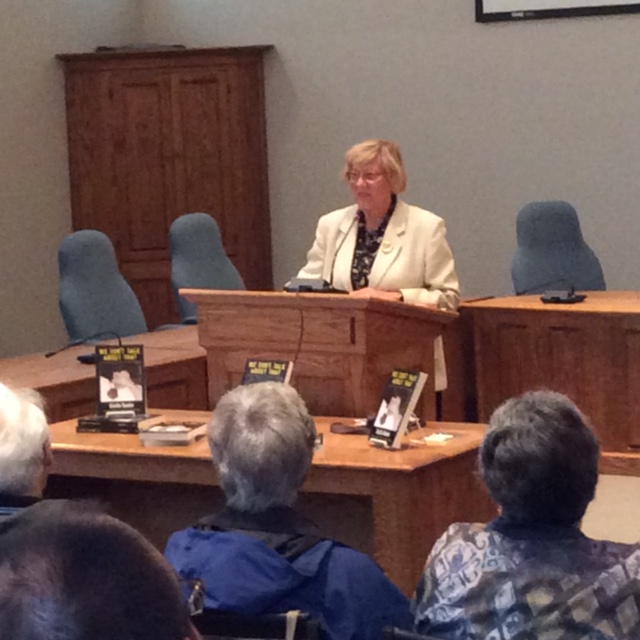
 Despite the very rainy weather we had a good gathering in the Council Chambers at Parksville Library today. One lady who came to hear what I had to say remembered my home town, Stresow, where I spent my childhood and, in further discussion, it became evident that she came from the very same town where my father was born. What a small world it is. She confided that she had escaped rape by having short hair and dressing as a boy.
Monthly Archives: September 2014
More Newspaper Coverage #PQB_News
 The Parksville Qualicum Beach News has published a story concerning my book in preparation for a book reading at Parksville Library on Friday September 26th at 1:30 p.m. You can find the article here.
Book Reading Today #WeDontTalkAboutThat
Another pleasant evening with 23 people this time at the Nanaimo North Library for a book reading with some interesting questions and discussion. One lady bought a copy yesterday and read the whole book overnight in order to be informed when she came to the book reading today – another case of “could not put it down”! So many people wondering when the next part of my life will be revealed. Many thanks to Stephen Warren and Darby Love from VIRL who helped to make this event possible.
Successful Book Signing Today #WeDontTalkAboutThat

Book signing at Chapters
I had a successful book signing at the Woodgrove Centre branch of Chapters today. Many thanks to Manager Tim and the rest of the helpful staff at Chapters.
Tomorrow I look foward to a book reading at the North Nanaimo branch of the Vancouver Island Regional Library on Hammond Bay Rd at 6:30 p.m.
Refresh – Four Minutes of Fame #WeDontTalkAboutThat
The YouTube link originally posted for this blog post was changed. The link below is now the correct path to the video.

Red light, interview in progress.
We all have our moment in the sun. I had all of 4 minutes under the bright lights and in front of the TV cameras last week. Check out The Show on YouTube and scroll forward to 29:15 for my interview about upcoming book signings and book readings.
https://www.youtube.com/watch?v=onwpKtKENSM&feature=youtu.be
Answer to a question: #WeDon’tTalkAboutThat
 One writer on a sub-group on LinkedIn posed this question:
“Who is the most memorable character in your book?
I did just that, the name I gave was “Gila” who was the heroine of “We Don’t Talk About That” whose story is an amazing story of survival. After several days had passed I went on to post the following on LinkedIn:
I am surprised how much text many of you wrote. For my part I tried to keep my posting very short. Now I may add a bit more of Gila’s story titled “We Don’t Talk About That“:
Christmas 1944 – it was the last year of my childhood but I did not know it then.
During the month of January 1945 the Russians made rapid advances into Germany. For my eleventh birthday nobody came to visit because people had been robbed or even killed by German deserters for clothing or money, everyone stayed safely at home. A few days later our teacher announced that the school would be closed, permanently. The Red Cross would turn it into a field hospital since the front was very close. We had heard the noise of the fighting for days now. Mr. Koenig had tears in his eyes when he, with a breaking voice, said “Good Bye children, may God be with you. We may never see each other again.” As we left he shook our hand instead of looking at the usual ‘Heil Hitler’.
That afternoon the church doors were wide open despite the cold. The organ was played ‘with all the stops pulled’ as the village folks said. And that was where the Russians found him, his wife sitting by his side. ……
It was very dark when some horrible screams woke me up. I thought it was a bad dream, but my dad whispered: “Please, be quiet, be very quiet.” We heard some loud cursing and the house door was opened and closed with a bang. The screams came from Helen and Betty. Several Russians had raped them. Their grandfather had tried to protect them and was brutally beaten. When he was unconscious they just threw him out the door and went on with their business. To our horror we found him dead and frozen in the morning. …..
A couple of days later all men and women between sixteen and sixty years of age were horded together, the unfit and nursing mothers were pushed aside, the rest were taken to Siberia. …..
The first Russians moved on and the next ones evicted everyone. We just followed all the other villagers with no idea where to go. We walked across a field where the mighty Russians had killed the last of the fighting German army. Body parts lay scattered. I pushed the pram with my baby sister. My mother called out “Gila, don’t look to your right.” Tell a kid not to do that! A soldier with his head beside him leaned against a fence. His legs were not attached but on the other side of the pram. This sight became a nightmare for me for many years.
Arriving at a house where about 40 women and children were standing around we asked if we could join them. One woman said “The more the merrier, that way we might get away with just one soldier raping each of us instead of a whole army.” The Russians locked us all into one small living room. One spoke a little German. Asked why the Russians raped young girls as well as old grandmothers he shrugged his shoulders, and said “Woman is woman. Has hole.” …..
The above is just a short part of the book. Gila, her mother and sisters walked on with hundreds of thousands of others alongside the Russian war machinery on their victorious march towards Berlin for three weeks, no food, no water, disease, lice; the dead and dying were just left in the ditch. …..
Starting towards the end of 1945 the rebuilding of some kind of order, school, farm work, the establishment of East and West German States, followed by Gila’s haphazard education to become a PhysEd teacher, kayak sport, escape to West Berlin, an unwanted affair, a confrontation with a convicted rapist on parole became all too much. Gila had just one wish: To get out of Germany, to get away, to emigrate, to be free, to start a new life.
See BOOKSTORE to purchase book. To FOLLOW my blog go to top of right hand column and click on FOLLOW button.
What happened to them? #camping #BalticSea #escape #kayaking
They were sleeping in four tents next to us. We were camping on the beautiful Isle of Hiddensee. Located between the mainland and the larger Isle of Rügen it was one of our favourite weekend and even holiday spots. Hiddensee was a narrow long island and you could walk from the high cliffs with the lighthouse at the Rügen side all the way down to the other end where it tapered out into sand banks. Starting to paddle or with a good breeze and able to hoist our five square meter sails it would only take us between three and four hours from Stralsund to Hiddensee. We would aim for about the middle of the island, a place called Neuendorf with the fishing harbour, surrounded by typical bright white romantic thatched island homes. These low houses with small windows were hunched down low to let the constant wind blow over them. We had to start walking on a sand bank for the last one or two kilometers and pull our boats until we hit deeper areas again. The island was quite narrow here and had dunes and a nice beach facing the open Baltic Sea.

Show your ID
We were four girls in two boats and had two tents. We found a nice camping place adjacent to the nude beach. We were surprised to see fully uniformed policemen checking the passports of the nude people. Where do you carry a passport if you have no clothing on? While we were spending the rest of the day sun-tanning and swimming several other tents had gone up in a row next to us with five single kayaks placed upside down between them. Five very fit looking men in their twenties were organising their blankets and cook ware. When they noticed us next to them they called “Want to have dinner with us? Just soup, – but good company as a side dish and music for dessert. You’ll have to have your own bowls and spoons though.”
For several days they were busy exploring the island and the very few shops in Neuendorf and Kloster, the village closer to the high part of Hiddensee. They would sit on the dunes every night for hours and watch the military search light reaching out with bright long arms over the Baltic, starting at the lighthouse and coming back from the sandbanks.
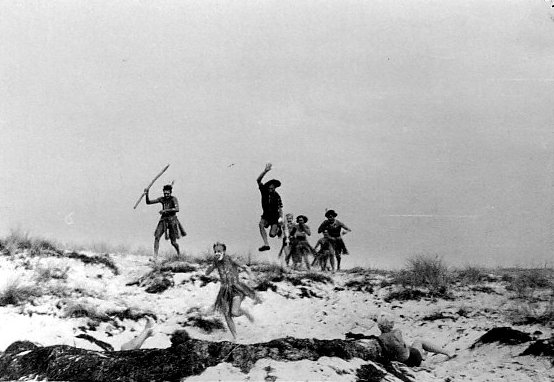
Tribal attack

Dress rehearsal
We planned to attend a costume dance and were busy picking beach grass and making grass skirts. Intrigued they inquired what we were up to. “Can we join you?” We were delighted. Now we did not have to walk home in the dark on our own after the dance. We made more grass skirts and with lipstick painted Indian designs on our faces and bodies. The men had found some feathers to complete our costumes. We celebrated with a kind of dress rehearsal on the beach and a few drinks loosened our inhibitions. With lots of noise we entered the dance hall and celebrated with our own tribal dance. We scalped a few people, and at the end won first price for which we received a bottle of rum. The boys disappointed us by saying ‘good night’ when we suggested sitting on the dunes with them and let the bottle go around. “Tomorrow is another day” were their parting words.

We won first prize
When tomorrow came their camping places were empty. Tents gone, boats gone, not even a garbage bag left. It was as if they had never been there. Inquiring of other campers nobody had seen or heard anything.
What happened to them?
To find out order your copy of “We Don’t Talk About That” right now! Reading this book will make your head spin.
 Giselle Roeder