
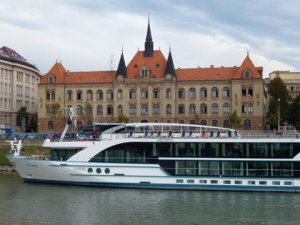
After checking in to our Scenic “Ruby” riverboat and getting settled in the cabin with the help of our own butler for the fifteen days of the cruise, we joined the other 167 travelers for a briefing. Before we knew it, we had cocktails in our hands, looking for a seat and munching on goodies placed on the tables. The cruise director welcomed everyone and caused a lot of laughter with his own brand of humor. He told us the do’s and don’ts while on the cruise. Lots of people were ecstatic about the fact that the drinks all day and evening were free. I would say, not really ‘free’ because we paid ahead of time, and drinks, excursions, and tips were advertised as included. For the next two weeks, we didn’t need any cash or credit card money. Most of the guests were from Australia (Scenic Cruises is an Australian company), the second largest group was from the UK, then Germany. We were about a dozen Canadians. Seating for meals was open, but the team of eight from our Probus Club in British Columbia stayed together for the dinners. I could tell you funny stories of our and other people – but this blog is not about people but the cruise.
 Casting off before dusk, gliding along the (not blue!) Danube, passing under the magnificent bridge between Buda and Pest, by the incredibly beautiful and lit up Parliament Building and Margaret Island, we had a three-course Hungarian dinner, red and white Hungarian wine and musical entertainment with Hungarian folk dancers.
 We arrived in Bratislava, the capital of Slovakia, the next morning. A fortress on a hill, castles, many other large buildings, and domed churches formed the magnificent skyline. At one time in history, it had been the Royal city of the King of Hungary. Almost a dozen queens and kings were crowned here. The Habsburg Emperor was also King of Hungary, though not at the same time. Bratislava was thriving during the 18. Century under the Empress Maria Theresia. More Austrians and Germans lived there than Slovakians. It became part of Czechoslovakia in 1919 after the great war and the fall of the Empires, and it got its independence in 1993.
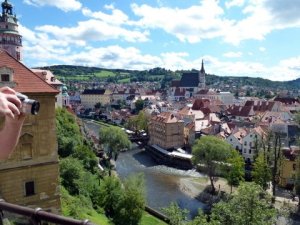 At each stop on the way to Amsterdam, we had a choice of three excursions. Here, in Bratislava, we decided to join a trip to Cesky Krumlov in the Czech Republic. We enjoyed an impromptu concert at the cobblestone plaza, we wandered the alleys, stopped for an ice cream in a typical Czech restaurant, didn’t understand a word spoken, decided to do the strenuous hike up to the old castle, and we loved the view from up there. After an exciting evening on our floating hotel, we were on our way to Vienna to enjoy Austrian food and wine.
It was great to have two days in Vienna, this world-renowned city; the city of art, music and elegant living. The souls of Mozart, Beethoven, Haydn and many other famous musicians live on in Vienna; the first waltz, considered a sinful dance, composed by Johann Strauss was danced here. Many years ago, when I was visiting Vienna for the first time, I had met the Grandson of one of the Strauss composers in Grinzing, a romantic part of the city known for its wine drinking cozy establishments. He invited me into the Strauss home for Sunday afternoon coffee, and I touched the Grand piano that two Johann Strauss men had composed on. I was desperate to find my friends again, checked the Vienna telephone book, phoned several Strauss names, I asked many people who might know of them, but to no avail. A city tour is a must; lots of walking in the inner city with lots of pedestrian-only narrow streets, and visiting the  famous coffee houses and sampling the many Vienna cake specialties will tire you out. I desperately wanted to see the Lipizzaner horses, possibly a show, but the building was closed. All I could see were posters with pictures to die for. Interesting was the evening concert and ballet offered by the count of Liechtenstein in his Vienna Palais. A champagne reception and little canapés preceded it. If you read my book ‘Forget Me Not’ you know I had met him once before in his castle garden in Liechtenstein. (page 99, story “I own this Joint.”)
 Our highlight on day two was the visit to the Schönbrunn Palace. Every person on our guided tour through the palace was overwhelmed by the art, the richness of the décor and the luxury the Habsburg Emperor family had enjoyed in Schönbrunn, it only being their summer retreat. The extensive gardens were fashioned after the ones in Versaille. To my surprise, our tour guide pressed her ‘lollipop’ sign into my hands before hurrying off to get our tickets. While waiting for her return, many of the group turned to me with questions, even people from other groups. I tried as well as I could to pretend I was ‘cool’ with being a tour guide.
I would like to spend more time in Vienna, live their lifestyle for a few weeks or months, maybe even during a whole winter with a chance to visit the Burgtheater (castle theater) where many famous actors, conductors, and singers perform. I had met a new man-friend about fifteen years ago, who promised to take me to the Vienna New Year’s Ball. It was almost impossible to get tickets for the ball a year in advance, but he said: “I have my ways.” I bought a stunning evening gown, and it is still hanging in my closet. Sadly, our friendship didn’t develop into what he had hoped. One of Vienna’s winter highlights is the New Years Concert, broadcast from Vienna and now copied by Symphony Orchestra in many cities of North America.
Join me as we continue the cruise through romantic ancient towns of Austria towards Germany in Part three.
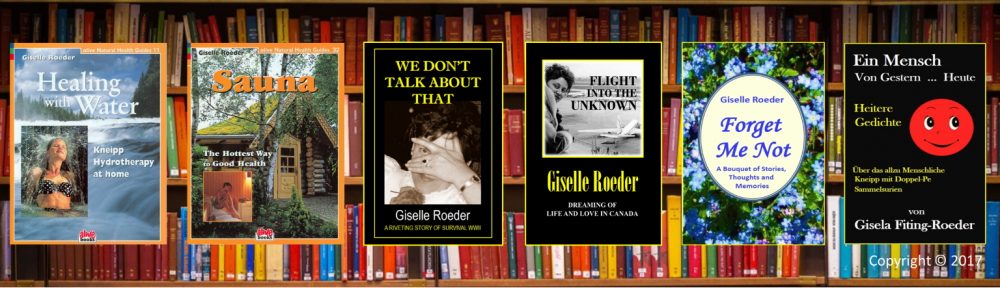
 NOW is the time to take a look at my books again. I have published the Second Edition of my memoir “We Don’t Talk About That” on Smashwords as an
  This one, book I, “We Don’t Talk About That” covers my first thirty years in Germany; the second book will deal with the next thirty years in Canada, and then we’ll have to take a good look at my incredibly active ‘retirement years’ – I am not sure yet if I quite make it another thirty years! Close though…
 translate my books. That will not happen – friends, it is not a matter of translation, it will be a total re-writing. I don’t have enough years left in my life to tackle it. Therefore, this little book may be a “candy” – and I promise that many of the poems deal and tell a lot of my life! For those of you who have German friends or relatives, you couldn’t send them a better gift! However, I find a poetry book is something you have to hold in your hand, it does not read the same when it’s an e-book, so – I have another surprise:

 Another part of the pre-Christmas time was St. Nicolas night celebrated with cleaning all our shoes, including Mom and Dad’s, on the evening of the 5th of December. St. Nicolas would come when we were sleeping, check the shoes and put some sweets into the shiniest pair. During the war we were told just to put one pair out to save St. Nicolas precious time. Most kids didn’t even have more than one pair of shoes anyway.

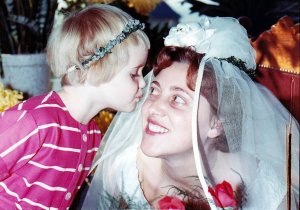 the little Canadian girl I had fallen in love with and right now she was tightly holding onto my hand. She was shaking. She was leaving her grandparents after a couple of months she had spent with them. I was taking her home to her daddy in Vancouver, Canada. I had married him after five months of lovely correspondence and hoped I would learn to love him after I had my heart set to be a mother to his little girl. She had picked my picture out of about three hundred replies to an ad he had placed in the German magazine “Constance”, and declared: “I want her to be my new mommy.”
 Last night we watched “Anne of Green Gables” – the ‘must see’ delightful television movie, always shown around Christmas time. The scene of Marilla taking Anne (with an ‘e’!) into the chicken pen to collect the eggs, put a big grin on my face. Anne hesitated to touch the freshly laid but slightly dirty eggs with even little feathers on them. Why did this scene remind me of a recent visit with my friend Jane?
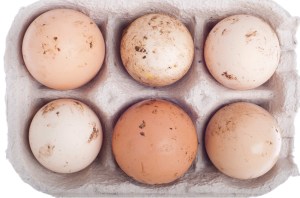 “Oh my God, Giselle, I can’t believe I have to tell you this. With a proud gesture, my landlady handed me a brown bag with half a dozen eggs in it. This was quite a gift! When I looked at them in my kitchen, my stomach turned. There were little feathers on them and some spots of chicken sh#t. No way would I eat those eggs! How could I dispose of them? I didn’t even want to touch them. I couldn’t put them in my garbage because she would find them. The thought of washing them never even occurred to me. But never mind, I found a way. I jumped into my car and drove to a rest stop on the autobahn. The garbage cans were often quite full. I stopped next to one and put the bag with the eggs in it and drove away, relieved. It didn’t take long and there was a siren howling behind me. My goodness, ‘Polizei!’ I quickly checked my speedometer but I was well under the speed limit. I didn’t feel guilty at all and kept on driving. My thought was he surely must mean someone else…The police car sidled up to me and the officer waved me to the side to stop. When he approached me, he made a motion for me to roll my window down, which I obligingly did. He handed me the brown bag with my eggs and said sternly:
 Watching ‘Anne of Green Gables’, who was only eleven years old but apparently felt the same way my friend Jane felt, it occurred to me that there might still be lots of city folks who have no idea of what they eat or where it came from. But then – with the enlightening of the 20th and 21st century social media, television, picture books and Farmer’s Markets it’s hard to imagine that children only see the headless chicken carcass wrapped in clear plastic on the supermarket shelves. Seeing those it’s hard to imagine that they were once the creatures responsible for the existence of the eggs down the aisle, neatly and cleanly packaged in recyclable soft cardboard cartons.
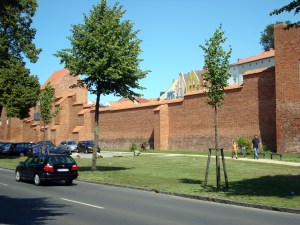 Stralsund at the Baltic Sea with a city wall which was rebuilt after heavy bombardments during WWII. Lest we forget! This wall is not for protection anymore – but primarily for its beauty, history, and tourism. (My guess!) Stralsund is now listed with UNESCO. You find other places with walls surrounding them along the Romantic Road and many other places in Germany. Some even have moats with drawbridges in front of the wall.
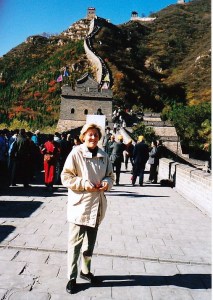 The part of the ‘Great Wall’ my group traversed starts not far from Beijing and was built to keep invading armies out. It runs on top of a steep mountainous landscape. Invaders would be seen early and would hardly have a chance before being destroyed from above. Needless to say, the views are stupendous. The ‘Great Wall of China’ is supposedly one of the very few constructions on earth seen from space. It took many Emperors, soldiers, and criminals over 2000 years to build it. Most of the existing wall was built during the Ming Dynasty (1368-1644) and, naturally, it has been repaired constantly ever since. It measures 8,851 km (or 5,500 miles) but in ancient times, all the different sections together stretched over 21,000 kilometers.
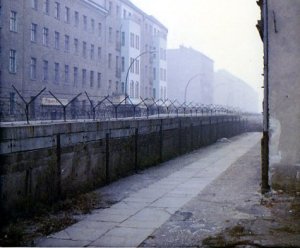 The Berlin Wall was just one part of what became known as the “Cold War”. After the Berlin Wall had closed the biggest ‘hole’ to stop the escapes, construction of a wall with mine fields, and guard towers was built around the entire communist controlled part of Germany. It was probably the only wall ever built to keep people “in” and not to keep the enemy “out”. Just as nobody knew that this wall was going to be built so nobody expected it to come crumbling down during anyone’s lifetime. Incredibly, during a huge mass demonstration on the eastern side of the wall when everyone expected the Russian tanks to crush them, nothing happened and the East German police, guarding the wall, put their guns down. The people stormed the wall, started hacking away at it and once a section broke down, the rush to get through before all hell would break loose, filled the night with screams. Screams turned to laughter as people were met by the waiting crowd on the western side with hugs and tears. With music and song punctuated by champagne corks popping, they started dancing on the wall. The night turned into the party of all parties, never experienced or dared to hope for, uniting people and families after nearly thirty years of being kept apart.
 It wasn’t about food or a turkey feast! For us, living in a small German village, it was mainly a special day in the church calendar. Nobody ever ate turkey, not even at Christmas or New Year. It was carp (fish), duck or goose. A great part of the celebration were the children. With their parent’s help, they decorated a basket with all kind of fruits or veggies out of the garden. I envied the children who instead of baskets carried huge bouquets made up of dried wheat, rye, barley and other grain stalks. Those were so much lighter than our baskets! The girls wore a flower wreath like a crown made up of the last of the blooms picked in field and garden. The boys had corsages pinned on the jacket or a hat. We all felt excited and very pretty!
 The Pastor’s wife was in charge of organizing us in front of the church while the hymn singing congregation waited inside. The smallest, youngest children, two abreast, came first and were followed by all the others according to size. With the organ playing, we would enter the church and slowly walk to the altar. The Pastor, waiting there, would receive our thanksgiving gifts and place everything on or around the altar. Relieved of our burden we could now go and find a seat with our parents in the pews. The Pastor would pray, thank God for a bountiful year and a good harvest. He always gave a rousing sermon and made everybody willing to donate even more. This ‘harvest’ was going to the poor in the village and the soldiers on the front.
 Yes, we surely felt very thankful for every potato and carrot. We were still safe and were not starving. I remember these years during WWII so well. Life has changed a lot after the war. The number of church-goers is down in the big cities but, I can imagine small villages may still be celebrating Thanksgiving this way. The church and the pub provided the social life during my childhood, and it may still be the same. Since I have been living in Canada for the last fifty-three years I have no idea if the Germans adopted the turkey eating tradition but I’ll find out! I used to believe it was a healthy tradition since turkey meat contains tryptophan, a relaxing amino acid which forms the base of serotonin and gets converted in the body into melatonin making you sleepy. I’m disappointed to learn now that it is a myth because chicken and cheese also contain the same amino acid. On Thanksgiving, it is the mass of turkey with all the trimmings (and alcohol) we consume that makes us lazy and sleepy. Personally, I like the dark turkey meat. Restaurants hardly ever serve it because of its high content of cholesterol. On Thanksgiving Day I couldn’t care less!
 Reading this brings back memories galore! If you had a taste of it or want to know a guy/girl with German roots better – read this, enjoy and SMILE!
 Millions of people like you and me, we are just “grains of sand” in the larger picture of the world and the people who rule it, no matter where we live. The title of the book I am talking about and that gave me high blood pressure and at times, Parkinson-like shaking that I almost gave up on it is “Goering – The Rise and Fall of the Notorious Nazi Leader”. The authors are Roger Manvel and Heinrich Fraenkel. The bibliography of the research done and the dozens and dozens of diaries, books by other writers and papers fill several pages at the end of this book. If you are a WWII history buff you ought to read it.
 Giselle Roeder