How Reading and Writing Influenced my Life

An on-line interview with Tina Frisco:

‘Little Red Riding Hood’, ‘Hansel and Gretel’, ‘Snow White and the Seven Dwarfs’ and ‘Rapunzel’ were the fairy tales my grandma told or read to me many times when I was a small kid. They stuck in my head and I believed they were true stories. These stories had a huge influence on my imagination. Even today I take some television shows to heart in such a way that I lose sleep over murders or behaviour unexplainable to me and I have to be reminded: “Don’t get upset, – these are just stories…”

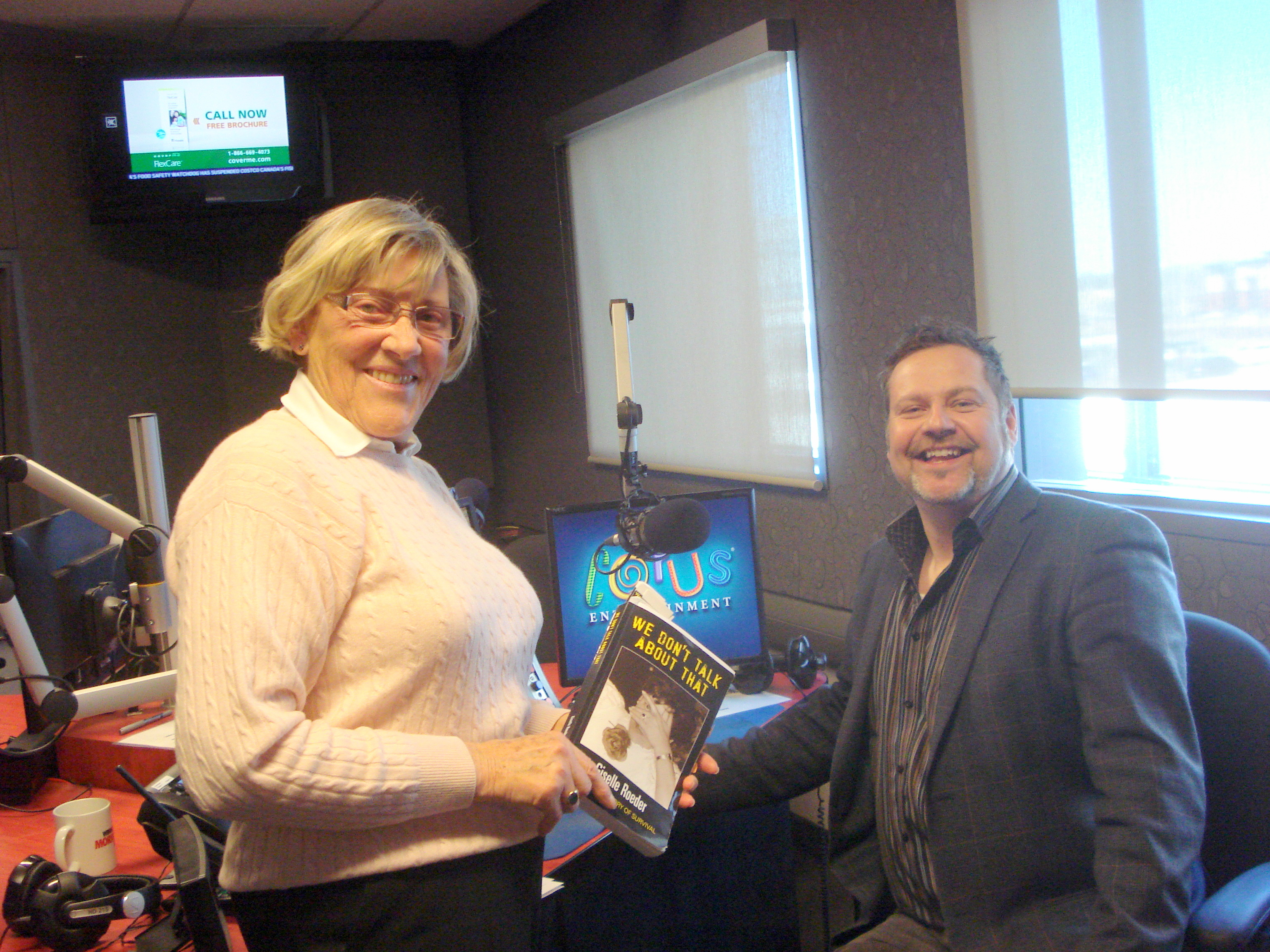
Tina Frisco had definite questions for me and she made it easy to give her open and honest answers. Maybe for you, my reader, they provide a glimpse into my “inner workings”. Enjoy!

http://tinafrisco.com/blog/guest-authors-artisan-garden/giselle-roeder/

Kids and Kittens

Kittens - 2

Me – feeding our cats sausage

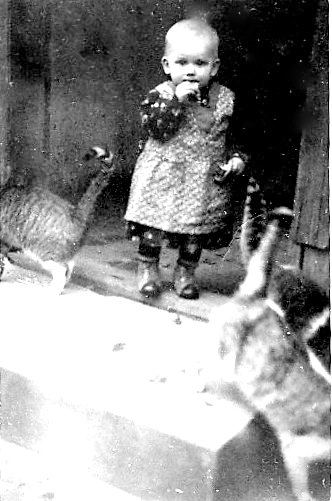
Cats were always around when I grew up. Mother had her cat ‘Molly’, Father had a gorgeous but fairly old cat ‘Peter’ he had owned already as a bachelor. Granny, who lived in the “Granny flat” part of our house, had a cat she called ‘Katzi’. They all were free to come and go and also choose who they wanted to play with, or sit with, or be stroked by. Katzi and Molly preferred to stay away from us children. Essentially they were “mousers”, – meaning they were not ‘house cats’. Tthey lived in the barn or stables of our small farm, hunting mice and rats. Sometimes Father would put a cat down into the root cellar when he had seen mouse droppings. They did a rather good job in doing what they were supposed to do. They did not eat all they hunted. Sometimes Father found a row of dead mice or rats lined up, the cat sitting there, looking up at him expecting a ‘thank you’, which they promptly got in form of words and strokes. To me it always seemed his strokes were worth more than ours.

Kittens - 3

My greatest love

My cousin Renate’s cat had several young kittens when I was nine. My sister Christel and I each got our very own little kitten. Christel’s cat was all black with yellow eyes; mine had a white underbelly, white boots on its hind legs and white shoes on its front legs. She otherwise had a mottled grey coat, but also had one white ear and a white nose. I called her Mooshie. I loved her more than my dolls. Often I dressed her in doll’s clothing and let her sleep in my doll carriage. Once, she got scared and jumped out and tried to run away. She repeatedly stepped on the dress she wore and tumbled about. It was very funny and we laughed heartily. My father happened to see the cat and gave me a good lesson: “If you love Mooshie, you won’t do that again. If she has to defend herself she will not be able to do so and if she climbs up a tree she will not be able to come back down.”

That happened in the same year when my mother’s cat Molly had a very bad eye infection and my father had to shoot her. It disturbed me greatly. He explained he was being kind to the cat. He cried when he shot his own old cat, Peter, a year later, when it was full of arthritis and could not walk anymore. Peter looked my dad straight into the eyes as if he knew what was coming. It was a very emotional moment for me. I will remember the expression in Peter’s eyes forever. I always wanted to have a cat like him.

One sunny afternoon we older kids were sitting on the broken steps leading up to our house and talking about this and that. The weather was very warm and we were bored. Looking up I saw my cat, Mooshie, coming towards us carrying what I thought was a mouse. She came right up to me, put the little thing down in front of me, looked me in the eye and said, “Meow” with a question mark.

“Mooshie”! I called out, “What is that?” She looked at me again and, after another “Meow,” left us, walking away purposefully.

We were amazed, not bored anymore. I picked up the little squirming thing and everyone agreed it was a baby kitten. It did not even have its eyes open yet, was naked and looked weird. After a few minutes, Mooshie came back with another one. She repeated the scenario with the “Meow” and left again. This happened two more times. When she had brought four of those little critters, she stayed with us and started licking them. Mother had heard our excited voices and had come to see what caused the racket. She was very helpful and understanding when I said I needed to have a bed for the little cat family. She brought a carton and an old baby blanket. We made a little nest and placed the kittens in the middle. Mooshie jumped in and curled around them. The babies found the food supply and suckled. It was fascinating and we watched for a long time.

It must have been a week later when Christel’s black cat, “Moorly”, a sister to mine, had babies as well. She had been smart and had them in Christel’s doll carriage in the house. She refused to move out of it, scratching and biting. None of our cats was allowed to stay in the house overnight. Even when it was raining or snowing, they were grabbed from the warm cozy place on the sofa or on a lap and heartlessly placed outside the house door. Father or Mother, whoever did the deed that evening, would put us off with, “There are enough warm places in the stables and barns; they know and they’ll be all right.” Christel agreed to have her doll carriage put in the barn so that the cats could stay in it. The bedding was all ruined but that was no big problem. It was simply replaced when Mother knew Moorly was in the house for her milk. The cats always got milk and the same food we had.

Sister Edith with Mom's new cat

Sister Edith with Mom’s new cat

It was fascinating to us how they developed from little naked blind mouse-like beings to the cutest playful kittens. Day and night we were talking and thinking of our little babies, no more boredom, and naturally we assumed we could keep them all. What a shock when our parents explained to us it wasn’t possible, – all of them needed to go to other houses. One by one they were picked up and we shed a tear or two when it came to the last one. Our only consolation was we knew all the people and they promised we could come and visit any time. I don’t remember if we ever did. The bombing had increased and the on-ground fighting of WWII had entered into Germany and everybody had other worries, even we children had to face it. Life changed dramatically.

Those were the cats of my childhood. The story is an excerpt from, and you can read more of the particular time in my book “We Don’t Talk About That”. There were other cats in my life later: Prince Eugene, another Mooshie, Minka, Max, two little goats and several poodles. But they will appear in my second book, the sequel to “We Don’t Talk About That.”

The Amazing All Grey City #Winnipeg #Prairie #Potholes #Bookstores

DSC06738

CJOB Radio interview with Greg Mackling

Once upon a time I lived in a green flower filled city alongside the sometimes peaceful, sometimes wild Pacific Ocean, deep blue with white crested, crowned waves. I was a woman living and drinking in this beauty wishing to have talent to paint until the day my mate tells me about an exciting opportunity for him to move to a city in the Canadian Prairie. He talked about Winnipeg, a city known as the Canadian Siberia with nine months of winter and the coldest corner in the whole wide world, Portage and Main and three months of hot summers with lots of mosquitos. But, – Winnipeg was also known for its “dry” cold and always blue sunny skies. Supposedly this climate was much healthier than the “wet” rainy coast and the propensity for getting rheumatism and arthritis. You can dress for the “dry” cold but the “wet” cold gets right under your skin.

We were told Winnipeg is a good place to bring up your family within the beautiful residential areas; it had large lakes for summer fun only about ninety miles away. Winnipeg was the birth place of “Winnie-the-Pooh”, the real little bear who became a mascot for the Canadian Army stationed in England before and during WWI, living out his life in the London Zoo. Millions of children still love A.A. Milne’s story about Pooh and name their teddy bears after him. Now his statue greets you at the entrance to the Winnipeg Zoo. This Prairie city of about 270.000 at that time offered lots of cultural and social life, clubs, theatre, concerts and the world renowned Winnipeg Ballet, on a par with the Moscow and the French Ballet troupes. One-hundred-and-four different ethnic groups were living peacefully together with lots of their typical eating places, loved and visited by all. Eat in a different part of the world every day! But the best: Winnipeg was well known for its friendly people! Every vehicle licence plate tells you: “Friendly Manitoba”, the Canadian province where it is located.

DSC06740

McNally Robinson Booksellers

Life has a way of interrupting your life; channel it into a different direction. I lived there for twenty years, became a corporate citizen, an employer, a Community Television Producer before the winds of change blew me back to my green country at the Pacific Ocean. No, I could not paint paintings but I could paint pictures with words. So I became a writer.

My recently published book “We Don’t Talk About That” is a memoir about my first thirty years of life. I tell the story of my first ten years during the Nazi period, the next ten years under Communist rule, and the next ten years, after my escape before the infamous Berlin Wall, trying to re-configure my life and hurt from being considered a second class citizen in the “Golden West” which was not so golden after all.

Chapters St Vital

Chapters, St Vital

This book brought me back to Winnipeg recently for a week long book promotion in March with a book launch and book signings in three big book stores: McNally Robinson, the largest bookstore I have ever seen, Chapters St. Vital with surely the friendliest staff and Chapters Polo Park in probably one of the most beautiful book store buildings. Winnipeggers still read and love the real thing: Books, physical books. Many mentioned that they don’t like eBooks. My book reading at a Rotary Club was well received and a CJOB radio interview with Greg Mackling reminded the listeners about my history within their fair city and many old friends, former customers and even former employees came to see me, say Hi and buy my book. And the Shaw TV’s Community Channel taped an hour long interview about my book and my history in Winnipeg when my first name was a household word.

Chapters Polo Park

At Chapters, Polo Park

Let me tell you what startled me most after arrival and the drive from the airport to the midtown hotel: Winnipeggers were driving only grey cars. All the busses were grey as well. One cornflower blue VW Beetle stood out as the only color spot as far as I could see down the road trying to avoid one pothole after another. You could not read any licence plates as they were covered with a thick grey coating. It dawned on me that nobody washed their car during the winter to avoid having their door locks frozen. I remembered! It was thirty-four years since I was living here! I learned that the winters are not Siberian anymore and climate change is taking its toll. That the previous week they still had 24 below Celsius but now for several days double digit degrees up to 18 above Celsius, the snow gone but the sand, used to sprinkle over the ice was coloring everything: Cars and buildings and roads and if you didn’t wear glasses, it got into your eyes, it covered your hair and it was impossible to keep your shoes clean longer than from the house door to your car.

My grandson Jack, born and raised in Winterpeg as the Winnipeggers lovingly call it, told me: At the entrance highway from the west used to have a sign:

Welcome to Winnipeg. I live here – what’s your excuse?

 For my stories from those first 30 years in Germany please read my book “We Don’t Talk About That” available from all major bookstores as well as on-line.

Radio Interview #TheBeach

Another day – another interview!

The Beach logoI am looking forward to meeting David Graham on the airwaves of CIBH The Beach Radio 88.5 FM at 8:45 a.m. on Tuesday, March 31st.

Dutch Clogs and a Nazi Flag Dress

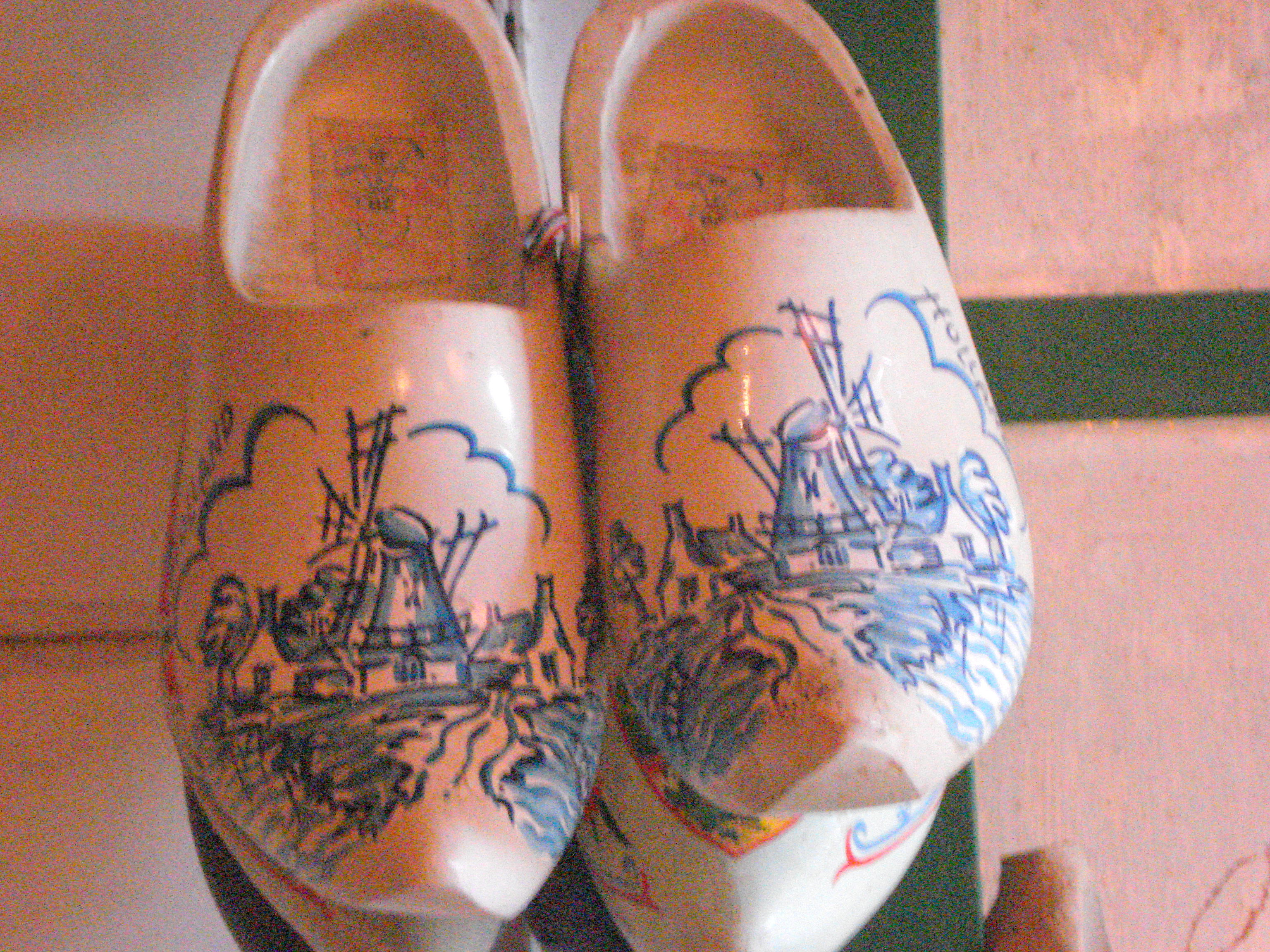
Several years after WWII ended life ever so slowly had returned back to a bit more normal and I had become a teenager. We lived in the eastern sector of Germany, a country without shops of any kind. I had outgrown the clothing my mother had made from rags and “one dress out of two”. Would it ever have been nice if jeans had been invented already because then all the kids would have looked more alike and there would not have been so much heartbreak with the teasing and bullying for the weird clothing I and my sisters had to wear to school. I will never forget the three winters I had to wear an old torn black form-fitted ladies coat with green patches and a huge big bust typical Dutch designline, stuffed with horse hair. I was only eleven, starved and thin as a stick. There was no choice: I was lucky to have found the coat under a bush where someone had discarded it. At least I had a coat at all during the winters 1945, 1946 and 1947. Uncle Fritz did a deal by exchanging fish for some Dutch clogs and those wooden shoes kept my feet very warm. But imagine the picture:

A small, starved thin eleven year old kid with a big busted fitted ladies coat and Dutch clogs! I wish I had a photograph! Today I can smile or laugh about it but back then it caused me many tears and I refused to go to high school when the time came. I had nothing to wear. The teasing was already bad enough in the small village where we lived, – but going to a city school? I’d have died…

Giselle

Modelling my “Nazi flag” dress

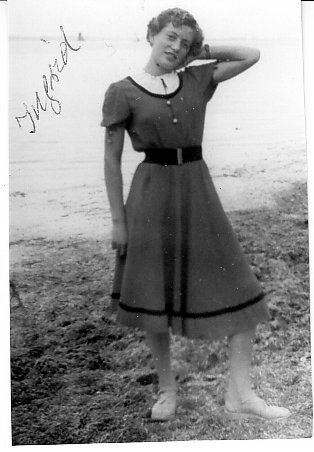
I got a chance to learn to sew but I had to bring my own material. You couldn’t buy anything, but a kind neighbor gave me a big Nazi flag she had found in an old trunk in her basement or attic. Her family and mine would have been arrested if anybody would ever have found out about it. To own a Nazi flag was forbidden after WWII. I undid all the seams, took the white center and the black stitched on swastika apart and my seamstress teacher helped me to design a pretty kind of ‘country dress”. The body of the dress was fashioned out of the red material with a wide swinging skirt, a white insert around the neck and small strips out of the swastika around the skirt and the insert and a black belt. It wasn’t quite Bavarian style, but very similar. I was proud and wore that dress happily. When I grew out of it my third sister Ingrid wore it. Well, – look at the pictures taken a few years down the road with my first camera, a very simple box camera. To find out how I got such a treasure

Ingrid modelling her "hand-me-down" dress

Ingrid modelling her “hand-me-down” dress

you’d have to read my book “We Don’t Talk About It”. (Chapter: ‘Berlin – here I come’)

I wish I could share several letters from a lady who picked my book up on impulse at Chapters just a few days ago. She read several hours in her car in the parking lot, “I couldn’t put it down” she writes, – “went to the gym, read while doing a workout on the bike, drove home, read some more, couldn’t sleep, and finished it the next morning”. I know that she really read every word of it because she asks questions about different things she couldn’t have known had she just ‘skimmed’ through it. So, – click on the links to the bookstores and order it now! You will be looking at the present world problems a little differently and have hours of reading to keep those little “grey cells” (as Hercule Poirot says) very stimulated.

Book Reading Today #WeDontTalkAboutThat

Another pleasant evening with 23 people this time at the Nanaimo North Library for a book reading with some interesting questions and discussion. One lady bought a copy yesterday and read the whole book overnight in order to be informed when she came to the book reading today – another case of “could not put it down”! So many people wondering when the next part of my life will be revealed. Many thanks to Stephen Warren and Darby Love from VIRL who helped to make this event possible.

Refresh – Four Minutes of Fame #WeDontTalkAboutThat

The YouTube link originally posted for this blog post was changed. The link below is now the correct path to the video.

Red light, interview in progress.

Red light, interview in progress.

We all have our moment in the sun. I had all of 4 minutes under the bright lights and in front of the TV cameras last week. Check out The Show on YouTube and scroll forward to 29:15 for my interview about upcoming book signings and book readings.

https://www.youtube.com/watch?v=onwpKtKENSM&feature=youtu.be

Answer to a question: #WeDon’tTalkAboutThat

Question markOne writer on a sub-group on LinkedIn posed this question:

“Who is the most memorable character in your book?

I did just that, the name I gave was “Gila” who was the heroine of “We Don’t Talk About That” whose story is an amazing story of survival. After several days had passed I went on to post the following on LinkedIn:

I am surprised how much text many of you wrote. For my part I tried to keep my posting very short. Now I may add a bit more of Gila’s story titled “We Don’t Talk About That“:
Christmas 1944 – it was the last year of my childhood but I did not know it then.
During the month of January 1945 the Russians made rapid advances into Germany. For my eleventh birthday nobody came to visit because people had been robbed or even killed by German deserters for clothing or money, everyone stayed safely at home. A few days later our teacher announced that the school would be closed, permanently. The Red Cross would turn it into a field hospital since the front was very close. We had heard the noise of the fighting for days now. Mr. Koenig had tears in his eyes when he, with a breaking voice, said “Good Bye children, may God be with you. We may never see each other again.” As we left he shook our hand instead of looking at the usual ‘Heil Hitler’.
That afternoon the church doors were wide open despite the cold. The organ was played ‘with all the stops pulled’ as the village folks said. And that was where the Russians found him, his wife sitting by his side. ……
It was very dark when some horrible screams woke me up. I thought it was a bad dream, but my dad whispered: “Please, be quiet, be very quiet.” We heard some loud cursing and the house door was opened and closed with a bang. The screams came from Helen and Betty. Several Russians had raped them. Their grandfather had tried to protect them and was brutally beaten. When he was unconscious they just threw him out the door and went on with their business. To our horror we found him dead and frozen in the morning. …..
A couple of days later all men and women between sixteen and sixty years of age were horded together, the unfit and nursing mothers were pushed aside, the rest were taken to Siberia. …..
The first Russians moved on and the next ones evicted everyone. We just followed all the other villagers with no idea where to go. We walked across a field where the mighty Russians had killed the last of the fighting German army. Body parts lay scattered. I pushed the pram with my baby sister. My mother called out “Gila, don’t look to your right.” Tell a kid not to do that! A soldier with his head beside him leaned against a fence. His legs were not attached but on the other side of the pram. This sight became a nightmare for me for many years.
Arriving at a house where about 40 women and children were standing around we asked if we could join them. One woman said “The more the merrier, that way we might get away with just one soldier raping each of us instead of a whole army.” The Russians locked us all into one small living room. One spoke a little German. Asked why the Russians raped young girls as well as old grandmothers he shrugged his shoulders, and said “Woman is woman. Has hole.” …..

The above is just a short part of the book. Gila, her mother and sisters walked on with hundreds of thousands of others alongside the Russian war machinery on their victorious march towards Berlin for three weeks, no food, no water, disease, lice; the dead and dying were just left in the ditch. …..

Starting towards the end of 1945 the rebuilding of some kind of order, school, farm work, the establishment of East and West German States, followed by Gila’s haphazard education to become a PhysEd teacher, kayak sport, escape to West Berlin, an unwanted affair, a confrontation with a convicted rapist on parole became all too much. Gila had just one wish: To get out of Germany, to get away, to emigrate, to be free, to start a new life.

See BOOKSTORE to purchase book. To FOLLOW my blog go to top of right hand column and click on FOLLOW button.


Granny’s Hands #WeDon’tTalkAboutThat

Durer handsMy treat for you today is reading a chapter from my memoir. It’s one of the many memories of my childhood.

Granny went to church every Sunday and her praying hands left an indelible imprint in my soul. She had grown up speaking mainly Low German and often had trouble pronouncing some words in High German. My parents wanted us to grow up with High German, preparing us for a better education. Granny tried hard to please her son, my father. I once listened to one exchange between her and Dad:

“Mother, – it is not ‘Gesus’, – it is ‘Jesus’.”

“Erich, you told me to speak High German to the children, and then the ‘j’ is pronounced ‘g’ like in ‘go’ and not as it would be in Low German ‘jo’.”

“In that case you are right, Mother. But ‘Jesus” is a name and it needs to be pronounced ‘Jesus’ and not ‘Gesus’. Would you say ‘Gohanna’ to Johanna, would you?”

“Oh, now I understand. I’ll remember not to speak to the children of ‘Gesus’ anymore.”


Many children had the measles and I got them too. My eyes hurt and I was very sick. I felt lousy, alone and sad, forgotten by everyone. The room was dark with the shutters closed. As the sunlight came through the slanted openings, I imagined it as long, silent fingers playing with the bits of silver and specks of brown in the dark blue wallpaper. I could even imagine faces in the shadows caused by the lilac trees outside – here and there a ship, and there was the good Lord himself on a cloud with some angels around Him. He had friendly, old eyes but He wiggled a finger at me attached to a long, sinewy hand. I was not afraid but just kept on looking at the imagery. The hand was white with a touch of pink and I could almost see through it. It was a beautiful hand.

The hand was cool and soft. I felt it on my forehead. It helped my eyes not to hurt so much but I did not want to open them, I wanted to feel those cool fingers. Was I an angel now, like those behind Him? It did not matter. I felt suspended between being and not being, I was floating. Please God, just a little longer….

Was it this plea or was it the voice coming from a distance, “She has quite a high temperature and she is delirious….”

All of a sudden, I was back in my bed, the perspiration trickling into my ears, which hurt, too. The long fingers and the streaks of sunlight were gone. There were no faces, no ships, no God, no angels on the wall, just that dark blue wallpaper with bits of silver and specks of brown. This used to be my father’s room. My bed was a black ebony sleigh bed. My father had told me proudly that it was his before he got married.

I opened my eyes just a bit and looked right into Granny’s wrinkled face. Her one hand was on my forehead and she took my hand in her other one.

“Did you have a nice dream, my girl? You smiled and you looked so happy.”

I just nodded – thinking she would laugh at me if I told her of the things I had seen. I felt that she belonged to Christel. She always hugged her, cuddled her, held her on her lap, stroked her wavy hair, and comforted her when she was crying. I was only allowed to just sit beside her, close enough, but never on her lap. She never stroked my hair.

Tears were stinging my eyes. I closed them again. Granny’s hand felt so good on my forehead and I wished she would not take it away. I thought of how beautiful her hands were, even though they were wrinkly or maybe because they were wrinkly. Her face was beautiful and wrinkly too. Often I had looked at her, wanting her to hug me so badly that it hurt. My mother did not hug me either, nor did my father. There was just a handshake and a light formal, “Good Night” kiss – nothing else. But I could not let anybody know or show how much I wanted to hug or be hugged – only babies did that. I was a big kid now, a kid ready to go to school. Maybe it was good to be sick. I could feel the hand on my head and it felt so good. I did not want it to stop.

“I want to look like Granny when I am a grandmother,” I decided.

My ears got worse and Dad had to go to pick up the doctor from the city. It was a good thing that he still had the motorbike. Granny had to put special drops into my ears at frequent intervals. The drops felt cool and tickled as they ran down into my ear canals. I asked where Mom was. Granny explained that she was not allowed to come close to me because I was contagious. Mom had never had the measles and when grownups get them, they could die. She also explained that the measles were dangerous for a new baby. Which new baby I thought but was too tired to ask.

“Don’t worry,” she said, “your mother often stands at the door and looks at you. She hopes you will get well soon.”

During my whole childhood, I had recurring ear infections and my ears are still very sensitive. Noise hurts, even drives me to tears, and I cannot stand windy days without a cover.
#Horses – and their shoes

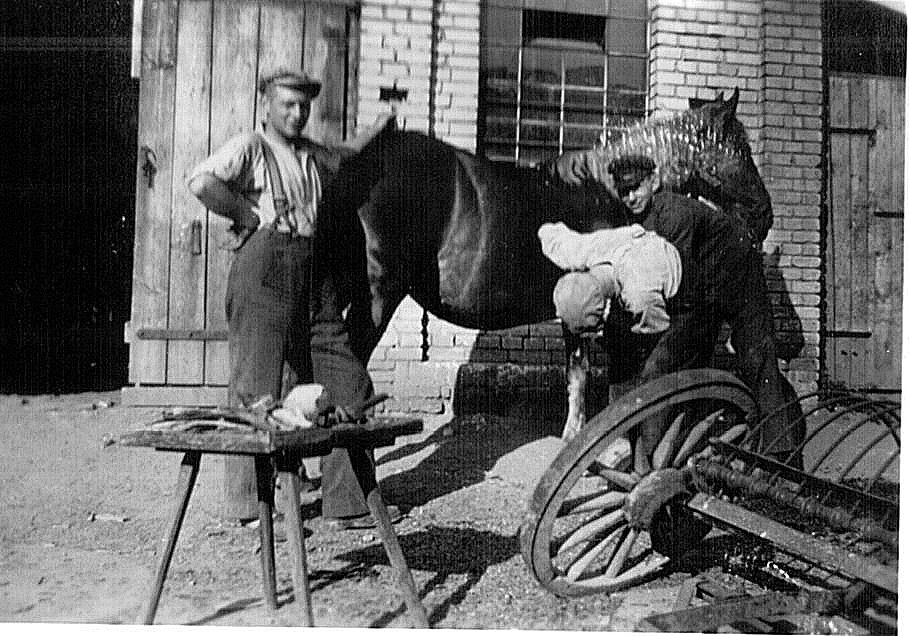
Erich Fiting-Helmut & ?

Shoeing a horse at Father’s smithy.

Do kids nowadays have a chance to see how a horse gets new shoes? Or do they experience the special “smell” when the red-hot iron horseshoe is fitted onto the horse’s hooves? Or do they hear the “swish” when the blacksmith places the iron in cold water for a second or two before he places and fits it on onto the horse’s hoves, one at a time, lifted up sometimes by another man, usually an apprentice? Would they even know what a farrier is? Hardly. I remember it well. I know about the ‘swish’. I remember what it smelled like. I remember being afraid the horse would be hurt. How can the glowing iron not hurt? And the long nails with the almost square head that go into the horseshoe to hold it in place? How can the horse stand it? I didn’t realize then that the bottom of the horse’s hooves are something like a very thick callous, or a very thick toe or finger nail of ours, no nerve endings in it. Only once have I seen a horse bucking and I was afraid my dad would get hurt.

Our own horse Lotte was conscripted in 1939. My dad explained ‘the Führer needs her for the war.” I asked, “Can’t he use another horse? Why our Lotte?” Yes, why our Lotte. It wasn’t just our Lotte. There is a short chapter about it in my book “We Don’t Talk About That”.

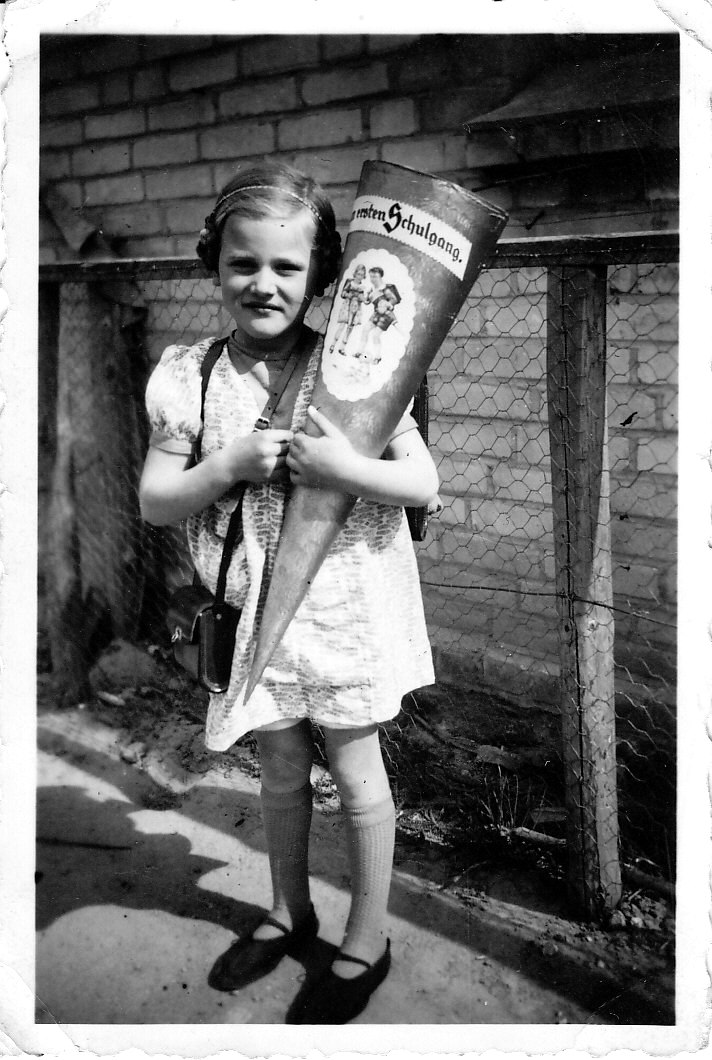
Gila-First Scool Day

First day at school with a horn of plenty (not!).

Omi-Mutti m. Ingrid - Tuti-Manfred-Christel-Dieter-Gisela - Siegfried

A family outing to the lake. Omi-Mutti m. Ingrid – Tutti-Manfred-Christel-Dieter-Gisela – Siegfried

I could hardly wait to go to school to learn to read, to be independent from Granny reading to me. It was in spring 1940. It was exciting to look forward to the big “School cone” and all the goodies in it. How disappointing to find very little – but then, – even a six year old knew there was a war going on. Pretending to be happy I was fighting tears, – just look at the photo. But soon the summer holidays stretched out for two long months and our cousins from the Island of Rügen came. We played our usual games and were happy to go to the lake with Mom, Granny and Aunt Tutti. She plays a very important role in the book. You’ll meet her again…