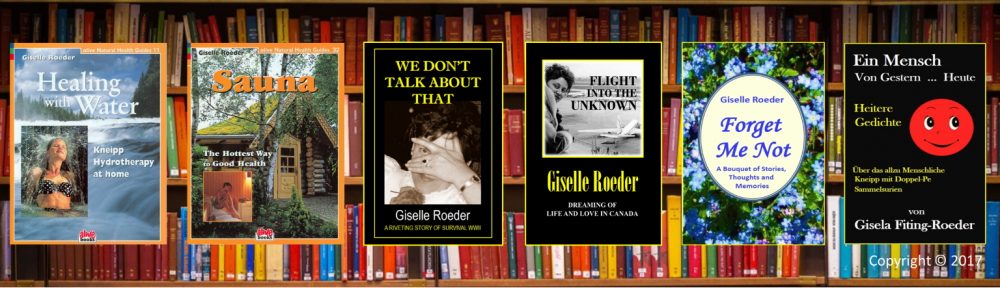
Giselle’s Memoir developed into a trilogy. Nanaimo Magazine stated, “Giselle had one hell of a life.” It did not fit into an ordinary book or become one with a thousand pages. The series title could be “The Nine Lives of Gila.”

1: “We Don’t Talk About That” is the story of surviving WWII and its aftermath. Starting after WWI, it outlines the changes in many European countries’ social makeup. Unemployment and staggering inflation when a loaf of bread cost billions and two beers a mere one-hundred billion led to the rise of Adolf Hitler. He promised work and bread and kept his promises. The following years brought an upswing in life but also carried Germany into WWII. The invasion of eastern Germany by the Russian army brought horror with unspeakable atrocities to ordinary people. Most survivors’ attitude is we don’t talk about that.
Gila’s life turned tragic when the fighting approached her neighbourhood with rape, murder and hunger. The Russians took her father and every 16 to 60-year-old able person to Siberia. The rest of the population, including Gila’s mother and her siblings, were evicted. They joined the trek of thousands ‘on the road to nowhere.’ Gila witnessed gruesome acts of violence. She barely survived diphtheria. Later, recovering from typhoid fever, she took responsibility for her three siblings while her mother worked. Despite her interrupted schooling through circumstances beyond her control, Gila’s determination empowered her to become a Physical Education teacher. She lived the first ten years of her life under the Nazis and her teenage years under communist rule. Germany’s division into East and West with its political ramifications caused her to escape to West Germany. Gila’s story is one of courage, pain, love, and longing for liberation.

# 2: “Flight Into The Unknown” deals with Gila’s life in the West. She saw an ad placed by a former German living in Canada. He was looking for a new mommy for his four-year-old daughter. Intrigued, she answered. An envelope with ‘Beautiful British Columbia’ magazines, a letter, and photographs arrived. A lawyer, the Canadian man’s father, called: “My son is not a fly-by-night,” inviting her to visit. Three months later, she got engaged by telephone. With Gila on holiday, the future in-laws organized the wedding without asking her.
Seven months after she had answered the ad, she immigrated to Vancouver, Canada. She soon realized it was the biggest mistake of her life. Her husband used her money to pay his debts. Gila had been blinded by his well-to-do parents, thinking, ‘the apple does not fall far from the tree.’ After a move to Winnipeg, Gila welcomed a second stepdaughter and gave birth to a son. Trials and tribulations were constant companions. After twenty years of marriage, raising the kids, and finally succeeding in her own business, the husband had an affair leading to a nasty divorce. Gila lost everything and moved back to Vancouver
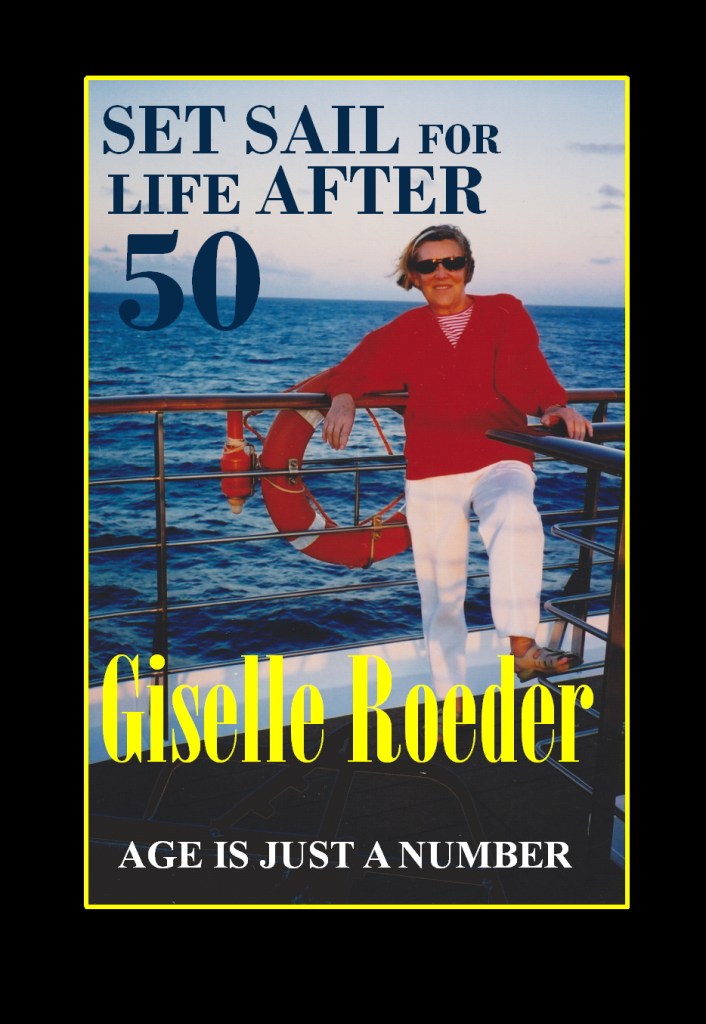
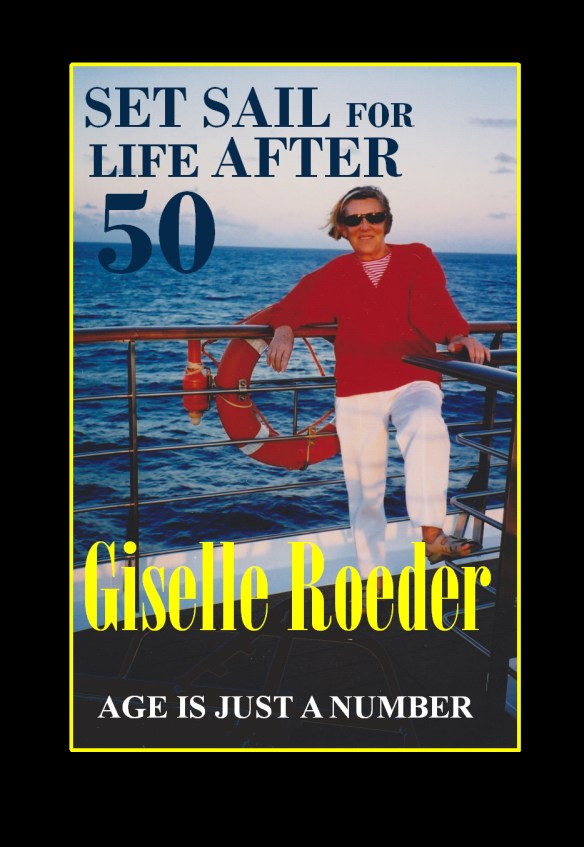
# 3: “Set Sail for Life After 50” is about new beginnings. Gila starts another business. Radio and television interviews give it a boost. A love affair keeps her happy with travels to attend and speak at health conventions across Canada, the USA, and even Australia. After years of struggling with emotional problems and trying counselling, she accepts her fate. Serious health problems cause her to sell her business. To find a cure, Gila flies to Germany, invited by the Kneipp Association. She returns energized, and her customers want to experience the same treatments. A new business is born: “Health Travel.” She takes nearly 200 Canadians to the health resort over the next few years. Several eligible men cross her path. At 70, she meets a Vancouver Island man; they decide to buy a house together and enjoy the companionship for the rest of their lives.



 Gila lived her first 30 years in three Germanys. She can’t remember her first 3 or 4 years, but she knows what happened. Hitler took over in 1933 because he promised work and bread for the starving population. Criminals caused brawls and a lot of unrest in the big cities. Hitler told his friend Roehm to establish a new kind of army; therefore, in 1934, he created the SA, also known as the Brownshirts or Stormtroopers, to get the ‘Riff-Ruff’ off the streets. The SA developed into a new army over time. Hitler had his friend Roehm killed because he became too strong. An old general, who fought in WWI explained: “Peace? Peace is just an interlude between wars.” Hitler applied to have the Olympics in 1936 in Germany and, in his usual style, screamed: “We will show the world a recovered Germany!”
 The ‘Brownshirts’ had been mostly bad boys, and they had no problem killing people. Everybody was scared of them. Rowdy groups in big cities started defacing and smashing shop windows of Jewish owners. Jews disappeared; they were either captured or took a chance to flee. The infamous ‘Crystal Night’ in Berlin was the height of the criminal acts, and the police lost power. Anybody speaking out against it, hiding or helping Jewish friends or had communistic ideas went to the new ‘Concentration Camps.’ These were not only populated by Jews, as is a common belief.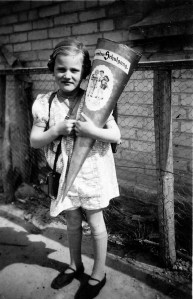

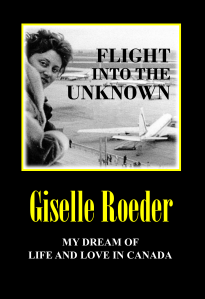 My problem was I had too much material. The “Flight Into The Unknown” would have been overbooked, overloaded with too many stories, too much baggage. What to leave out? Many months ago, Lyn Alexander, my editor, had suggested making my memoir into a series. “Series are in,” she had told me. “Divide what you have in this ‘Flight’ manuscript and write a third book.” I was fighting it.
 experiences just like a cat.
 As the year-end approaches, Smashword has deep discounts on thousands of ebooks. The SALE starts at midnight on December 25th and ends at midnight on January 1st.
 The coupon codes are exclusive to Smashwords and will not affect prices at other retailers.
 I just finished reading this book. All along, I was wondering how the author, Margaret Skea, would have been able to find so much material during her limited time in Wittenberg. I asked myself repeatedly, “Is this fiction, based on truth? Is this a biography of Katharina von Bora?” Or is it “intelligent fiction?” When I read the author’s comments at the end of the book and learned that IT IS fiction, I couldn’t believe it. Written in the first person, it was so real, I was Katharina, or I was next to her, holding my breath, prayed with her, felt her despair… What an exceptional writer! If I had the time, I would want to read every one of Ms. Skea’s books. Notably, the prequel “Katharina: Deliverance,” telling of her childhood in a convent, her vows as a nun, her escape, her meeting with Dr. Martin Luther, the former monk.
 Giselle Roeder