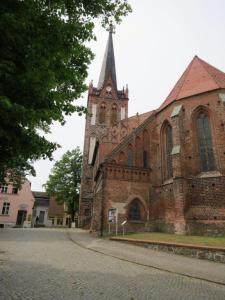
Stresow Church
Once upon a time, there was a small village in the eastern part of Germany called “Stresow.” A church with a cemetery surrounding it and a pub was built in the center. Those two places were also the centre of any social life of the hard-working farmers. Since women were not allowed in the pub, they would meet after church in the cemetery during their task of taking care of the graves to visit with each other and chat. To this day, the graves are planted with flowers in German cemeteries and each family tries to have the best-looking one.
Many years went by. After WWII in 1945, the states of East Prussia, Silesia, and Pomerania, about one-third of Germany were ceded to Poland. The German inhabitants had ten minutes to get out of their homes where they had lived for generations. My own family was amongst the millions evicted, and so was the family of my cousin Joachim. With only the clothing on our back and with what we could carry, we were three weeks on the road to nowhere, slept in barns when lucky or under the stars. (the full story in my memoir “We Don’t Talk About That”)

I have never been back to my birthplace but my cousin Joachim has. Poland belongs to the EU, and visits are possible. Joachim has been back several times. He only lives about seventy kilometers away while I live on another continent. Joachim made friends with the Polish family who now lives in his father’s house. He had the most incredible experience in 2006. A friend of his Polish friend is a teacher in the neighboring town of Bad Schoenfliess. He is in charge of a museum and was happy to show Joachim two rooms dedicated to the “German Time.” There are photographs of Joachim’s family and his ancestors as well as of my parents and other families we know. Joachim was amazed.
The most significant surprise was a folder he was given with old handwritten documents, letters, and newspapers of the years from 1871 to 1896. They had been contained in a ‘Time Capsule” buried when a new church tower was built in 1896 after the old church tower had collapsed. Nobody could read any of these documents since they were written using the German Süterlin letters. Joachim was able to read them. There was a list of twenty-four farmers living in Stresow in 1871, including Joachim’s great-grandparents. Two pastors serving the small community between 1871 and 1896 had written an account of life during those years. Joachim was able to re-write the most critical documents. Photographs of the old and the new church tower were included in the time capsule.
What an exciting experience for my cousin Joachim!
The same year he had another surprise coming. In 1945, when the family was evicted and had to leave within ten minutes, his grandmother had stuffed one hundred-forty-five photos into his school satchel with a change of underwear. These photos had been picked up out of the mud after the Russian invasion. I had picked ours up from the pile of manure in the middle of our yeard. They represent the only memorabilia of our life from before 1945. During the long walk, Joachim, his grandparents, and his mother had a chance to stay in a house for two nights. Joachim and his two small sisters played with the six-year-old son Robert living there. They looked at the pictures. Joachim’s satchel was forgotten when they left, and his grandma always lamented as long as she lived about the loss of those treasured photos from home. She died and never got over the loss.
Almost sixty-one years later, the ITS, a search service connected to the Red Cross as well as churches, found Joachim’s sister Marianne. She had looked for and listed their dad’s name many years ago. Now, with the Internet, it had been possible for the previous six-year-old Robert, at sixty-seven years old, to find the family who had stayed with them in 1945. Robert had kept the photos in a box in his attic all those years. During a project to add on to his house, he came across it and started searching for the kids he had played with in 1945.
Joachim phoned Robert and made a reservation to visit the next day. The newspaper in Joachim’s hometown got hold of the story, and I have in my hands a copy of the one-third page with a photo of my cousin holding a photograph of himself and his two sisters. A large one at the bottom is of ten men, the artistic biking club with Joachim’s father and uncle in their sports uniform. Needless to say, Joachim in his eighties and the former little Robert in his late sixties, are now close friends.

Former WWI Memorial
Joachim exclaimed when he first related this story to me:
“You cannot pay for something like this. To get your lost treasure back after sixty years is absolutely miraculous.”
 Three of my books in e-book format are
  u may never have heard of the “Main River” in Germany. Compared to the other large rivers like the Rhine, the Elbe and the Oder it does not flow the same way. Those start in the south of Germany and make their way towards the North Sea or the Baltic Sea. The 330 mile long Main River cuts across Germany through Franconia, a beautiful area with gems of cities not to be missed. Canals with almighty locks connect this hardly known river with the Danube. The last part of the impressive canal was only completed in 1992. It provides an international waterway connecting Rotterdam at the North Sea with Konstanca on the Black Sea.
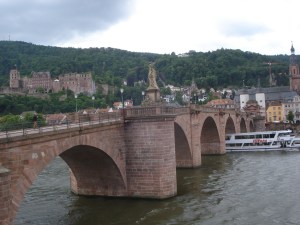 We visited many of the pretty, fairy-tale towns along the Main. Since Scenic Cruise Lines has electrically assisted bikes for more adventurous guests, about thirty chose to ride next to the ship and meet up at the next stop. Arriving in the area of the modern metropole of Frankfurt we again had a choice of excursions. We elected Heidelberg, the oldest and most famous university town in Germany. At one time in my life I had to lecture there, needed to go to a hairdresser, they talked me into a color rinse, and my hair turned out red. RED! I hated it – but it couldn’t be changed until it washed out over the next four weeks. We had also read the fabulous ‘Schellendorf’ series of books by Lynn Alexander, set in Heidelberg. We tried to find the Schellendorf house, stable and other places but naturally did not miss walking up to the old castle ruin which provides an incredible view over the surrounding wine country with the Neckar river winding its way through it.
 Father Rhine! We must have entered it during the night because I do not remember our ship slipping from the Main into the Rhine River. Many poets have written about the Rhine, many songs are sung about it, and many cruise companies offer tours up and down the Rhine River. It springs in Basel Switzerland and winds its way through vast valleys and narrow gaps between mountains all the way to Holland, picking up other, smaller rivers joining it along the way. The best-known one of such rivers is the Moselle. A dangerous turn to navigate the Rhine for any ship is the corner at the Lorelei. The German poet Heinrich Heine wrote a song of a beautiful siren sitting on top of the steep cliff, combing her golden hair, singing and causing many a ship crashing, the captains lured by her and not paying attention at the sharp narrow bend in the river.


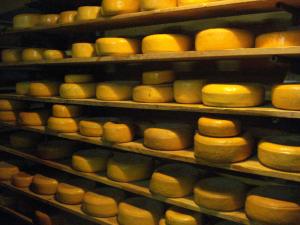 Interesting was a place where they made cheese, big wagon wheels of cheese were displayed to age on many shelves. And before you ask, yes, we could watch the process in the making and taste the types of cheese.
 I don’t want to add to it. I am just a person who, after writing the memoir “We Don’t Talk About That” – the years growing up under the Nazis, and then later under the Communist Regime in East Germany – who really is OVEFED but UNDERNOURISHED by the present political situation. I would like to stick my head in the sand and write another book, a happy one! But that is dangerous and surely not advisable.
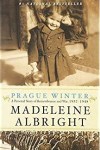 Madeleine Albright was the first woman ever nominated and accepted to become the Secretary of State in 1993. Wow! What a story! From the little Czech girl in “Prague Winter” to making history for women. What an intelligent person! She has written a number of books. One paragraph in the book I read resonated with me so strongly that I absolutely must share it with you:
 True words! So, my dear readers and followers, we are NOT TO STICK OUR HEADS INTO THE SAND. Let’s open our eyes; a lot of what has happened back then, what I have written about in “We Don’t Talk About That” and Madeleine Albright in “Prague Winter”, is happening again and there are a lot of signs that worse may be to come. Madeleine Albright is working on a new book “Fascism” to be published in April 2018. “The author examines the economic, religious, racial, and cultural factors that are today dividing populations and fostering bigotry across the globe, while also looking at how demagogues from Mussolini to Duterte have attracted followers by exploiting fear, nurturing anger, and promising easy answers to complex problems,” according to HarperCollins, her publisher.
 This one, book I, “We Don’t Talk About That” covers my first thirty years in Germany; the second book will deal with the next thirty years in Canada, and then we’ll have to take a good look at my incredibly active ‘retirement years’ – I am not sure yet if I quite make it another thirty years! Close though…
 translate my books. That will not happen – friends, it is not a matter of translation, it will be a total re-writing. I don’t have enough years left in my life to tackle it. Therefore, this little book may be a “candy” – and I promise that many of the poems deal and tell a lot of my life! For those of you who have German friends or relatives, you couldn’t send them a better gift! However, I find a poetry book is something you have to hold in your hand, it does not read the same when it’s an e-book, so – I have another surprise:

 Another part of the pre-Christmas time was St. Nicolas night celebrated with cleaning all our shoes, including Mom and Dad’s, on the evening of the 5th of December. St. Nicolas would come when we were sleeping, check the shoes and put some sweets into the shiniest pair. During the war we were told just to put one pair out to save St. Nicolas precious time. Most kids didn’t even have more than one pair of shoes anyway.

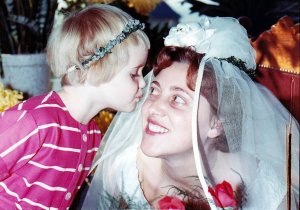 the little Canadian girl I had fallen in love with and right now she was tightly holding onto my hand. She was shaking. She was leaving her grandparents after a couple of months she had spent with them. I was taking her home to her daddy in Vancouver, Canada. I had married him after five months of lovely correspondence and hoped I would learn to love him after I had my heart set to be a mother to his little girl. She had picked my picture out of about three hundred replies to an ad he had placed in the German magazine “Constance”, and declared: “I want her to be my new mommy.”
 Giselle Roeder